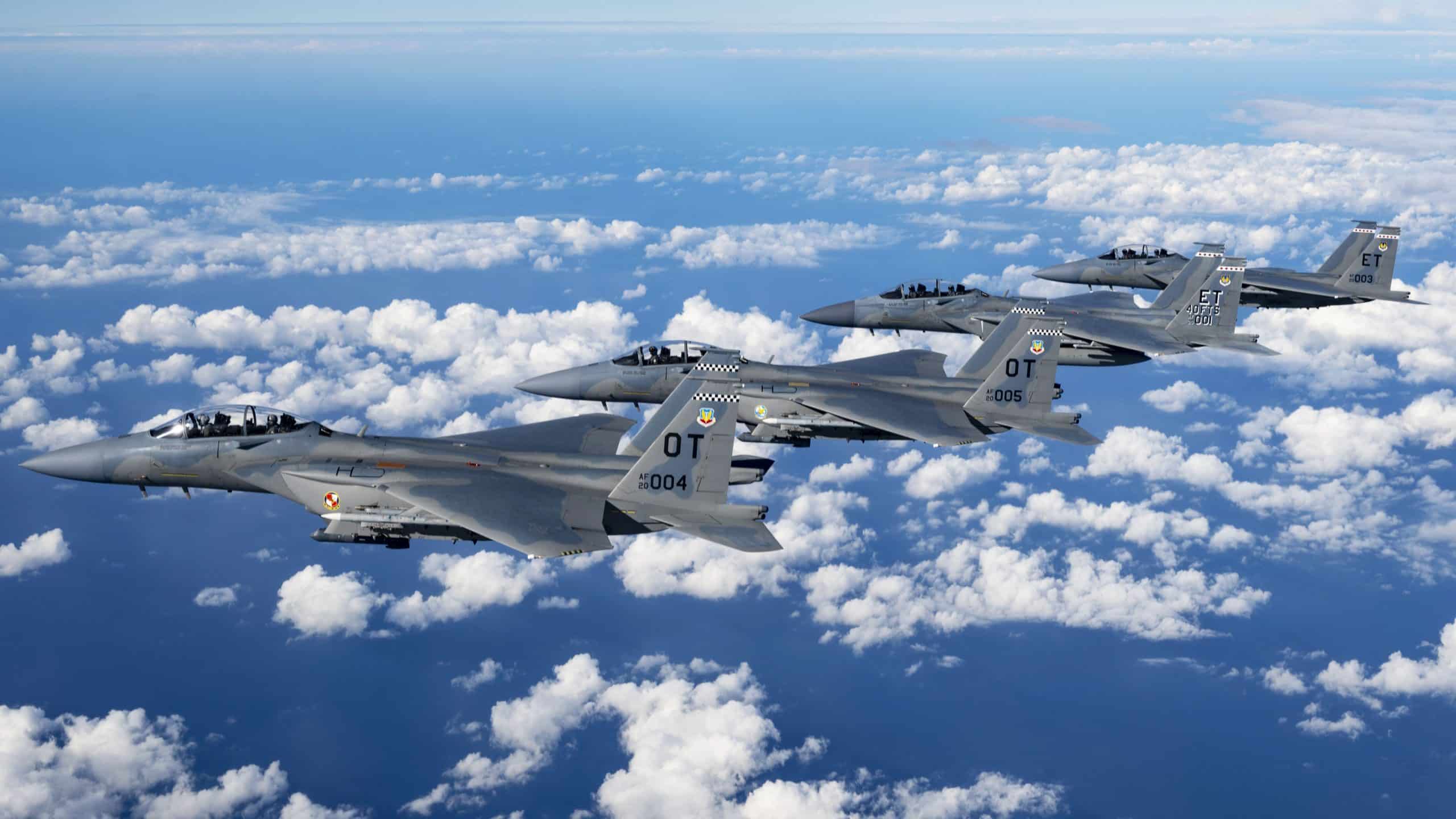
Senators Fight For More Boosts to U.S. Airpower After Increase to F-15EX Order
As the USAF confirms its intent to buy more F-15EX Eagle IIs, Senators Budd and Shaheen have launched three new bills designed to expand the U.S. fighter inventory and retain experienced pilots.
New plans from the U.S. Air Force boosting their order of F-15EX Eagle II fighters to as many as 267 aircraft may not be the last we hear of this program expanding, at least not if several members of the U.S. Senate achieve their aims.
Just after the Pentagon revealed its $1.5 trillion budget request for FY2027, its largest ever, U.S. Senators Ted Budd (Republican, North Carolina) and Jeanne Shaheen (Democrat, New Hampshire) have, as members of the Senate Armed Services Committee, spearheaded the launch of three pieces of legislation that they say are “focused on elevating and preserving the dominance of American military airpower in modern warfare”.
Thank you to @SenTedBuddNC and @SenatorShaheen for introducing bipartisan legislation to support our Airmen & the future of American airpower.
This three-bill package tackles key priorities:⁰ Multiyear procurement authority⁰ Authorization for 200 new F-15EXs⁰ Aircrew… https://t.co/T1LaIOsl9i
— Office of the Secretary of the Air Force (@SecAFOfficial) April 23, 2026
Firstly, the Airpower Acceleration Act is intended to commit the U.S. in law to an expansion in procurement of both the F-35 Lightning II and the F-15EX Eagle II. It calls for an increase to the Eagle II order beyond even the newest known figure, seeing the planned fleet expand up to 329 aircraft with a specific view to use the additional units to replace the F-15E Strike Eagle during the 2030s.
A U.S. Air Force KC-135 Stratotanker aircraft refuels a F-15E Strike Eagle aircraft during Operation Epic Fury in the U.S. Central Command area of responsibility April 5, 2026. The first F-15E was delivered to the USAF in 1988, with the last aircraft arriving in 2004. | Source: U.S. Air Force photo

The bill would mandate a 10% increase in the number of combat coded fighter aircraft operated by the U.S. Air Force from 2030 up to 2035 (totalling at least 1,369 aircraft), increasing to a 20% increase from 2035 onwards (totalling 1,558 aircraft). Mandatory minimum inventory figures for military equipment are usually the domain of the Executive branch, although Congress has previously stepped into this ring with the legal requirement for the U.S. Navy to field no fewer than 11 aircraft carriers and 31 amphibious warfare ships.
No specific numbers are mandated for F-35 procurement, though it should be noted that an increased number of F-35s of all variants have already been requested by the Air Force for procurement in FY2027.
A rise in the order of F-15EX Eagle IIs has long been advocated by many experienced commentators, who note the value it can provide in mixed fighter packages spearheaded by low-observable types like the F-22 Raptor, F-35 Lightning II, and, eventually, the Boeing F-47.
Here’s footage of a #F15EX Eagle II armed with 12 AIM-120 AMRAAM’s and a pair of AGM-158 JASSM’s. Note the pylon mounted IRST-21.
(USAF) pic.twitter.com/dbRduL3e8G
— Global Defense Insight (@Defense_Talks) August 10, 2022
Tailing behind, beyond detection range, the F-15s can use their exceptional payload to bring extra munitions into the fight. Incredibly, an F-15EX can carry as many as twelve AIM-120 AMRAAM missiles into combat while still also having room for two AGM-158 JASSM stand-off cruise missiles.
Aircrew Retention
The second bill in the legislative package targets the retention of trained, experienced aircrew within the U.S. Air Force. The Retention Enhancements for Tactical Aircrew Initiative (RETAIN) Act provides for the offering ‘to the maximum extent that is practical’ of non-monetary incentives to active duty aircrew in order to make remaining in the service as attractive and easy as possible throughout one’s career.
This includes offering more personal choice in terms of duty location assignments, opening up the availability of remote working for non-flying assignments, and the option to transfer to non-combat career paths within the armed forces.
U.S. Air Force fighter pilots assigned to the Florida Air National Guard’s 125th Fighter Wing step out to the aircraft during Agile Combat Employment (ACE) training at Tyndall Air Force Base, Florida, Feb. 11, 2026. | Source: U.S. Air National Guard photo by Tech. Sgt. Marissa Welker

Aviation Incentive Pay (AVIP) for officers with at least eight years of service would be fixed at the maximum allowable level, while bonuses and contract lengths offered to active duty aircrew must match or better those offered to aircrew serving in reserve forces.
Lastly, the Fighter Aircrew Career Flexibility Act would increase the allowable one-time career intermission length for fighter aircrew from four months to one year.
Senator Budd commented on the proposed legislation, stating “The future of American military dominance relies on maintaining our air superiority, and the path forward is clear – rebuild our Defense Industrial Base through restoring our combat aircraft forces and retaining experienced aviators.”
Ted Budd, left, North Carolina senator, prepares for an incentive flight on an F-15E Strike Eagle at Seymour Johnson Air Force Base, North Carolina, Aug. 18, 2023. | Source: U.S. Air Force photo by Senior Airman David Lynn

“We cannot afford to fall behind China, and that is why Senator Shaheen and I have brought forward a robust, bipartisan legislative package that gives the U.S. a fighting chance to preserve our airpower to be the most lethal fighting force in modern warfare, while also retaining our nation’s most elite pilots,” he added.
Senator Shaheen, a Democrat, challenged the Trump administration to follow through on its commitments to strengthen the U.S. military’s fighting capability: “If the Administration truly views China as the pacing challenge to our nation, we need to get serious about curbing their growing global influence – and that includes air dominance. Our commonsense, multi-pronged approach will make an overdue investment in American fighter capacity to help ensure the United States keeps our competitive edge for generations to come.”
U.S. Senator, Jeanne Shaheen, speak with U.S. service members during a U.S. Congressional Delegation visit about Operation Southern Guard at Naval Station Guantanamo Bay, Cuba, Mar 28, 2025. | Source: U.S. Marine Corps photo by Cpl. Cassidy Shepherd

Penned by Senators from both main parties, and with wide cross-party support – including from Tim Kaine, the 2016 Democratic nominee for the Vice Presidency, who co-sponsored the two bills in the package focused on aircrew retention – there is a real chance of this legislation making solid headway on Capitol Hill.