Pentagon Finally Releases Footage Of Unidentified Object Shot Down By F-16 Over Lake Huron
In 2023, a U.S. Air National Guard F-16CM shot down a UAP, or unidentified aerial phenomenon, over Lake Huron. Newly released footage appears to show that the object was likely a balloon.
On Feb. 12, 2023, a U.S. Air National Guard F-16C shot down an “unidentified object” in the Canadian airspace above Lake Huron. At the time, the object was described as being shaped like an octagon and was flying at 20,000 feet, posing a threat to commercial aircraft flying in the area.
The engagement marked the fourth time an object was shot down over North America: as we reported in detail back then, the first one was the famous Chinese high altitude balloon shot down with an AIM-9X infrared-guided air-to-air missile off the coast of South Carolina and within U.S. territorial airspace on February 4, 2023, at 2:39 p.m. by an F-22 Raptor, belonging to the 1st Fighter Wing from Langley Air Force Base. The second one was a “high altitude object” described as “cylindrical and silver-ish gray” and appeared to be floating, that was shot down by F-22 launched from Joint Base Elmendorf Richardson on Feb. 10, 2023, over Alaska. The third object was shot down on Feb. 11 over Yukon, Canada. According to some reports, the objects shot down over Alaska and Yukon (second and third downing) were too balloons, although the size of both was smaller than the famous Chinese one shot down in Feb. 4.
This is how this Author commented the third object being shot down yesterday. It still applies today:
“For the moment we can’t but notice the trend is concerning. What’s particularly interesting is that while the first one was clearly a balloon, the second and third remain unidentified, hence possibly belonging to the category of the so-called UAP (Unidentified Aerial Phenomena). Are these objects unmanned aircraft unleashed to spy on the U.S.? Maybe. For sure something is happening and after the criticism caused by the response to the China’s spy balloon (that flew over the U.S. for days before being shot down over the Atlantic Ocean), NORAD has engaged the “intruders” earlier (off the coast of Alaska, over territorial waters on Feb. 10; most probably over an unpopulated area in Canada, on Feb. 11).”
At the time, we noticed that the number of engagements had increased after airspace monitoring was enhanced following the Chinese balloon incident. Most probably, the ROE, or Rules of Engagement, had also been changed, leading to the early “decommissioning” of the unidentified object. “Interestingly, no photos of the engagements have been released yet, but pilots have certainly shot some photographs and pointed the targeting pods of their aircraft at the objects,” we noticed.
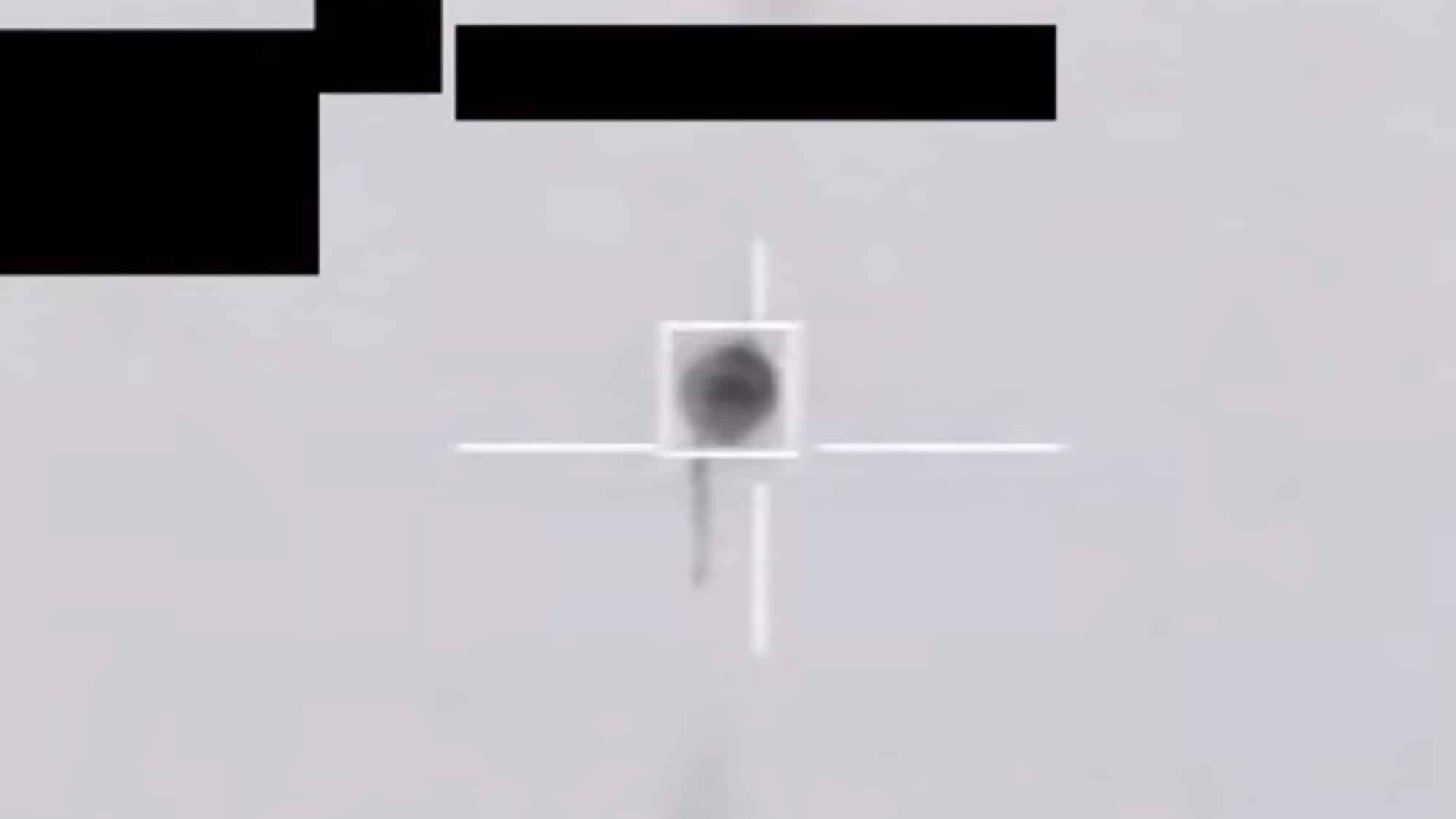
We finally got a chance to see a video of the UAP being shot down by the Minnesota ANG F-16 with an AIM-9X AAM (Air to Air Missile) as the footage was released by the Pentagon as part of the second batch of declassified material made available to the public under the Presidential Unsealing and Reporting System for UAP Encounters, or PURSUE, initiative. The first batch was published on May 8.
You can have a look at the clip yourself here below.
Here’s the description that accompanied the video in the DOW release:
On March 6, 2026, eight members of the U.S. House of Representatives requested access to 51 potentially UAP-related records allegedly held by the Department of War and the Intelligence Community. The All-domain Anomaly Resolution Office (AARO) identified a collection of responsive materials held on a classified network. Many of these materials lack a substantiated chain-of-custody.
AARO assesses that this video, whose uploader-defined title is, “USAF ANG F-16C (callsign [CALLSIGN]) Shoots Down UAP over Lake Huron with [Weapon System], 12 Feb 2023,” is likely derived from an infrared sensor aboard a U.S. military platform operating within the United States Northern Command area of responsibility in 2023. A user uploaded this video to a classified network in February 2023.
Video Description: At the 11 second mark, the sensor focuses on an area of contrast in the center of its field-of-view. At the 20 second mark, the footage appears to depict a kinetic interaction between two distinct areas of contrast, with the initial subject of the footage fragmenting in a radial displacement pattern that suggests a high-energy event.
While technically still not identified, the footage recorded by the F-16’s ATP (Advanced Targeting Pod) suggests the UAP was actually a balloon: you can see a cluster of wires, possibly tangled together, can be seen dangling beneath the object, giving the impression of a single cable, although no payload or other attached object is readily visible. Moreover, also the way in which the object appears to rupture and break apart seems to confirm it was a balloon, although much remains unknown about its exact nature and purpose.
Therefore, the “mysterious” UAP in the end was arguably a balloon-like object that will disappoint all those who were hoping to see some exotic kind of UFO (unidentified Flying Object), as UAP are still widely called. More or less, the same effect that the image of the unidentified object that was shot down by U.S. Air Force F-22 over Canada’s Yukon territory on Feb. 11, 2023, obtained and shared by CTVNews.ca.
That grainy image, part of a larger freedom of information request, provided the first visual confirmation of the unidentified object, an object described in reports as a “cylindrical” item with a metallic top and a dangling wire carrying a small payload. “Visual – a cylindrical object […] “Top quarter is metallic, remainder white. 20-foot wire hanging below with a package of some sort suspended from it.”
CTVNews.ca has obtained an image of the unidentified object shot down over Canada’s Yukon territory in February 2023. (Department of National Defence via Access to Information Request) | Source: Department of National Defence

In the end, we can only reiterate what we have been saying since 2023: regardless of the object’s actual nature, it is at least worth noting that the imagery of these UAPs, or objects described as such, is almost always of poor quality. This stands in contrast with the level of definition and detail that current-generation sensors carried by front-line aircraft should be able to provide, somehow fuelling speculation and making definitive identification of the objects far more difficult.