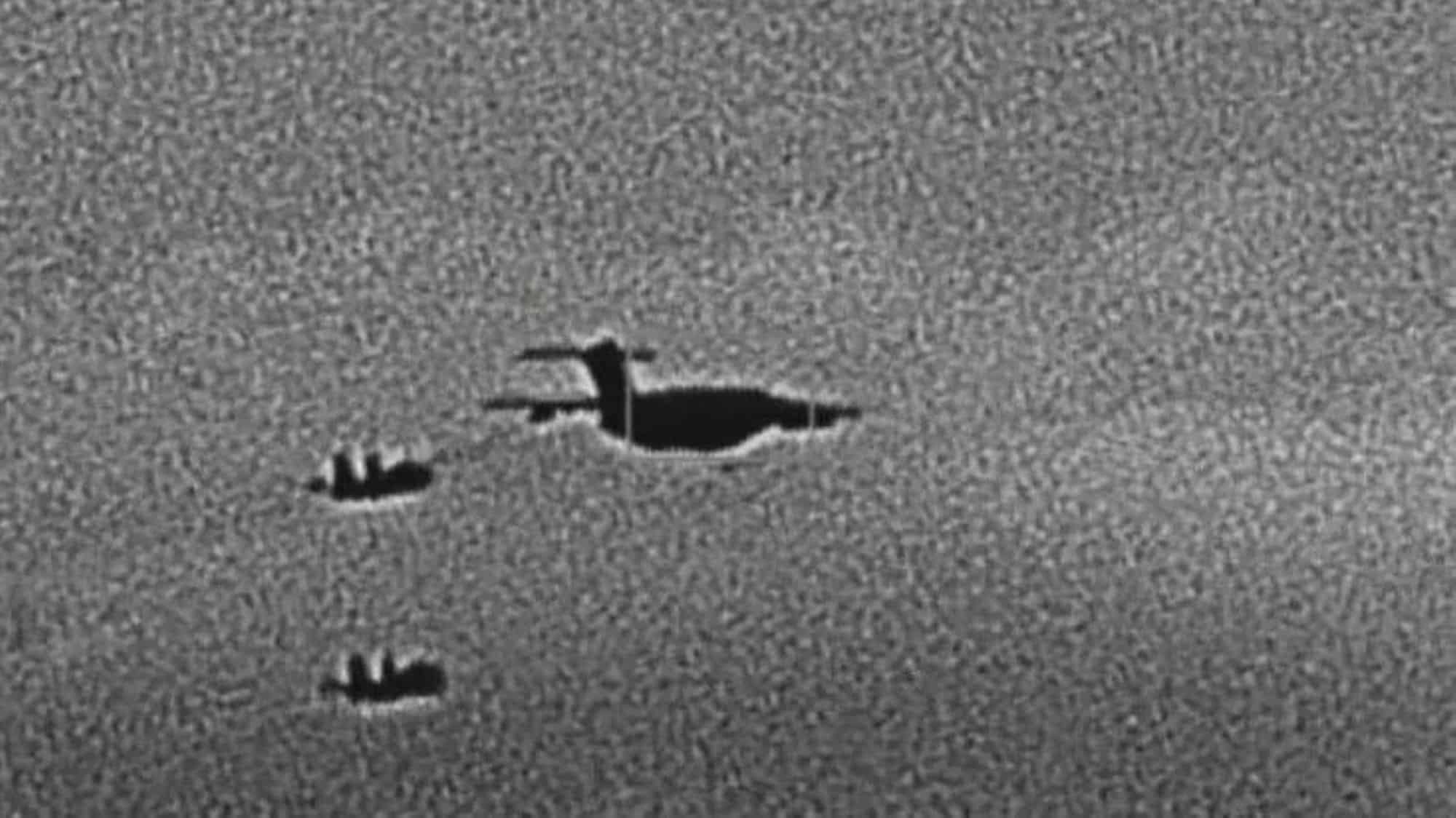
China’s Y-20 Tanker Intercepted while Refueling J-16 Fighters Near Taiwan
Between May 24 and 26, China flew nearly 60 military aircraft, helicopters and drones in Taiwan’s ADIZ, including a Y-20 tanker which refueled J-16 fighters.
A People’s Liberation Army Air Force (PLAAF) YY-20A/YU-20A aerial refueller was among the 21 aircraft Taiwan’s Republic of China Air Force (RoCAF) tracked and intercepted on May 25, 2026. The Taiwanese Ministry of National Defense (MND) identified the other aircraft as J-16 and J-10 fighters and the KJ-500 Airborne Early Warning and Control (AEW&C) aircraft, saying they were acting in concert with PLA Navy vessels.
The RoC’s Military News Agency released an infrared capture from a targeting pod showing the YY-20A with what it identified as two J-16 fighters. The aircraft were flying on either side of the tanker, with the faint outline of a refueling hose seen connecting with the jet on its port (right-side).
The image does not show the interface usually seen on multifunction displays (MFD), which appears to have been edited out. The interface could have helped identify the aircraft and the targeting pod that has captured the infrared image of the three aircraft.
國防部昨(25)日表示,自1512時起,陸續偵獲中共殲-10、殲-16、空警-500等各型主、輔戰機及無人機計21架次出海,其中16架次逾越中線及其延伸線,進入我北部、中部、西南及東部空域,配合共艦,假「聯合戰備警巡」之名,騷擾我周邊空、海域。
:國防部#國防部 #臺海 pic.twitter.com/nXS0br7Tmt
— 軍聞社 Military News Agency, ROC(Taiwan) (@mna_roc) May 25, 2026
However, going by the October 2024 incident when a RoCAF F-16 captured a PLA Navy carrier-borne J-15 fighter for the first time on its Sniper targeting pod, it is likely the same assets were used here. Taipei Times also reported that the RoC aircraft that trailed the trio was an F-16, although the military did not comment on that.
Overall 21 sorties of #PLA aircraft in various types (including J-10, J-16, KJ-500, etc.) detected from 1512 hr today. 16 out of 21 sorties crossed the median line of the #Taiwan Strait and entered the northern, central, southwestern and eastern part ADIZ in conducting air-sea…
— 國防部 Ministry of National Defense, ROC(Taiwan) (@MoNDefense) May 25, 2026
The Y-20 has seen a couple of milestones recently, with the introduction of the Y-20B variant, powered by the domestically-made WS-20 turbofans. The variant conducted its first foreign deployment late in April 2026 when it flew to South Korea to retrieve the remains of Chinese soldiers killed in the Korean War.
4月20日13時頃、PLAAF Y-20B輸送機が中国中部の某基地より韓国に向けて離陸した。
同機は第13次抗美援朝烈士遺体帰国任務に就く。帰国予定は22日。
Y-20B初の対外任務となる。 https://t.co/bvGCWTOFVM pic.twitter.com/ak1AchX4p4
— お砂糖wsnbn (@sugar_wsnbn) April 20, 2026
ADIZ flights
Usually, the Taiwanese MND’s daily reports on routine ADIZ intrusions by China cover a period of 24 hours until 6 am of the day they are released. This time, the flight of the 21 Chinese aircraft that included the Y-20 was reported in a matter of hours, without waiting for the following day.
Here is a translation of the statement:
“Overall 21 sorties of PLA aircraft in various types (including J-10, J-16, KJ-500, etc.) detected from 1512 hr today. 16 out of 21 sorties crossed the median line of the Taiwan Strait and entered the northern, central, southwestern and eastern part ADIZ in conducting air-sea joint training along with other PLAN vessels. ROC Armed Forces have monitored the situation and responded accordingly.”
9 sorties of PLA aircraft, 7 PLAN vessels and 1 official ship operating around Taiwan detected up until 6 a.m. (UTC+8) today. 8 out of 9 sorties entered Taiwan’s southwestern and eastern part ADIZ. #ROCArmedForces have monitored the situation and responded. pic.twitter.com/cB0lBDiHRU
— 國防部 Ministry of National Defense, ROC(Taiwan) (@MoNDefense) May 25, 2026
Beside the image of the Y-20 refueling the two J-16s, the MND also released a picture of a PLAN Type 052D class destroyer sailing outside Taiwanese waters. In the preceding ADIZ violation report that tracked Chinese aircraft until 6 am on May 25, the MND monitored nine Chinese aircraft sorties, out of which eight crossed the imaginary “median line.”
Seven PLAN vessels were also observed, with all of the naval and air assets skirting Taiwan southwestern and eastern air and maritime boundaries. No further details were provided.
A PLAAF Y-20B equipped with air refueling pods. | Source: Chinese Internet

Regarding the response, the statement said the “ROC Armed Forces […] employed Combat Air Patrol (CAP) aircraft, Navy ships and coastal missile systems in response to the detected activities.” The MND did not identify the aircraft designations, but named and counted their type as two UAVs, seven fighter, bomber and support aircraft, and one helicopter.
By 6 am on May 26, the MND reported 29 Chinese aircraft and seven PLAN ships, of which 24 crossed the median line and entered Taiwan’s northern, central, southwestern and eastern ADIZ. The Chinese aircraft package consisted of fighters, helicopters, UAVs and support aircraft, all of which flew various patterns surrounding the island.
29 sorties of PLA aircraft, 7 PLAN vessels and 1 official ship operating around Taiwan detected up until 6 a.m. (UTC+8) today. 24 out of 29 sorties crossed the median line and entered Taiwan’s northern, central, southwestern and eastern part ADIZ. #ROCArmedForces have monitored… pic.twitter.com/ms5KTvicQq
— 國防部 Ministry of National Defense, ROC(Taiwan) (@MoNDefense) May 26, 2026
It should be noted that an Air Defence Identification Zone (ADIZ) is not sovereign airspace, but is rather a notional extension of its aerial borders. It is used to give a country advanced information and sufficient time to respond to incoming aircraft, before it enters internationally recognized national airspace.
Diplomatic overview
It must also be noted that the latest Chinese flights into Taiwanese ADIZ come after the Trump-Xi summit in Beijing, where the latter warned Washington that continued support to Taiwan would trigger a conflict between the two superpowers. This was immediately followed by Russian President Vladimir Putin’s more expansive summit with Xi Jinping.
Analysts have broadly read this as Russia and China conveying mutual suspicion towards the U.S. At the same time, Moscow and Beijing assess that Washington will continue to leverage Ukraine and Taiwan, in some way or the other, in its strategic rivalry with the two well into the future, regardless of the dispensation in the White House.
Screengrab of the video showing the PLA Navy’s J-15 captured on the Sniper Advanced Targeting Pod of the RoCAF F-16. | Source: Youth Daily News on X

Fascinatingly, the U.S.-China equation is also marked by China ensuring its consistently stated “strategic stability.” In fact, it paused its routine flights into Taiwan’s ADIZ from Feb. 27 to Mar. 5 – the opening days of the war with Iran – before they reportedly resumed on Mar. 7.
China signaled that it will not exploit the U.S.’ sudden preoccupation elsewhere, in what could also have been viewed as China trying to open up a second front in cooperation with Iran. At the same time, the resumption of the ADIZ violations conveyed that Taiwan is an uncompromisable goal for China, irrespective of the status of its relations with the U.S.