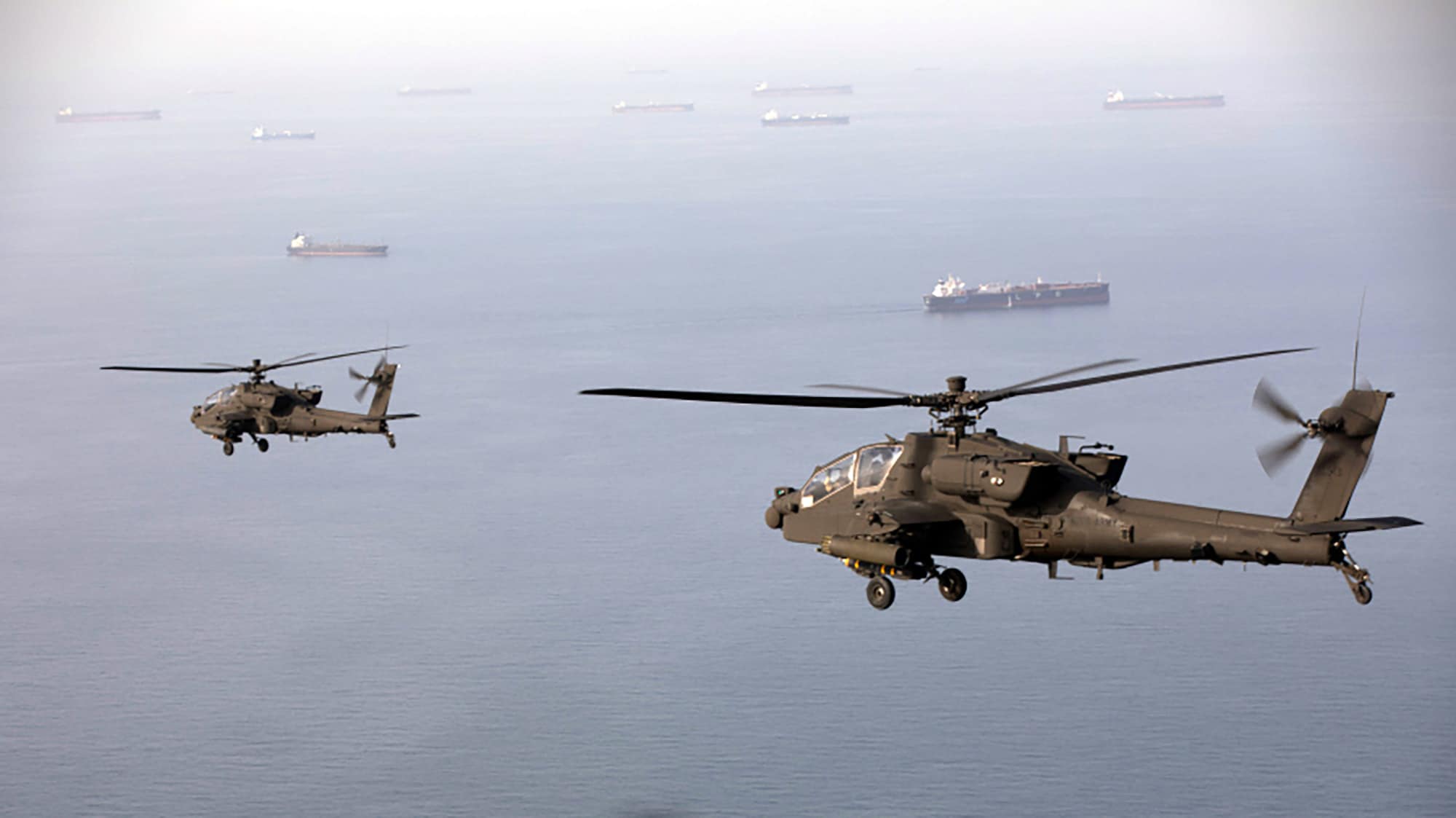
U.S. AH-64 Goes Down Near Strait of Hormuz, Crew Safe
A U.S. Army AH-64 Apache has crashed near the Strait of Hormuz for unknown reasons, with the crew rescued safely according to President Trump.
A U.S. Army AH-64 Apache attack helicopter went down near the Strait of Hormuz on June 8, 2026. The news was first reported by The New York Times, citing two people briefed on the incident, who mentioned that the two crew members were rescued.
U.S. President Donald Trump, asked about the incident before boarding Air Force One, said the two crew members “are fine” and “nobody [was] injured,” according to Reuters. A statement from the Pentagon or the U.S. Central Command (CENTCOM) is not available.
The causes of the incident are still unknown, with the NYT saying the incident is already under investigation. Reuters says that Trump was asked about this by reporters, to which he responded a report would be released soon.
This is the first AH-64 Apache helicopters lost in the Middle East since the start of the hostilities with Iran. Notably, the incident happened just a day after Israel and Iran stopped a new wave of attacks following a new escalation.
U.S. Army AH-64E Apache Guardian operating at sea with USS America, fitted with the mast-mounted MUM-T system in place of the Longbow radar. | Source: U.S. Navy photo by Mass Communication Specialist Seaman Nicholas Douglass

Apaches over the Strait of Hormuz
U.S. Apache helicopters have been operating over the area for months now. CENTCOM also released some photos showing the AH-64s flying a patrol in April, “providing a visible presence in support of freedom of navigation.” Earlier, General Dan Caine, Chairman of the Joint Chiefs of Staff, said Apaches were hunting one-way attack drones in the same area.
In May, U.S. Navy MH-60 Sea Hawk and U.S. Army AH-64 Apache helicopters were used to sink six Iranian small attack boats. The boats were reportedly threatening commercial shipping in the Strait of Hormuz, according to Adm. Brad Cooper, head of CENTCOM.
No other details were provided regarding the U.S. attack and it is unclear if the MH-60s and AH-64s were operating together or if they were involved in separate incidents. The Navy’s and Army’s helicopter are flying armed patrol missions over the area, and both types were seen carrying AGM-114 Hellfire missiles.
Alongside fast jets, the AH-64 is very well suited for such maritime patrol missions. In fact, the platform combines persistence, precise sensors and a flexible weapons mix that allow it to counter fast watercraft as well as OWA drones that might be launched against oil tankers and ships in a crowded littoral environment.
An AH-64 Apache from 4th Attack Reconnaissance Battalion, 2nd Aviation Regiment, 2nd Combat Aviation Brigade, 2nd Infantry Division fires a 30mm M230 Chain Gun during a joint Gunnery Qualification Table XII on Oct. 20, 2017. | Source: U.S. Army photo by Sgt. Patrick Eakin

As recent U.S. Army counter-UAS demonstrations have shown, the AH-64E can detect, track and defeat drones with multiple weapons, including the 30 mm M230 chain gun, APKWS-guided 70 mm rockets, HELLFIRE variants and even JAGM. This offers crews scalable options depending on range, target size and collateral-risk considerations.
The helicopter is also well equipped on the sensor side, pairing electro-optical and infrared sights with the mast-mounted AN/APG-78 Longbow radar, which is designed to rapidly detect, classify and prioritize large numbers of contacts. In the Strait of Hormuz, where threats may include small one-way attack drones, fast attack craft and other fleeting, hard-to-sort targets, that combination makes the Apache a credible hunter-killer platform.