U.S. and Iran Agree to Halt Attacks after New Round of Airstrikes
After the U.S. strikes against Iranian coastal targets in response to the attack on a commercial vessel, the two sides agreed once again to halt further hostilities ahead of new talks.
The U.S. and Iran have once again agreed to halt hostilities after the recent round of reciprocal attacks, according to Reuters and Axios. The new ceasefire arrives ahead of the new talks between the two sides which are expected on June 30, 2026.
“Technical talks are slated to continue on all areas of the MOU. Both sides will stand down for now and vessels can move freely,” the official said.
(Reuters) – Iran and the United States agreed to halt recent hostilities in the Gulf and renew talks regarding their dispute over the Strait of Hormuz, a U.S. official said on Sunday, raising hopes of saving an interim peace deal that was under pressure from days of tit-for-tat…
— Phil Stewart (@phildstewart) June 29, 2026
Attack on M/V Ever Lovely and U.S. response
On June 25, the Singapore-flagged container ship M/V Ever Lovely was hit by an Iranian one-way attack drone while exiting the Strait of Hormuz along the Omani coast. The vessel is the first to be struck since the beginning of the 60-day ceasefire between the U.S. and Iran.
US launched strikes on Iranian missile, drone and radar sites near the Strait after a drone attack on the Singapore-flagged container ship Ever Lovely.
Fortunately, all 21 crew on board the vessel were reported safe. pic.twitter.com/hi3NUooJcr
— The Maritime (@themaritimenet) June 27, 2026
“The unwarranted aggression against commercial shipping by Iranian forces clearly violated the ceasefire,” said the U.S. Central Command (CENTCOM). “Furthermore, Iran’s dangerous behavior undermined freedom of navigation as commerce increasingly flows through the vital international trade corridor.”
U.S. President Donald Trump stated that at least four Iranian one-way attack drones had targeted the commercial vessel, adding that three were intercepted by U.S. forces. While CENTCOM has not publicly commented on this, U.S. officials quoted by multiple outlets confirmed the President’s account.
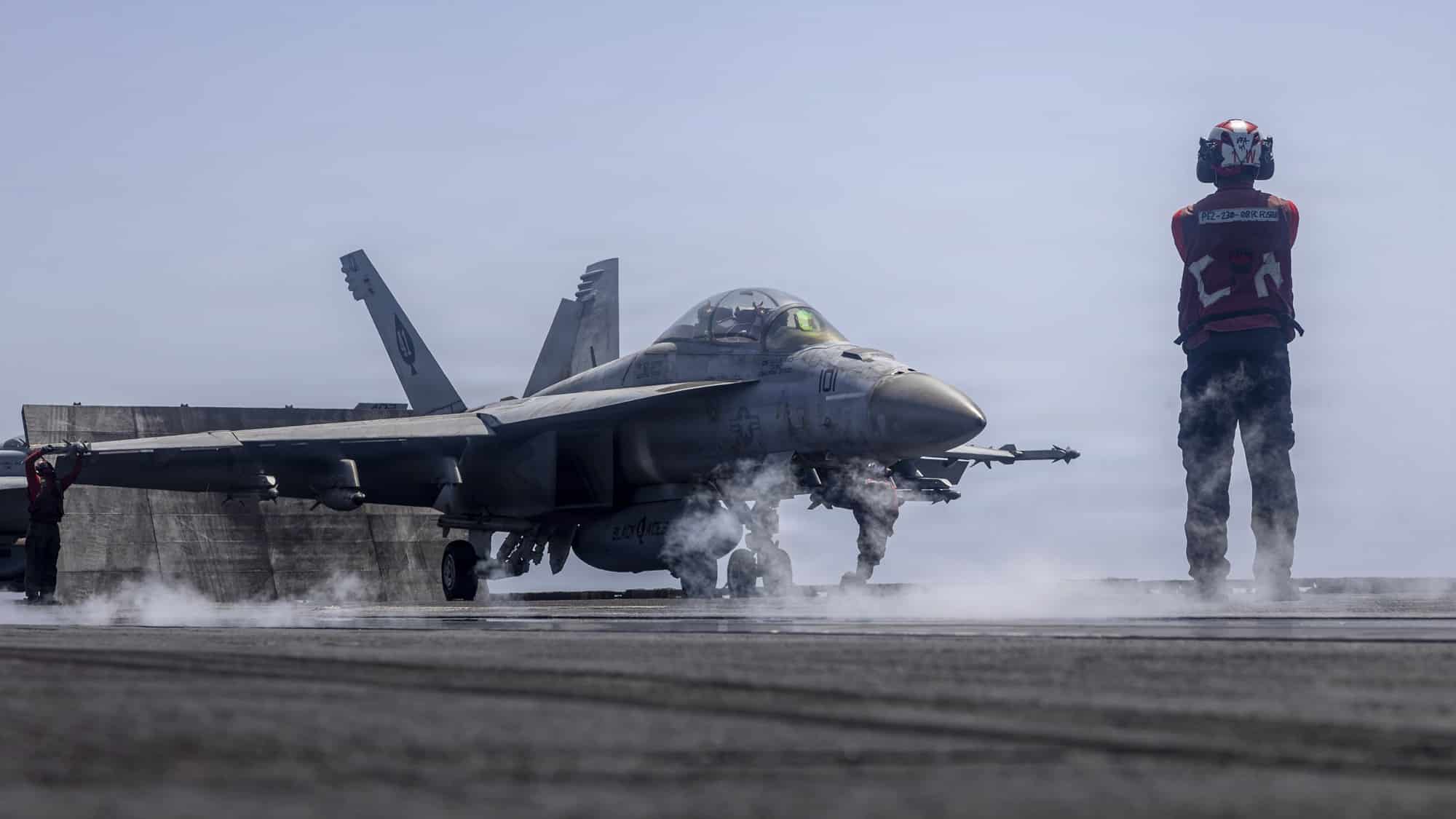
In response to the attack, the U.S. military conducted airstrikes against military targets along Iran’s southern coast on Jun. 26, 2026. According to CENTCOM, American aircraft struck Iranian missile and one-way attack drone storage facilities, as well as coastal radar sites.
https://t.co/CckXLJSpah pic.twitter.com/NoMQ7cNtN5
— U.S. Central Command (@CENTCOM) June 27, 2026
CENTCOM described the operation as “a powerful response” against the unwarranted aggression. The command did not provide additional details, however Air & Space Forces Magazine, citing a source familiar with the operation, reported that six U.S. warplanes attacked four targets along Iran’s southern coastline.
Iranian retaliation and new wave of U.S. strikes
Iran rejected the U.S. characterization of events, accusing Washington of violating the interim peace agreement first. Iranian officials described subsequent military actions as “defensive” responses to American strikes.
The Islamic Revolutionary Guard Corps (IRGC) claimed they were able to “thwart and foil the attack,” and U.S. forces had been forced to retreat during the operation. No evidence was provided to substantiate the assertion, with the IRGC promising a retaliation.
Iranian state media then reported that the IRGC targeted locations associated with U.S. military forces in the region following the American airstrikes. Bahrain, which hosts the headquarters of the U.S. Navy’s Fifth Fleet, announced that Iranian drones had entered its airspace and condemned the attack as a violation of the memorandum.
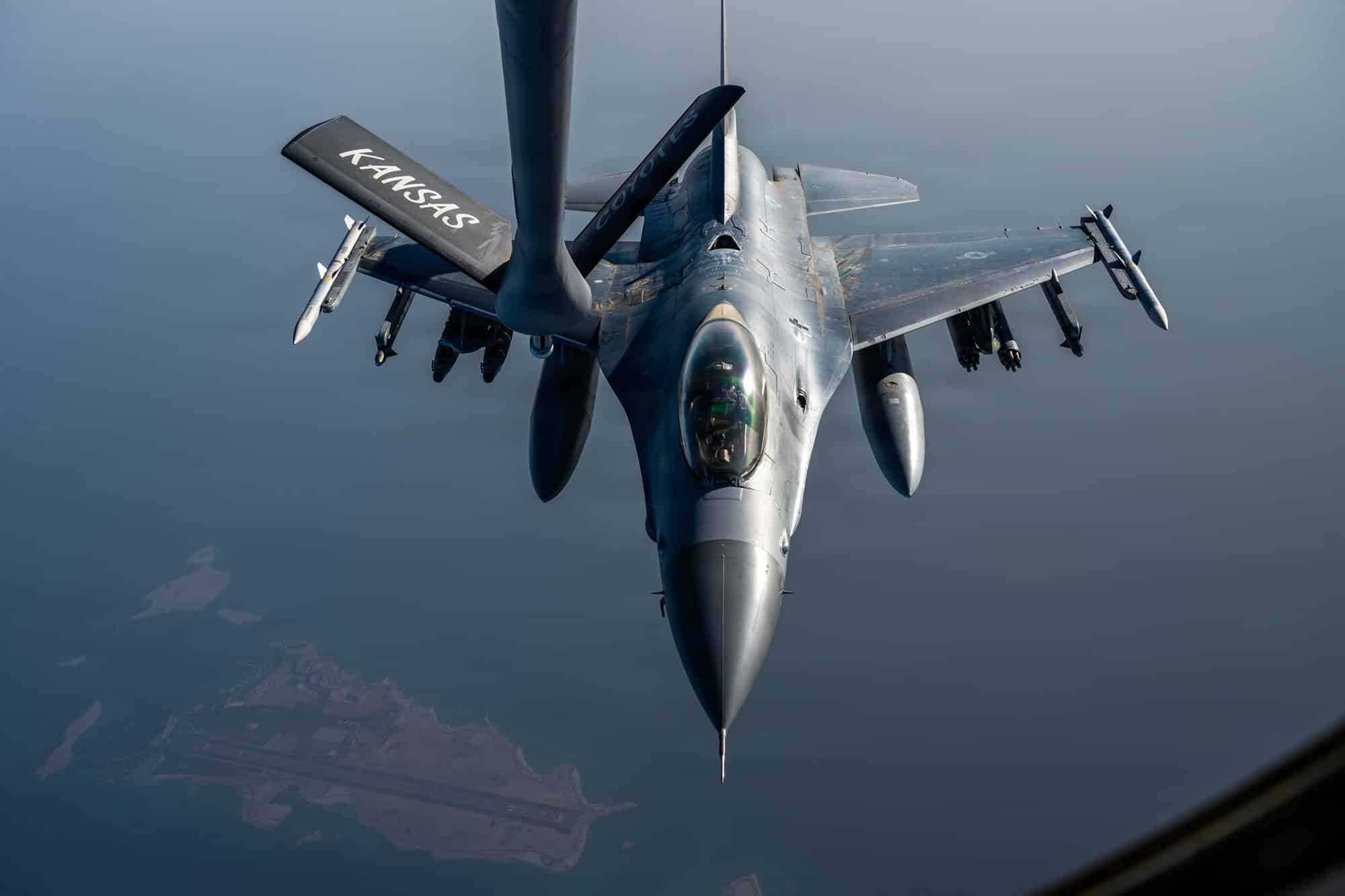
A U.S. Air Force F-16 flies over the U.S. Central Command area of responsibility. The F-16 is among more than 100 land and sea-based aircraft supporting Project Freedom. | Source: U.S. Air Force photo
Similarly, Kuwait’s military said that air defenses were activated to deal with Iranian missile and drone attacks, with at least two ballistic missiles intercepted. A large U.S. installation in the country is Ali Al Salem Air Base, which also hosts the Kuwaiti Air Force’s Eurofighter Typhoon fleet.
Iranian media also reported that IRGC naval forces had fired “warning shots” toward vessels allegedly using shipping lanes not authorized by Tehran. However, the Panama-flagged tanker M/T Kiku, carrying more than two-million barrels of crude oil, was struck by an Iranian one-way attack drone on June 27.
The U.S. then responded with a new wave of airstrikes, targeting Iranian military surveillance infrastructure, communication systems, air defense sites, drone storage facilities, and minelayer capabilities. CENTCOM said that U.S. Navy and Air Force fighter jets conducted strikes on a total of ten military targets at multiple locations in and near the Strait of Hormuz.
U.S. Navy and Air Force fighter jets conducted strikes tonight on 10 Iranian military targets at multiple locations in and near the Strait of Hormuz for Iran’s drone attack on M/T Kiku. pic.twitter.com/Z0TLZRqmF6
— U.S. Central Command (@CENTCOM) June 28, 2026
“It’s a larger strike than last night,” a U.S. official told Fox News’ Jennifer Griffin. “Iran had a chance to stop shooting and they didn’t take it, instead, they attacked another ship in Hormuz this morning, the MT Kiku.”
US official tells me US military is carrying out a new round of airstrikes against Iran right now in response to IRGC hitting a ship in Strait of Hormuz earlier today. US military is
hitting air defense, drone storage, cruise missiles, targeting radars, minelaying capabilities…
— Jennifer Griffin (@JenGriffinFNC) June 27, 2026
Same targets attacked again
Following the U.S. airstrikes, reports mentioned that some of the Iranian targets attacked by the U.S. jets were already attacked during the air campaign against Iran as part of Operation Epic Fury. The explanation provided by officials is that Iran have repaired the damage from previous airstrikes.
“I asked a senior defense official why the US has had to go back and restrike these sites that have been hit multiple times since February 28 when the war began,” wrote Fox News’ Jennifer Griffin on X. “I was told Iran has reconstituted its air defense and missile systems along the Strait of Hormuz since the US bombing campaign ended on April 7.”
I asked a senior defense official why the US has had to go back and restrike these sites that have been hit multiple times since February 28 when the war began. I was told Iran has reconstituted its air defense and missile systems along the Strait of Hormuz since the US bombing…
— Jennifer Griffin (@JenGriffinFNC) June 27, 2026
Some of the targets were later geolocated by using videos released by CENTCOM and open source imagery. Among these was a communication tower at a coastal radar site.
Geolocation:https://t.co/U3vY6CGPyu
— GeoConfirmed (@GeoConfirmed) June 28, 2026
Renewed tensions in the Strait of Hormuz
The latest exchange between the U.S. and Iran comes as maritime traffic gradually resumed through the Strait of Hormuz after months of disruption.
Iran has increasingly sought to assert control over shipping routes through the Strait, insisting that vessels follow transit corridors designated by Tehran. Iranian officials have warned that ships failing to comply with these instructions cannot be guaranteed safe passage.
Meanwhile, the U.S. continues to support an alternative southern transit lane along Oman’s coastline. Officials reiterated that U.S. forces remain committed to safeguarding commercial navigation through one of the world’s most strategically important maritime chokepoints.
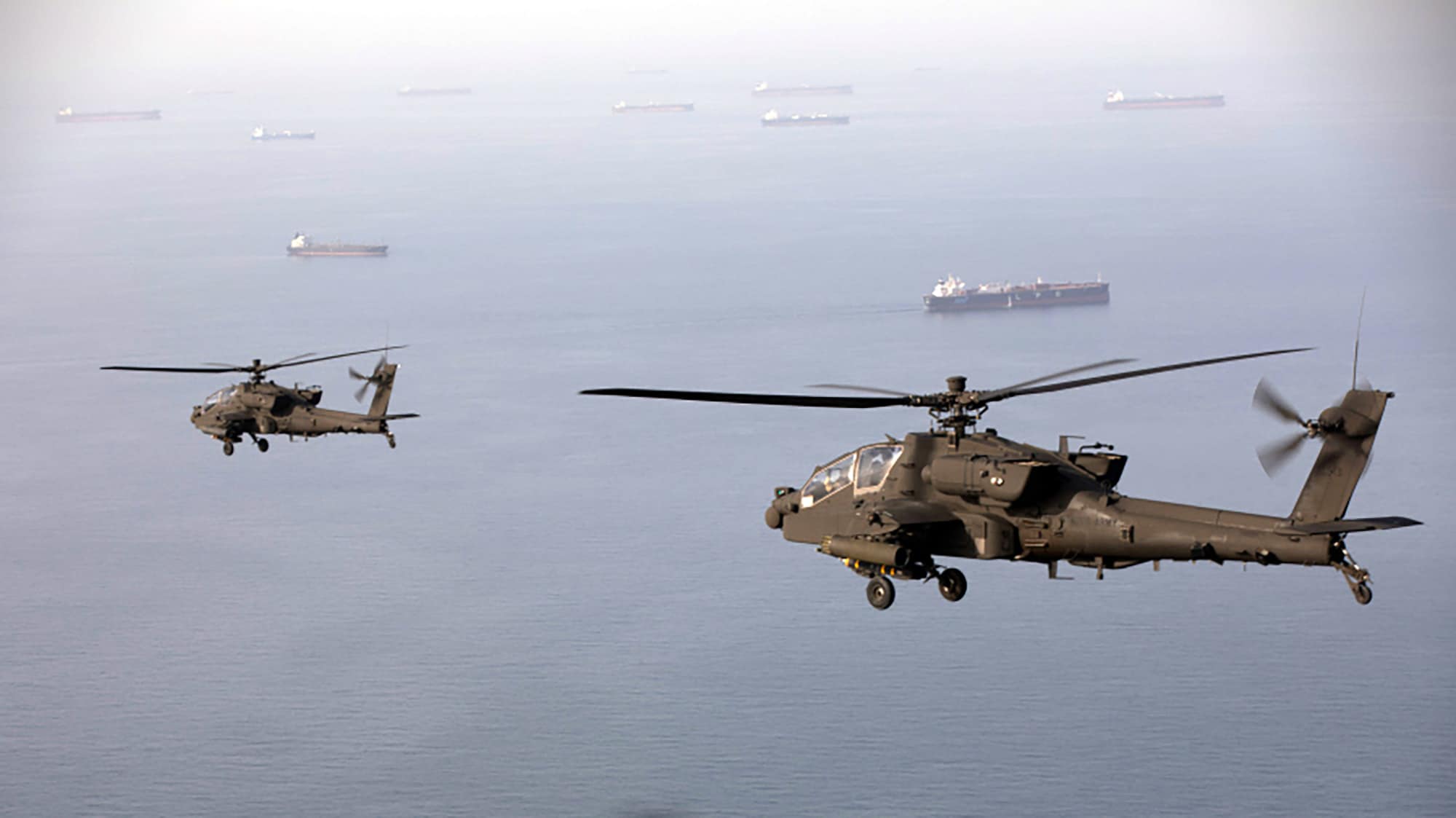
AH-64 Apache helicopters patrol the Strait of Hormuz. Actually the photos released by CENTCOM were probably taken as the aircraft were inbound the area rather than above it, somewhere off the coast of Oman or UAE. | Source: CENTCOM
Fragile ceasefire
The exchange represents the most significant military escalation since Washington and Tehran signed an interim peace memorandum intended to end months of hostilities and reopen the Strait of Hormuz to international shipping. Both sides accused each other of violating the ceasefire, vowing to respond to the provocations.
Vice President JD Vance stated that the United States had complied with the agreement, warning that “violence will be met with violence” if Iran continues military actions rather than pursuing diplomatic channels. A similar statement was released by President Trump.
“There may come a point when we are no longer able to be reasonable, and will be forced to militarily complete the job that we very successfully started,” Trump wrote on social media. “If that happens, the Islamic Republic of Iran will no longer exist!”
Anyway, despite the renewed exchange of strikes, both governments have continued to publicly support negotiations aimed at reaching a broader settlement. As mentioned in previous reports, the negotiations’ main points surround Iran’s nuclear program and long-term security arrangements in the Gulf.