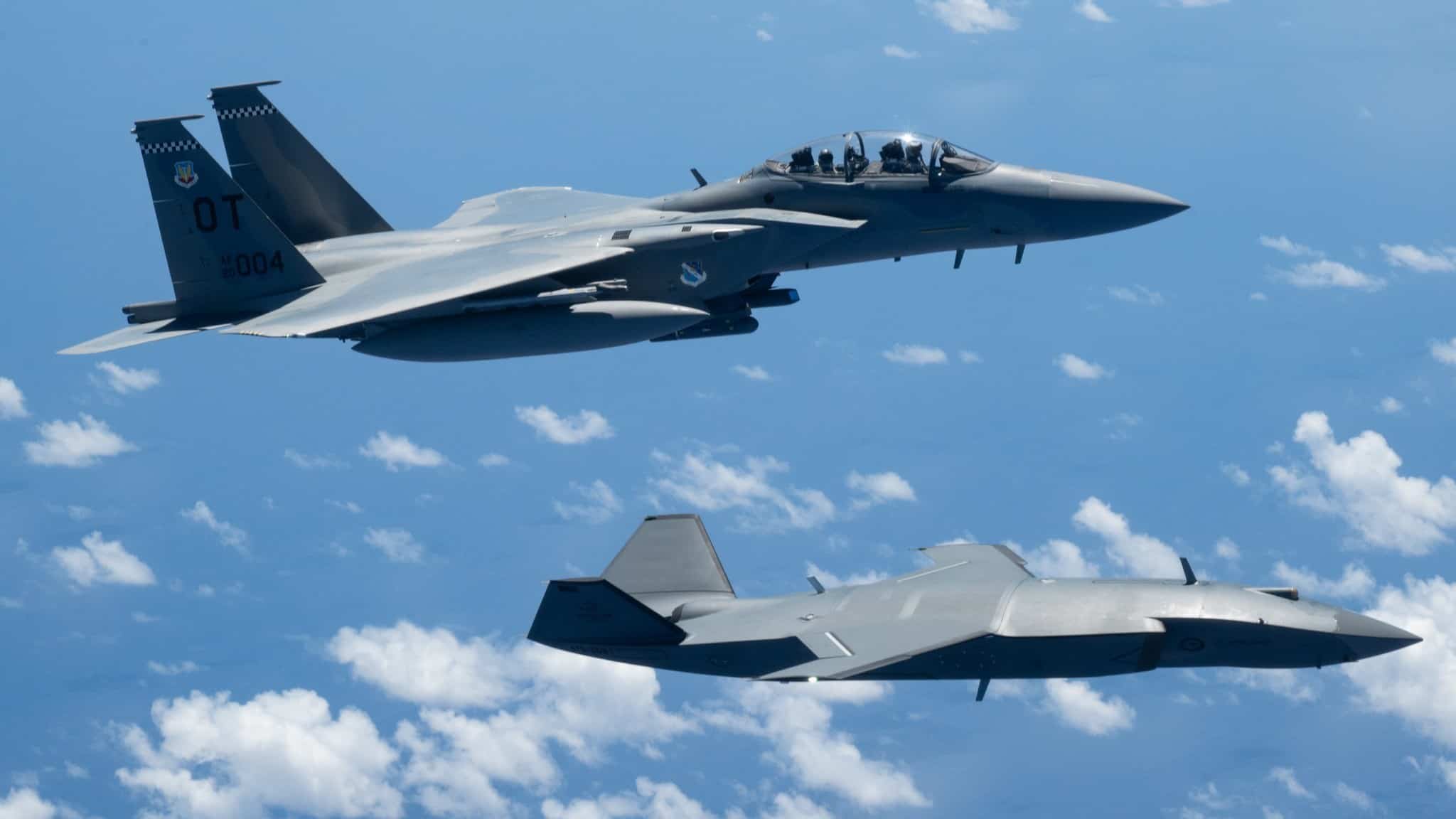
F-15EX Eagle II and MQ-28 Ghost Bat Fly Together During Valiant Shield 2026
The MQ-28 Ghost Bat took part in a flight with the F-15EX and a proof-of-concept FARP operation as part of the Experimental Operations Unit’s activities during Valiant Shield 2026.
The Pacific Air Forces (PACAF) released new undated photos from Exercise Valiant Shield 2026, showing that the MQ-28 Ghost Bat flew together with the F-15EX Eagle II. The milestone flight transformed into reality Boeing’s concept artworks which suggested the goal of having the two platforms work together in Manned-Unmanned Teaming (MUM-T) operations.
“An MQ-28 Ghost Bat and U.S. Air Force F-15EX Eagle II participated in Exercise Valiant Shield 2026 over the Philippine Sea, demonstrating the future of human-machine teaming in the theater,” said PACAF in a post on social media. “Uncrewed systems act as a force multiplier, extending the reach and effectiveness of human pilots.”
It is unclear if crew of the F-15EX, assigned to the 85th Test and Evaluation Squadron, took control of the MQ-28 during the flight. It should be noted that the service’s fighter jets already took control of drones during past tests, thus the possibility of the F-15EX controlling the MQ-28 should not be excluded.
An F-15EX Eagle II and an MQ-28 Ghost Bat fly together during Valiant Shield 2026. | Source: PACAF
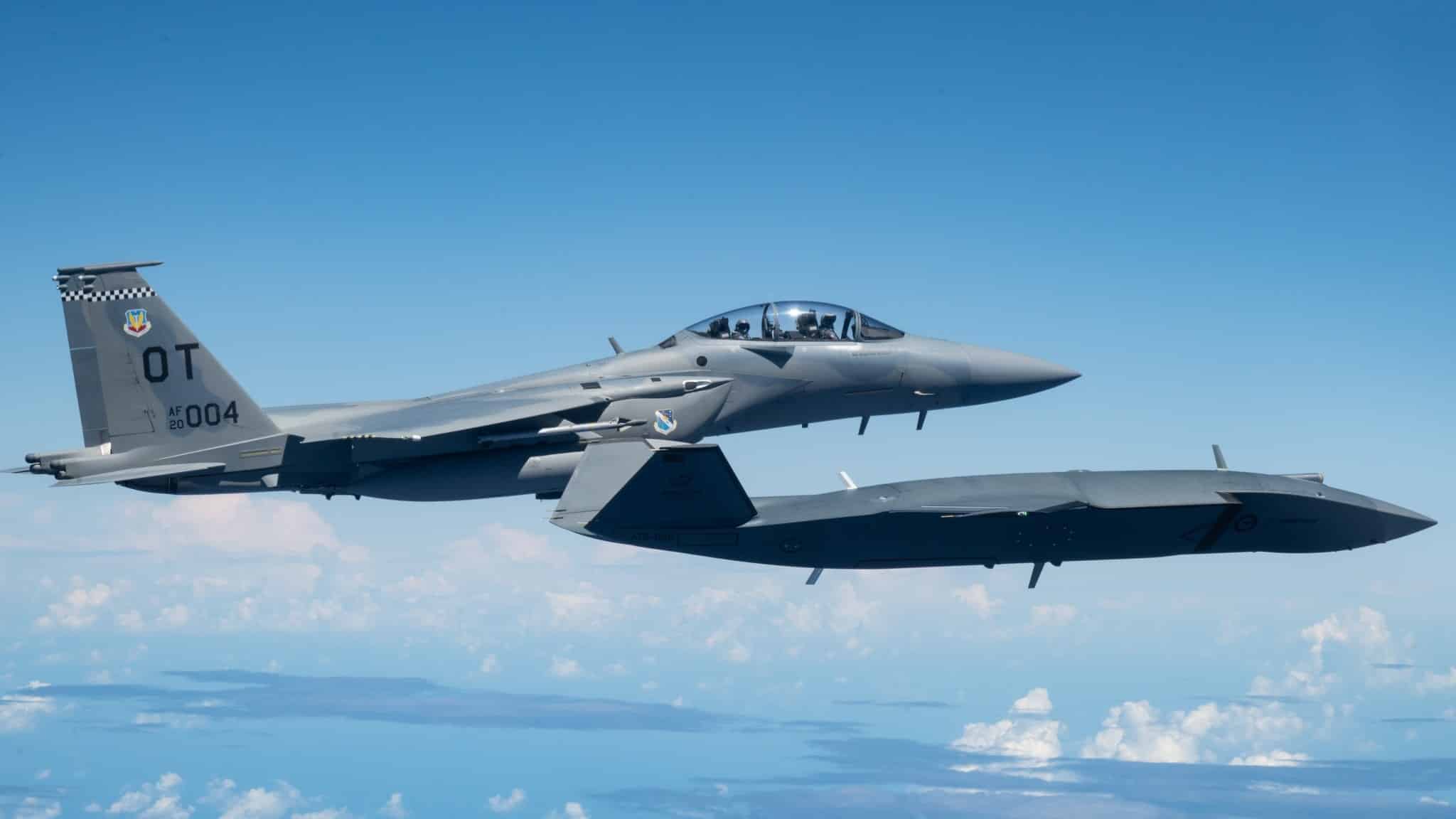
Moreover, in the press release announcing the MQ-28’s involvement in Valiant Shield last month, PACAF said “the uncrewed MQ-28 will fly in concert with crewed fighter platforms, providing a critical opportunity for the joint force to refine tactics, techniques, and procedures for this next evolution of airpower.”
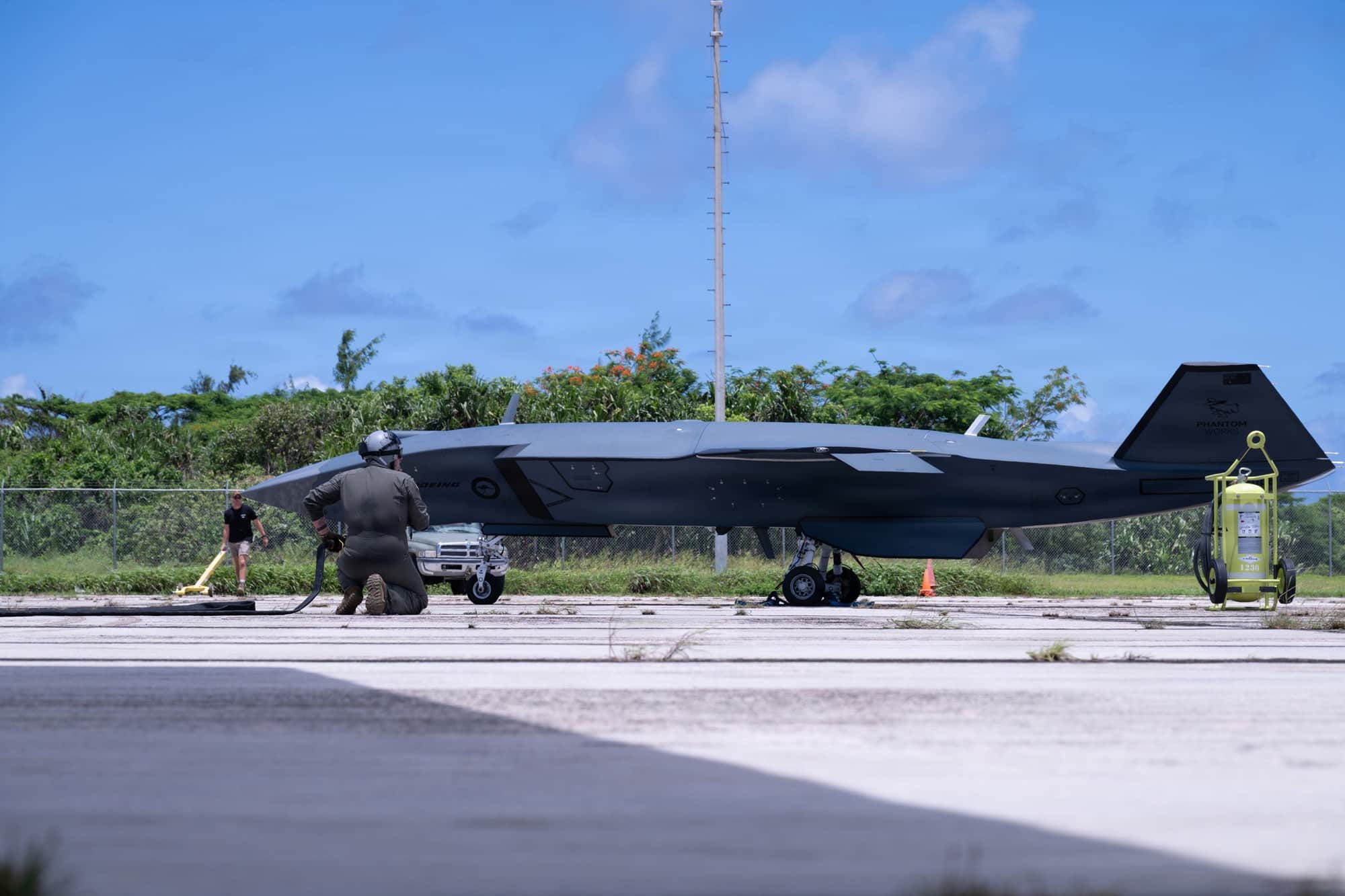
The MQ-28 was deployed to Rota, Commonwealth of the Northern Mariana Islands, for the duration of the exercise. The specific aircraft is a production representative airframe, which is equipped with an Infra-Red Search and Track (IRST) system.
While at Rota, the MQ-28 also took part in a proof-of-concept Forward Arming and Refueling Point (FARP) operation for Collaborative Combat Aircraft (CCA) on June 28. The operation was supported by a HC-130J Combat King II and Airmen assigned to the 79th Rescue Squadron, alongside members of the Royal Australian Air Force and the Experimental Operations Unit (EOU).
The involvement of the EOU is notable as it was activated in June 2025 at Nellis Air Force Base, Nevada, to accelerate the introduction of CCA. The role of the EOU will be to develop the initial tactics, techniques and procedures needed to ensure CCAs are integrated in the fleet and tactically viable for future conflicts.
The unit recently conducted a round of testing with the YFQ-44A at Edwards Air Force Base, California. The service said the unit “executed a series of sorties that refined core operational and logistical procedures for deploying and sustaining CCA in a contested environment.”
With PACAF confirming the involvement of the EOU, it is likely the participation to Valiant Shield 2026 was part of a new round of testing which used the MQ-28 as surrogate for the FQ-42 and FQ-44. The Air Force recently awarded production contracts for the two CCAs.
A U.S. Air Force HC-130J Combat King II and Airmen assigned to the 79th Rescue Squadron, alongside members of the Royal Australian Air Force and the Nellis Air Force Base-based Experimental Operations Unit, conduct a proof-of-concept Forward Arming and Refueling Point operation for Collaborative Combat Aircraft with the MQ-28 Ghost Bat in Rota, Commonwealth of the Northern Mariana Islands, June 28, 2026, in support of VALIANT SHIELD 2026. | Source: U.S. Air Force photo by Senior Airman Austin Salazar
F-15EX Visits Kadena Again
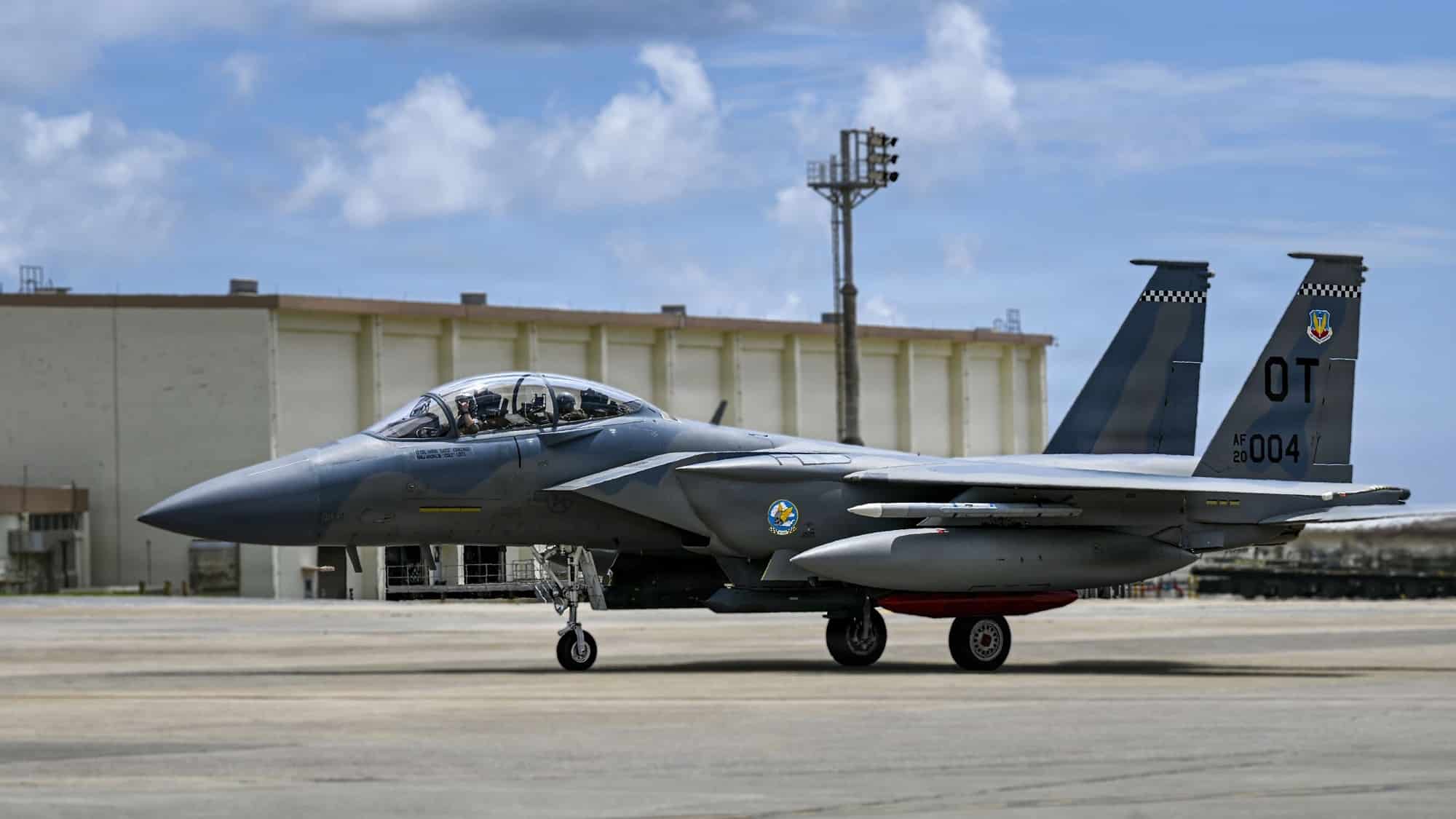
The same F-15EX which flew with the MQ-28 also arrived at Kadena Air Base, Japan, on June 29, 2026, accompanied by two F-15E Strike Eagles. The visit, whose duration is unknown, might have happened after the flight with the MQ-28, as Valiant Shield officially ended on July 1.
This is the second time an F-15EX is deployed to Kadena as the base prepares to receive its permanently assigned Eagle IIs. As we reported in the past here at The Aviationist, the base is transitioning from the F-15C/D Eagle to the new F-15EX Eagle II.
The 67th Fighter Squadron will be Kadena’s first operational F-15EX unit, followed by the 44th Fighter Squadron. A total of 36 new fighters is expected to be delivered there starting next year, according to Air Force Secretary Troy Meink.
A U.S. Air Force F-15EX Eagle II assigned to 85th Test and Evaluation Squadron, Eglin Air Force Base, Florida, lands at Kadena Air Base, Japan, June 29, 2026. | Source: U.S. Air Force photo by Airman 1st Class Gracelyn Hess
“The F-15EX represents the next chapter of airpower at Kadena,” said U.S. Air Force Brig. Gen. John Gallemore, 18th Wing commander. “Our Airmen have the opportunity to train with the aircraft, build confidence in its capabilities and ensure we’re ready to project lethality and integrate into operations as we continue providing combat power in support of a free and open Indo-Pacific.”
Valiant Shield
Valiant Shield is a biennial, multinational, joint exercise focused on integrating the joint force in a multi-domain environment. The exercise brings together forces from the U.S. Air Force, Navy, Marine Corps, Army, and Space Force, alongside regional allies and partners, to train across a vast geographic area in the Pacific.
First established in 2006, Valiant Shield has evolved into one of the largest and most sophisticated military exercises in the Pacific. This reflects the growing emphasis on joint and combined operations in response to an increasingly contested security environment.
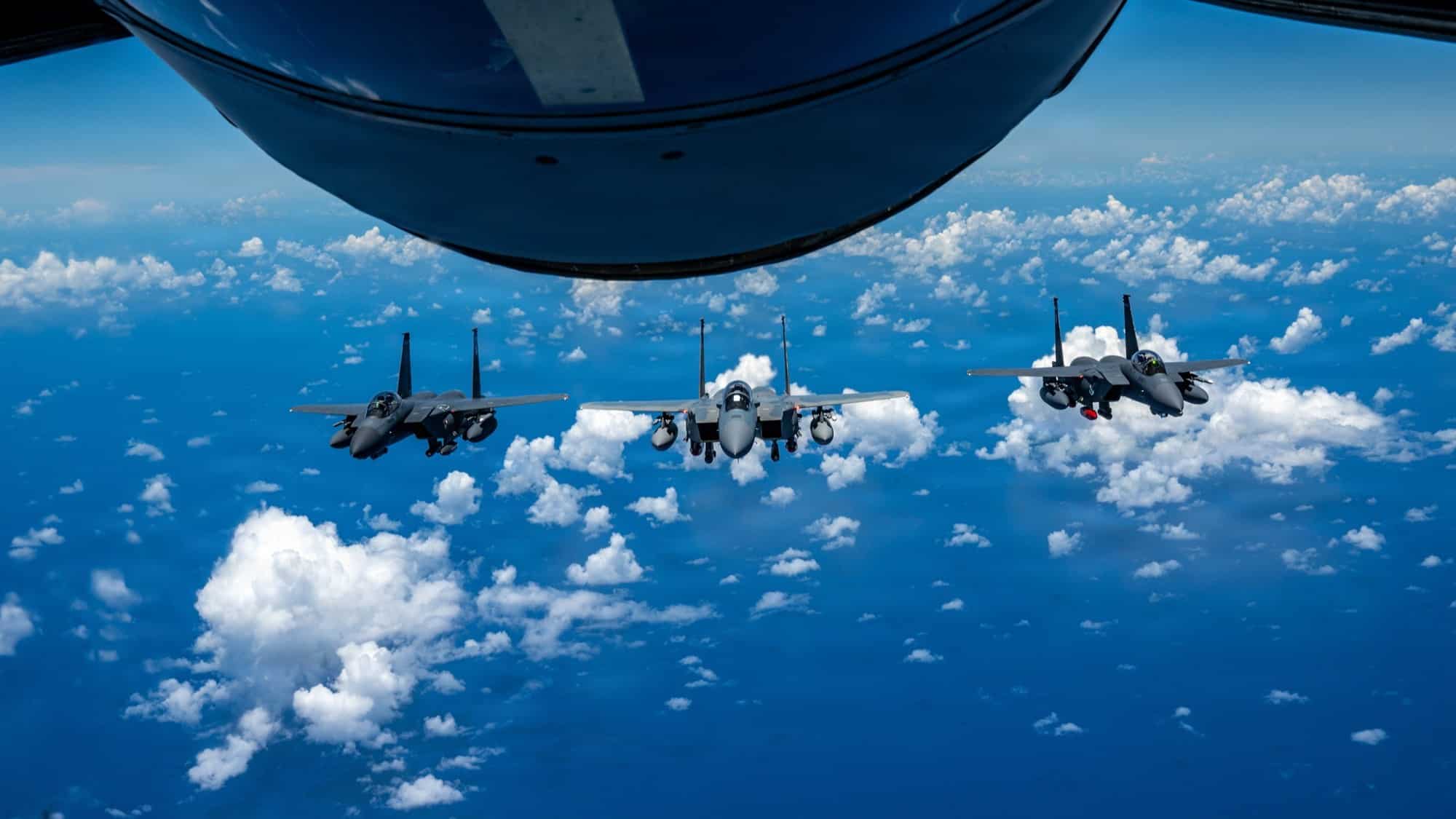
A U.S. Air Force F-15EX Eagle II and F-15E Strike Eagles assigned to the 85th Test and Evaluation Squadron, Eglin Air Force Base, Florida, fly in formation after receiving fuel from a KC-135 Stratotanker assigned to the 909th Air Refueling Squadron over the Pacific Ocean, June 29, 2026. | Source: U.S. Air Force photo by Staff Sgt. Dwane R. Young
“Valiant Shield demonstrates our enduring commitment to a free and open Indo-Pacific,” Adm. Steve Koehler, commander of U.S. Pacific Fleet. “Exercising advanced multidomain capabilities with our allies ensures we continue to seamlessly innovate and operate together, project combat power together and prevail over any challenge – together.”
The exercise typically features a wide range of assets, including fighter aircraft, bombers, aerial refueling tankers, intelligence, surveillance and reconnaissance (ISR) platforms, naval surface combatants, submarines, amphibious forces, and advanced command-and-control systems. “This routine training fosters real-world proficiency in sustaining joint forces through detecting, locating, tracking, and engaging units at sea, in the air, on land, and in cyberspace in response to a range of mission areas,” explains PACAF.