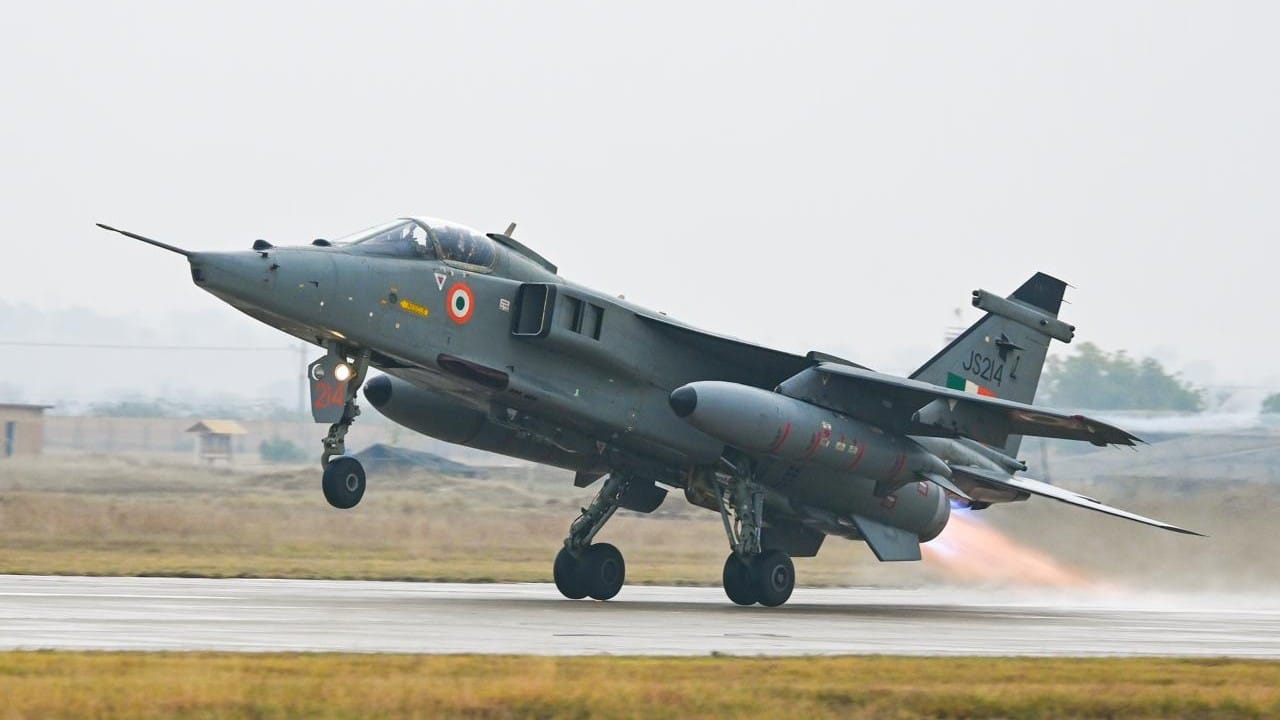
Indian Air Force Received Nine Retired RAF Jaguars
India for the last few years has been importing retired British, French and Omani Jaguars along with separate components to supply spares to its existing fleet.
The Indian Air Force (IAF), the only remaining operator of the Anglo-French SEPECAT Jaguar strike aircraft, has received nine retired Royal Air Force (RAF) aircraft since the beginning of this year, British Parliamentary proceedings revealed on Jul. 3, 2026. The information was revealed in a written response by MP and Secretary of State for Defence Luke Pollard to a query raised by Ben Obese-Jecty, who asked how many retired Jaguars have been transferred to India since Jan. 1, 2026.
Pollard put the figure at nine, specifying these included five GR1 variants and four twin-seat T2 trainers. The variants employed by India were developed from the GR1, also known as Jaguar S, and the T2, also known as Jaguar B.
This development follows reports from December 2025 about New Delhi also looking to buy spares from 20-24 ex-Omani jets – while considering retired Nigerian and Ecuadorian aircraft – to keep its fleet flying. An image on Reddit in June, shared by user ‘MindCorrupt’, also purported to show three Jaguars without the wings in protective covering at an unidentified port in the UK, with the thread saying the aircraft were destined for India.
A query sent to India’s MoD and the IAF spokesperson Wing Commander Jaideep Singh did not elicit a response at the time of writing.
France and the UK retired their Jaguars in 2005 and 2007, respectively. India, however, is still forced to operate these older fighters to avoid capability gaps, amid the retirement of the MiG-21, delays in the LCA Tejas Mk1A due to late deliveries of the GE F404-IN20 engines, the new Rafales still a few years away, no plans for a Su-30MKI engine upgrade and the fifth generation Advanced Medium Combat Aircraft (AMCA) still reported to be on the drawing board.
BIG: The UK has officially confirmed the transfer of 9 retired Jaguar fighter jets to India.
These aircraft won’t return to combat but they’ll play a crucial role in keeping the Indian Air Force’s Jaguar fleet mission-ready with spare parts.
With 42 more Jaguars still… pic.twitter.com/2tmZqvK8jM
— BharatVoxx (@BharatVoxx) July 6, 2026
Notably, IAF Jaguars, along with Su-30MKIs, have also trained with British F-35Bs as part of mock carrier strikes on the HMS Prince of Wales during last year’s Exercise Konkan.
Retired Jaguars’ transfer
The UK held in storage a total of 51 retired Jaguars before the transfer of the nine aircraft to India. Pollard gave a brief breakup of the current decommissioned Jaguar fleet still within the country: “Of the 42 Jaguar aircraft the Ministry of Defence still holds, 13 are the GR1 variant and none are the T2 variant.”
Pollard’s response does not specify the composition of the remaining 29 airframes, which the question’s scope did not cover. The balance of the surviving fleet would be expected to comprise a mix of the upgraded GR3 single seaters and T4 twin seaters.
India Receives Nine Decommissioned Jaguar Attack Aircraft From the United Kingdom
India remains the last country operating Jaguar aircraft, known locally as the Shamsher. As the platform has long been out of production and original spare parts are becoming increasingly scarce,… pic.twitter.com/Xxqfyn59WM
— Agnika (@AntarAgnika) July 6, 2026
The Omani effort meanwhile was channeled through the 13th Joint Military Cooperation Committee meeting on Nov. 24, 2025. The procurement from the Gulf country is also what IAF officers specifically describe as a “Christmas tree” purchase, buying only selected spares and components, instead of the entire airframes, of which nearly two dozen should be available.
India’s ex-Jaguar cannibalizing efforts
This is not the first time India has purchased retired Jaguars from former users as a source of spares for its fleet, especially after HAL ceased production. In 2018, India acquired 31 retired Jaguars from France to cannibalize parts.
According to The Wire, Oman also provided two additional aircraft with eight Rolls-Royce Adour Mk 811 engines and 3,500 lines of spares. The UK similarly sold two twin-seater Jaguars and 619 rotables for around $400,000.
The UK just sent India nine dead jets to keep old ones alive.
These are retired RAF Jaguars, five GR1s and four T2s, headed straight into India’s spare parts pool.
Here is what this parts deal actually reveals about the state of India’s Jaguar fleet and why the IAF still… pic.twitter.com/v9AV9dYlvJ
— Military Observer (@TheMilObserverr) July 6, 2026
The IAF’s Jaguar fleet, as per the latest count in the World Air Forces 2026 report stands at 130 aircraft, following three losses in 2025, with other assessments estimating 120 jets. These are spread across six squadrons, each typically operating 18 to 20 airframes.
The twin-engine Anglo-French jet remains the mainstay of the service’s battlefield interdiction mission – a role it terms as the Deep Penetration Strike Aircraft (DPSA). The aircraft began entering IAF service in 1979, with the first 40 jets purchased in a flyaway condition.
Subsequent examples were license-built between the 1980s and 2008 by the state-run Hindustan Aeronautics Limited (HAL) in a technology-transfer by SEPECAT – the Joint Venture between France Breguet and the UK’s British Aircraft Corporation. Locally called the “Shamsher” (courageous sword), the IAF’s Jaguar IS, IB and the maritime strike IM variants aircraft subsequently underwent the domestically-evolved Display Attack Ranging Inertial Navigation I, II and III (DARIN I/II/III) upgrades.
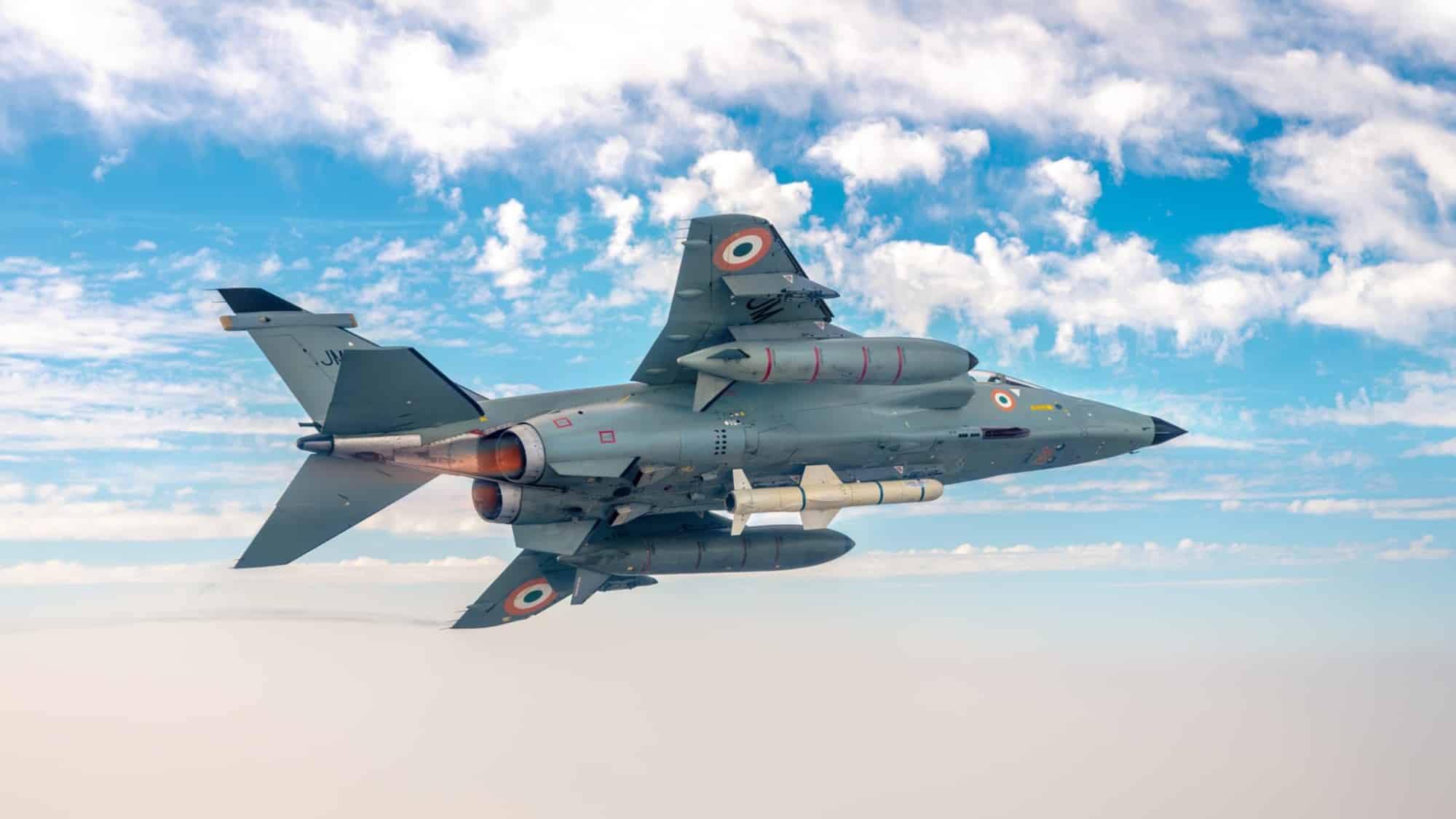
An IAF Jaguar with an Harpoon anti-ship missile on Feb. 2, 2024. | Source: Indian Air Force
Indian Jaguars marred by lack of a new engine
The IAF’s Jaguars have long flown with the antiquated Rolls-Royce Adour Mk 811 afterburning turbofans, whose cancelled replacement limited the exceptional capabilities of the DARIN III standard. DARIN III arrived in 2008, when the jet’s defining Israeli Elta EL/M-2052 Active Electronically Scanned Array (AESA) made it the first jet in the IAF’s fleet with such a sensor, followed by a first flight in 2012.
The Jaguar is a twin engine strike aircraft in the IAF’s inventory. It has the capability to execute precision strikes, deep inside adversary’s territory.
@AviationWall, @AviationKedar, @neel385#IAFCapabilities#IndianAirForce pic.twitter.com/VAa1QJSQGL
— Indian Air Force (@IAF_MCC) May 23, 2022
Other DARIN III features include a fully digital glass cockpit with three multifunction displays; a new digital engine and flight instrument system (EFIS) digital displays; a digital Heads-Up Display (HUD); a new Israeli-made Elbit Display and Sight Helmet (DASH) used to cue to the Advanced Short-Range Air-to-Air Missile (ASRAAM); and integration of the U.S.-made AGM-84L Harpoon anti-ship missile.
İngiltere, emekli Jaguar savaş uçaklarını Hindistan’a devrediyor!
İngiltere, SEPECAT Jaguar saldırı uçaklarını envanterden çıkarmasından uzun süre sonra, 9 adedini, yaşlanan Jaguar filosunun hizmette kalmasını desteklemek amacıyla Hindistan’a devretti.
1974 yılında… pic.twitter.com/BE1F40eygA
— M5 Dergi (@M5Dergi) July 6, 2026
However, the jet also needed improved kinematic performance and maintainable engines, for which a potential candidate was the Honeywell F125-IN powerplant. The $13.2 million program was cancelled in 2019 after its cost was deemed too exorbitant.
While the reasons behind the nearly dozen Jaguar crashes between 2015 and 2025 are not officially known, IAF pilots have frequently lamented the Adour Mk 811’s poor thrust that limited maneuverability.