
FQ-42A and FQ-44A CCAs Are in Serial Production
A month after contracts were awarded, GA-ASI and Anduril announced that their CCAs are already in production.
The U.S. Air Force’s Collaborative Combat Aircraft (CCA) program took a major leap forward on Jul. 28, 2026, with General Atomics Aeronautical Systems, Inc (GA-ASI) and Anduril announcing major progress on the production front of their respective aircraft. While GA-ASI declared the FQ-42A Dark Merlin entered production with “full-scale manufacturing underway,” Anduril rolled out the first FQ-44A Fury produced at its Arsenal-1 factory in Ohio.
The development comes a little over a month after the U.S. Air Force awarded production contracts for both the CCAs and the various mission autonomy software as a part of the program’s Increment 1 phase. The awards also saw the ‘Y’ being dropped from the CCAs’ ‘YFQ’ designations, representing the transition from experimental aircraft to operational assets part of the Air Force fleet.
It was remarkable to watch @anduriltech‘s first Ohio-made, unmanned combat aircraft roll off the production line at Arsenal-1 in Pickaway County this morning. Congratulations to everyone involved in this significant milestone for national defense! pic.twitter.com/arka9TgkRf
— Governor Mike DeWine (@GovMikeDeWine) July 27, 2026
Recently, from July 21, the two CCAs also participated in their first Agile Combat Employment (ACE) exercise at Creech AFB, Nevada. The exercise saw the Experimental Operations Unit (EOU) conducting multiple sorties, integrating crewed aircraft and replicating operational scenarios to inform requirements.
Full-scale #manufacturing of FQ-42A Collaborative Combat Aircraft is underway. The semi-autonomous fighter will deliver uncrewed #airpower for the U.S. Air Force.
More on #FQ42A CCA: https://t.co/4im1OcMRKz pic.twitter.com/UaaAK6uWp9
— General Atomics Aeronautical Systems, Inc (GA-ASI) (@GenAtomics_ASI) July 28, 2026
FQ-44A Fury
Anduril highlighted, in its announcement on X, the success of the producibility that it envisions for both its factories and weapons. “557 days ago, Arsenal-1 didn’t exist. Today, the first FQ-44A built in Ohio rolled off the production line,” said the company.
Anduril disclosed late in March that its CCA entered production at Arsenal-1. Later, the existing aircraft progressed to flight trials with the Experimental Operational Unit (EOU) at Edwards AFB, California, in April, and in July, fired a live AIM-120C Advanced Medium-Range Air-to-Air Missile (AMRAAM) for the first time.
557 days ago, Arsenal-1 didn’t exist. Today, the first YFQ-44A built in Ohio rolled off the production line. pic.twitter.com/zVM8i75vrW
— Anduril Industries (@anduriltech) July 28, 2026
The aircraft that was rolled out of the assembly line at Arsenal-1 bears the flag of Ohio on its vertical stabilizer, together with the writing “Ohio, the birthplace of aviation.” Rolling out the first Fury in four months of setting up the factory and beginning operations seemingly backs Anduril’s touted ethos of its aircraft and munitions products being unprecedentedly scalable.
The company has repeatedly said it trades off technical sophistry for mass producibility to support longer sustained wars against peer adversaries. Its ethos revolves around simple design, proven components from established supply chains and vendors, and employing reconfigurable factory lines with common, non-specialist manufacturing machinery and tooling equipment.
We’re one step closer to getting CCA to the warfighter with this live fire test! pic.twitter.com/1jAsIiXzVa
— General Ken Wilsbach (@OfficialCSAF) July 15, 2026
What changes, especially internal in terms of components like networking and flight control suites, are present inside the production-representative Fury remains to be seen. The company has long established that Fury is a scalable fighter drone meant to supplement a fighter fleet that has dwindled since the 1990s.
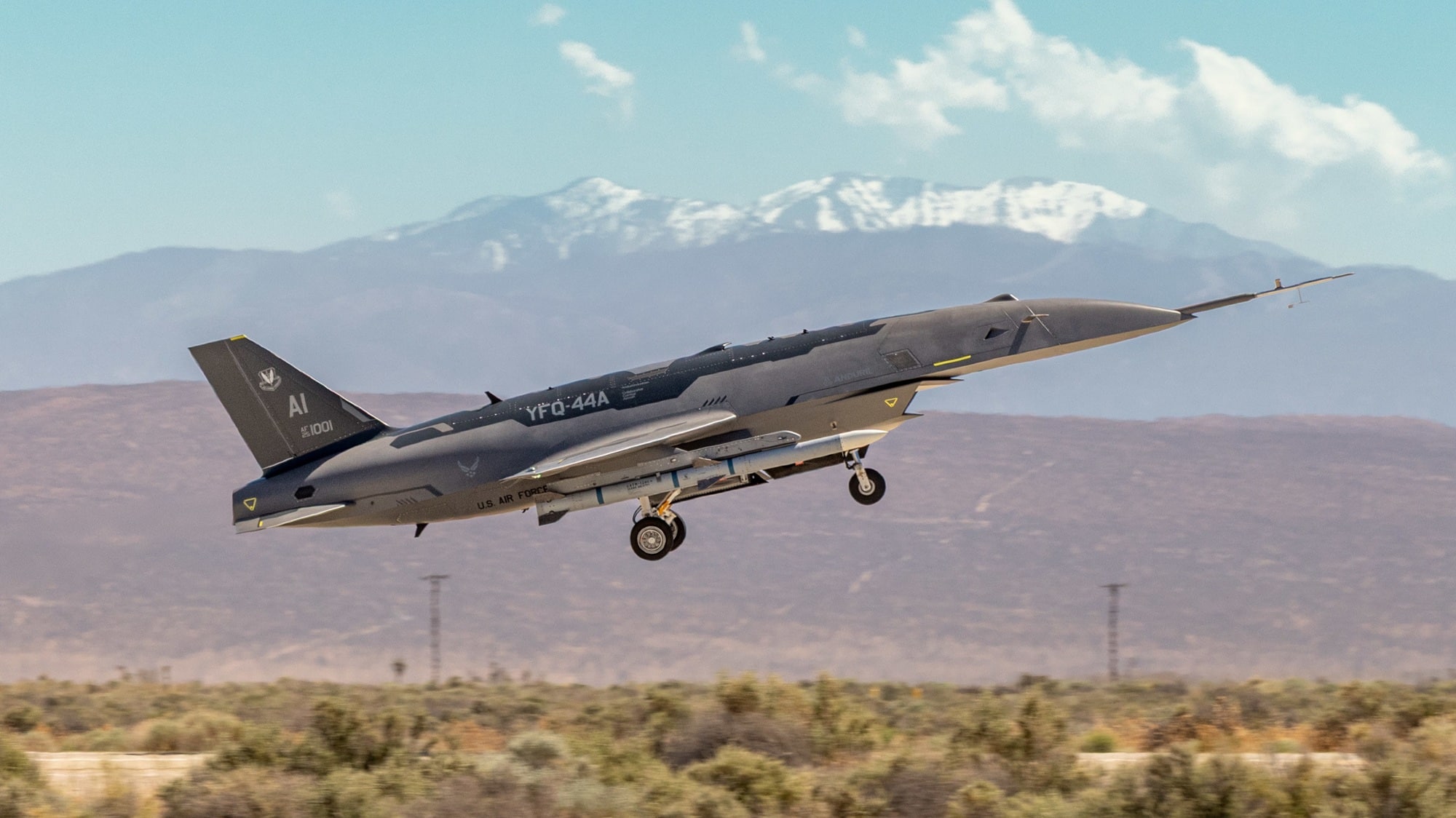
The FQ-44 is largely an off-board weapons release platform, leveraging networking and targeting data from other manned assets. For this role the aircraft carries weapons externally and employs a forward-looking infrared search and track (IRST) sensor housed inside a small dorsal bump.
During the YFQ-44’s first live-fire of the AIM-120 AMRAAM, the U.S. Air Force stressed the precedence of human oversight and control in lethal use of force by CCAs. “CCAs will not autonomously employ weapons. The decision to release any weapon system remains exclusively with a human operator, who maintains command and control of the platform at all times,” the service’s statement said.
A YFQ-44A takes off from the runway at Edwards Air Force Base, Calif., during a Collaborative Combat Aircraft exercise. | Source: U.S. Air Force photo by Ariana Ortega
FQ-42A Dark Merlin
The FQ-42A Dark Merlin hit a bump earlier this year when an airframe suffered a mishap on Apr. 6, 2026 at the company-owned Gray Butte Airport near Palmdale, California. The company said, following the incident, that it had paused the Dark Merlin’s flight testing, resuming a month later.
The aircraft was considered a total loss. A safety review found the cause to be an autopilot miscalculation for the weight and center of gravity of the aircraft, prompting a software remediation.
The review was conducted together with the Air Force, with both endorsing the modifications ahead of returning to flight testing. The announcement about the production arrived two months after the return to flight.
A U.S. Air Force YFQ-42A Dark Merlin aircraft assigned to the Collaborative Combat Aircraft Experimental Operations Unit descends in the air before landing at Creech Air Force Base, Nevada, July 22, 2026. | Source: U.S. Air Force photo by Staff Sgt. Jake Jacobsen

The company did not provide further details and it is thus unclear if a first aircraft was already rolled out of the factory or if it is still on the assembly line.
STATEMENT ON YFQ-42A CCA FLIGHT INCIDENT
A YFQ-42A Collaborative Combat Aircraft test platform experienced a mishap following takeoff from a company-owned airport in the California desert on Monday at approximately 1 p.m. Pacific.
No one was injured in the incident. Flight… pic.twitter.com/9Gdh4362HB
— General Atomics Aeronautical Systems, Inc (GA-ASI) (@GenAtomics_ASI) April 6, 2026