
X-62 VISTA Conducts AI-Controlled Intercepts with IRST Pod
AI agents, using data from a Legion Infrared Search and Track pod, controlled the X-62 VISTA and executed 27 autonomous intercepts of airborne targets throughout eight flights.
The U.S. Air Force and Lockheed Martin’s Skunk Works division announced new milestones with the Test Pilot School’s (TPS) X-62 Variable In-flight Simulation Test Aircraft (VISTA) following the Mission Systems Upgrades (MSU). Among these were the autonomous intercepts conducted by the AI agents by using data from an Infrared Search and Track (IRST) sensor.
The milestones were part of two accelerated test programs, HAVE HEAT and HAVE HOLIDAYS, conducted with the X-62 VISTA throughout April 2026 but only revealed on Aug. 4, 2026. The two programs were driven by the MSU, a strategic investment from the Test Resource Management Center to expand autonomy testing with the X-62 in more complex scenarios.
Skunk Works®’ AI used Legion Pod® sensor data on the X-62A VISTA to autonomously intercept live targets. pic.twitter.com/ogPAtOsdrj
— Lockheed Martin (@LockheedMartin) August 4, 2026
HAVE HEAT
The HAVE HEAT program saw the X-62 employing the Legion Pod, Lockheed Martin’s IRST podded IRST sensor. The goal was to demonstrate the ability of AI agents to use real sensor data to autonomously intercept airborne targets in real time.
“HAVE HEAT represents a meaningful expansion of avionics capability towards integrated, AI-driven control of multiple sensors and air vehicles for mission autonomy. This bridges a capability gap and positions us to test advanced autonomy faster,” says Lt. Col. Joshua Strafaccia, dean of faculty for research, U.S. Air Force Test Pilot School.
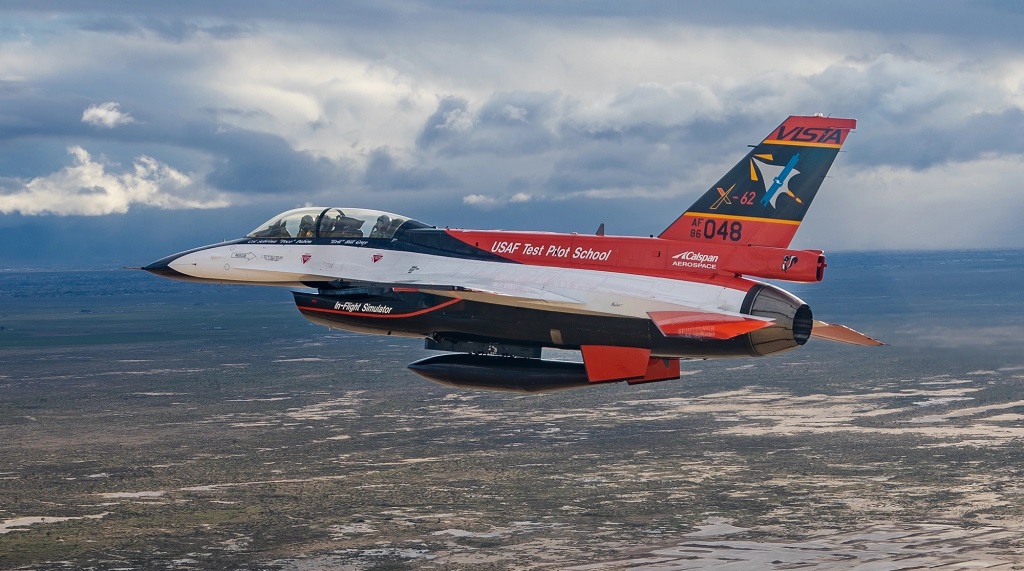
The X-62 VISTA basks in the Mojave sun before embarking on several test flights supporting HAVE HEAT and HAVE HOLIDAYS for the Air Force Test Pilot School and industry partners at Edwards Air Force Base, California, April 22, 2026. | Source: U.S. Air Force Photo by Lindsey Iniguez

In its press release, Lockheed Martin explained that the X-62 tracked a live T-38 Talon, feeding the IRST data to the AI agent that autonomously piloted the fighter into a tactical intercept position. The company further explained that Skunk Works’ “Supermassive” AI agent generation capability, whose full integration and ground test occurred in just three months, dramatically improved speed and agility.
“Our ongoing partnership with TPS is driving important progress with this latest flight test series demonstrating that our AI can effectively and reliably close the sensor‑to‑action loop aboard an operational combat aircraft,” said Ron Fehlen, vice president and general manager, Lockheed Martin Skunk Works. “Our autonomous agents consumed classified infrared search and track feeds and executed combat‑critical maneuvers in real time. This achievement marks a decisive advance toward delivering AI‑augmented air dominance for the United States.”
NEWS: X-62 VISTA continues setting precedents, demonstrates ability of #AI agents to ingest live infrared sensor data to #autonomously intercept live airborne targets. #AFMC #TRMC
Learn more about the next phase of X-62- https://t.co/LotIBlJFmq@HQ_AFMC @LockheedMartin pic.twitter.com/WOCen8e99N
— Edwards Air Force Base (@EdwardsAFB) August 4, 2026
HAVE HOLIDAYS
The service described HAVE HOLIDAYS as a parallel program to HAVE HEAT. The program included simultaneous integration and evaluation of a wide suite of modular technologies into the X-62’s Enterprise Open Mission System Architecture computer.
Among these technologies were the integration of a non-prime, third-party autonomous agent onto the X-62, testing of enhanced safety rules to prevent autonomous vehicles from violating user-established operational limits, and further chip integration for advanced sensor exploitation.
The X-62A VISTA flies in the skies above Edwards Air Force Base, California, April 30, 2024. | Source: U.S. Air Force Photo By Richard Gonzales

The Air Force explained that “this system-of-systems test served as critical technical risk mitigation on the design and development of logistics and integration frameworks required to maximize flight opportunities post-MSU, paving the way for broader government, academic, and industry partnerships.”
Next steps
The service said in its statement that the next step of the Mission Systems Upgrades (MSU) will feature the integration of the RTX PhantomStrike radar and an unspecified modern network data communications. The integration of this AESA (Active Electronically Scanned Array) radar was first announced in December 2025.
“X-62 is continued proof that an agile, dedicated team can rapidly advance Department of War initiatives through intentional collaboration. Accomplishing these significant milestones is a direct reflection of the adaptability and warfighter focus personified by all members of the school,” says Col. Maryann Karlen, commandant, U.S. Air Force Test Pilot School.
The Air Force further explains that using the X-62 “provides consistency for continued national investment in human-machine teaming without sacrificing safety or human contributions to the AI models developed.” Additionally, “the completion of the MSU effort will position X-62 as a foundational enabler for the Air Force’s highest-priority programs.”
The X-62 Variable In-Flight Stability Test Aircraft (VISTA) flies in the skies over Edwards Air Force Base, California, March 23, 2023. | Source: U.S. Air Force photo by Ethan Wagner
Similarly, Lockheed Martin says “the X-62’s Mission Systems Upgrade will enable the aircraft to demonstrate seamless integration of combat systems, sensors and airborne AI agents within a next‑generation mesh network.”
X-62 MSU
The Mission Systems Upgrade (MSU) builds on DARPA’s Air Combat Evolution program, which resulted in the first-ever human versus AI dogfight in 2023. The next phase of the testing will evaluate integration of combat systems and collaboration with airborne agents in increasingly complex environments.
Specifically, the incorporation of advanced radar and sensor integration will allow to fly the aircraft into more complex scenarios and will evaluate AI systems integration, collaboration, and make decisions in real time, explains the service.
The first mention of the radar upgrade for the X-62 came in August 2024, when the service released a Request for Information (RFI) for a potential radar upgrade on the X-62. Specifically, the radar was described as “part of a set of modular components that can be used individually or together to provide sensory input to aircraft.”
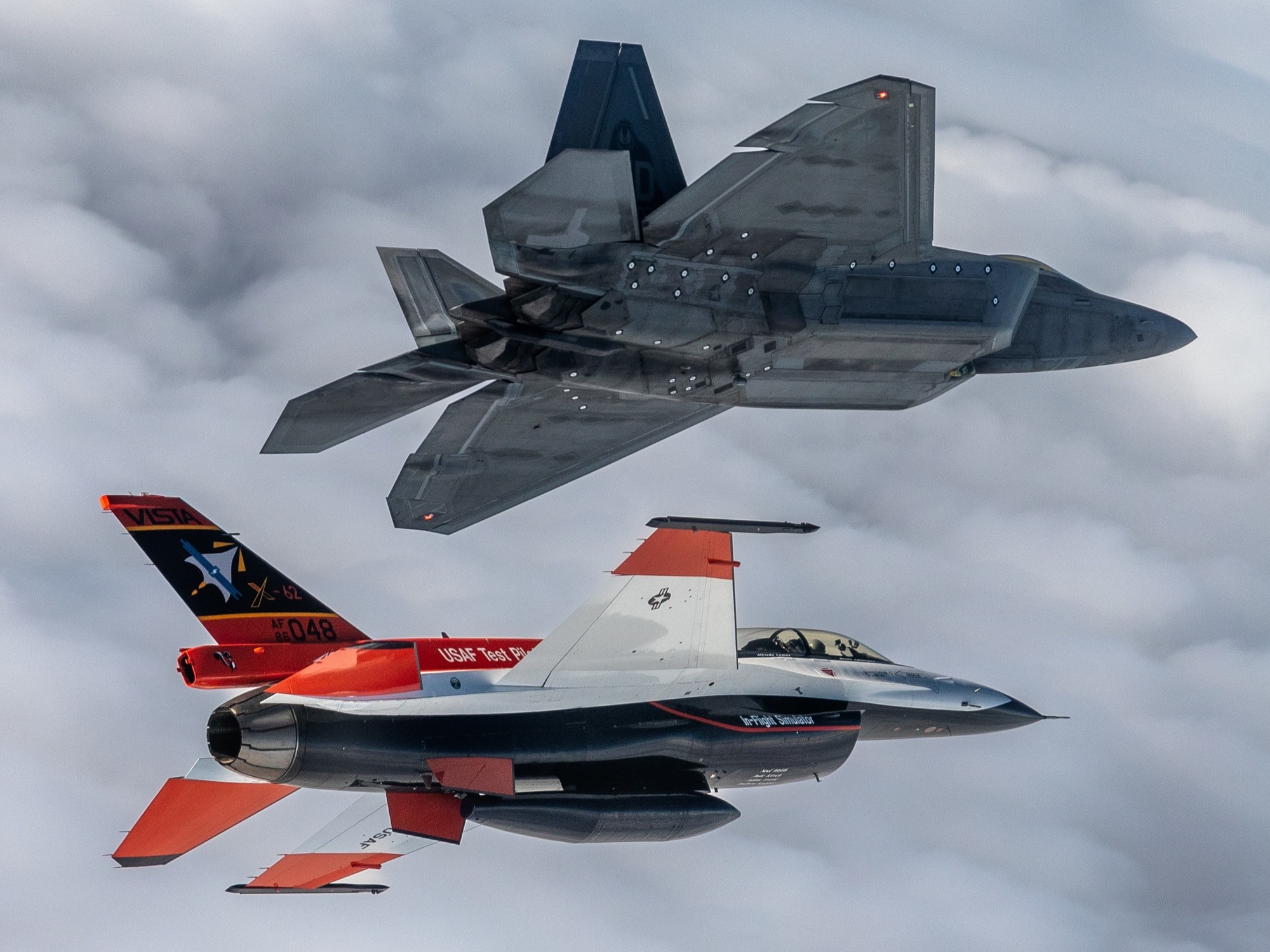
The landmark X-62 VISTA artificial intelligence and autonomy testbed is receiving a variety of mission system upgrades thanks to investments by the Test Resource Management Center (TRMC). | Source: U.S. Air Force photo by Lindsey Iniguez
The RFI also mentioned the goal of having the autonomy agents control and use the radar: “the aircraft will be capable of processing raw data from the AESA radar in an autonomy enclave that can use machine learning to process the data and directly control the sensors using either the existing modes available via the radar OFP or via experimental modes and experimental combinations of modes inaccessible or unachievable by human use.”
Among the requirements are air cooling, weight less than 200 lb, AESA technology “that can operated in an unclassified mode,” air-to-air and air-to-ground modes and startup time less than 2 minutes. In December 2025, RTX announced the selection of its PhantomStrike radar, whose weight is below 150 lb and is powered by air-cooled gallium nitride (GaN) technology.