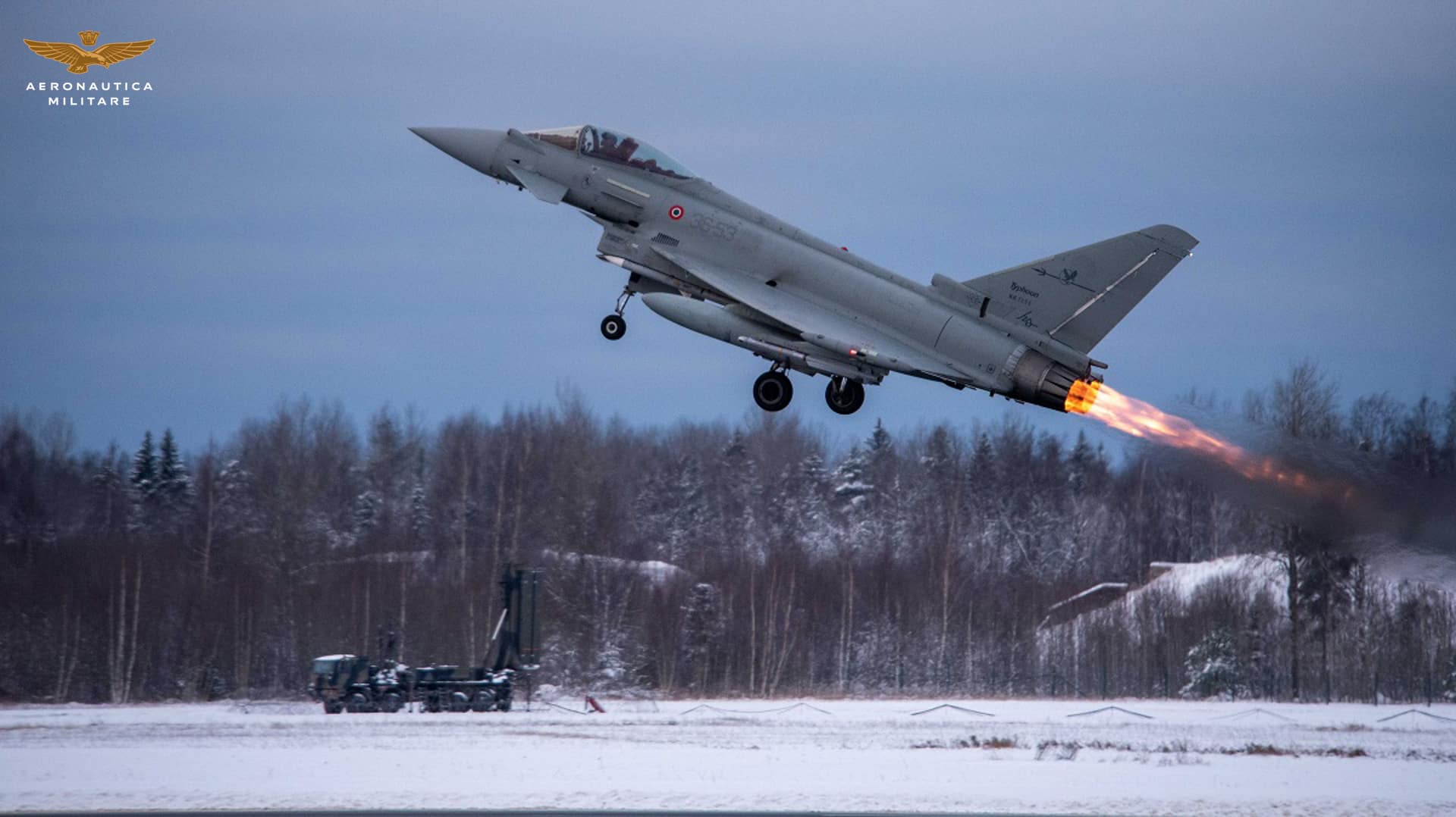
Italian Typhoon Shoots Down Drone Over Latvia
An Italian F-2000 Typhoon assigned to the NATO Baltic Air Policing mission shot down an unidentified drone which entered Latvia’s airspace.
An F-2000A Typhoon (as the single seater Typhoons are designated in Italy in accordance with the MOD’s Mission Design Series) of the Italian Air Force has shot down an unidentified which entered Latvia’s airspace in the morning of Aug. 14, 2026. The aircraft, operating as part of NATO’s Baltic Air Policing (BAP) mission, was scrambled from Šiauliai Air Base, Lithuania, together with another Typhoon, as well as two Turkish F-16s from Ämari Air Base, Estonia.
The Italian fighter jets, assigned to the the Task Force Air “Baltic Thunder III,” were controlled by NATO’s Combined Air Operations Centre (CAOC) in Uedem, Germany. Their deployment started on July 31, with the first scramble few days later, on Aug. 3.
The Latvian Ministry of Defense said this was “a foreign unmanned aerial vehicle that had entered Latvia as a result of Russian electromagnetic warfare,” without identifying the nationality. The Latvian Armed Forces issued an alert for the population to shelter in place until the threat was removed.
Earlier today, two Italian Eurofighters from Šiauliai Air Base, Lithuania, and two Turkish F-16 fighter jets from Ämari Air Base, Estonia, on Air Defence missions over the Baltics, scrambled after an unidentified drone entered Latvia’s airspace
After positive… pic.twitter.com/MJQOHeloCR
— NATO Air Command (@NATO_AIRCOM) August 14, 2026
NATO’s Air Command said that, after the positive identification, the drone was shot down over an unpopulated area. Latvia later identified the area as the Balvi Municipality, located in the north-east of the country and bordering the Russia’s Pskov Oblast.
Due Eurofighter F-2000 della Task Force Air “Baltic Thunder III” dell’#AeronauticaMilitare, impegnati nella missione #NATO di difesa aerea sul fianco orientale dell’Alleanza, sono decollati in scramble dopo la violazione dello spazio aereo lettone da parte di un drone.
Gli… pic.twitter.com/Dyl17pIEh0
— Ministero Difesa (@MinisteroDifesa) August 14, 2026
The incident happened in the early morning hours, as the Latvian MoD said the alert ended at 4:50 local time. No other details have been provided at the time of writing.
In Latvian airspace, in Balvi Municipality, NATO Baltic Air Policing fighter jets have successfully shot down a foreign unmanned aerial vehicle that had entered Latvia as a result of russian electromagnetic warfare.
At the same time, the National Armed Forces informed that the… https://t.co/HWa1EHNy41
— Ministry of Defence of Latvia (@MoD_Latvia) August 14, 2026
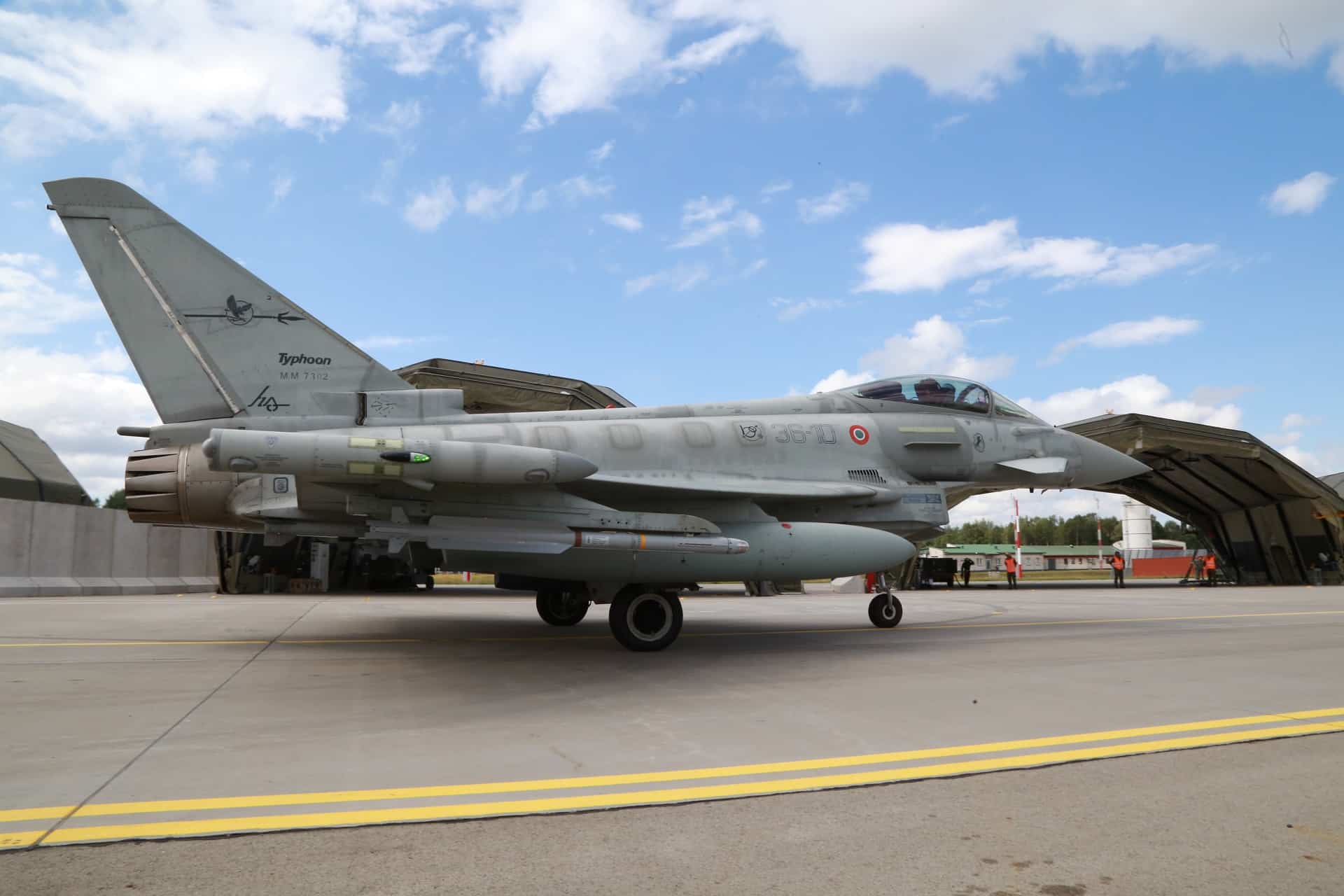
Additionally, this would be the first time that an Italian Typhoon opened fire during an interception as part of a NATO mission. It is unclear which weapon was used, although the Italian fighters usually fly during Quick Reaction Alert (QRA) missions with two AIM-120 AMRAAM radar-guided missiles and two AIM-2000 IRIS-T IR-guided missiles, in addition to the 27 mm Mauser BK-27 cannon with up to 150 rounds.
Similar incidents recently
The incident in Latvia comes amid a growing number of drone incursions into NATO airspace along the Alliance’s eastern flank. French Rafales already shot down a drone over Latvia in June 2026, again near the border after electronic warfare caused the drone to go off course.
One of the most significant recent examples occurred in Romania in late July. The country recorded drone incursions on four consecutive days amid a series of Russian attacks against Ukrainian targets near the Danube river.
File photo of an Italian Eurofighter F-2000A Typhoon assigned to the Baltic Air Policing mission. | Source: Italian Air Force
On July 24, a Romanian F-16 shot down a Shahed-type drone that had entered Romanian airspace. The following day, another drone was intercepted and destroyed, while on July 26 a third drone was shot down by an F-16 approximately 12 km northeast of Sulina, over Romanian territorial waters.
On July 27, a fourth drone briefly entered Romanian airspace east of Sulina, prompting another scramble of two F-16s. This time, however, the aircraft crossed back into Ukraine before it could be intercepted.
The sequence was particularly notable because Romania had previously relied primarily on monitoring and warning measures despite repeated violations, before its F-16s were authorized to destroy the intruding drones. NATO fighters, including Italian Typhoons, were also involved in the interceptions, although the Romanians F-16s were the ones who opened fire.
The Romanian incidents were followed by further drone activity in the region. More recently, on Aug. 11, two unidentified Gerbera-type drones were destroyed near the Neptun Deep offshore gas project in the Black Sea.