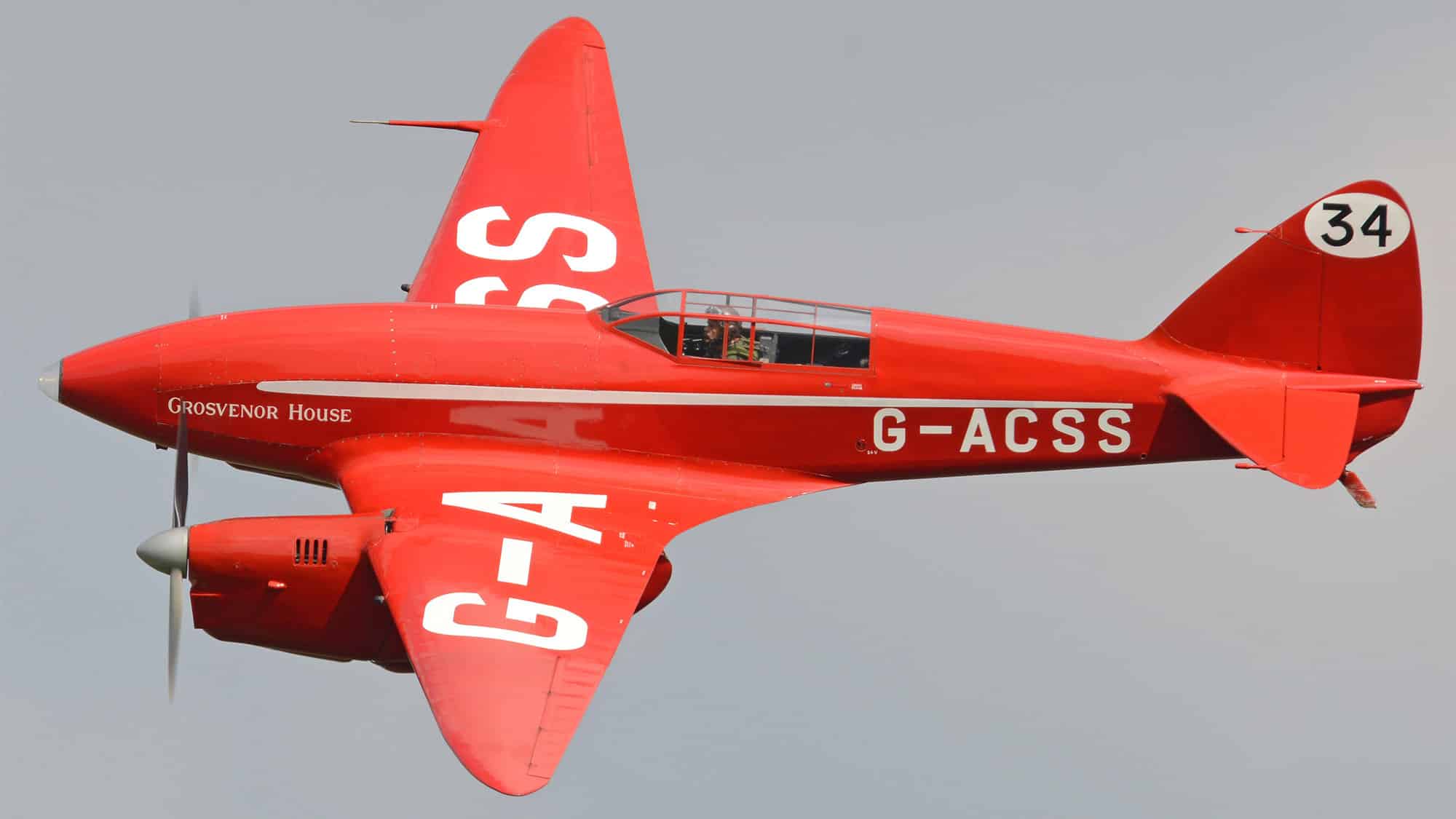
Iconic Shuttleworth DH.88 Comet Racer Damaged After Landing Incident
The only airworthy example of an original de Havilland DH.88 Comet nosed-over while landing following a display at Shuttleworth’s Flying Proms. The pilot was quickly extracted, and has since been discharged from hospital after medical checks.
G-ACSS, named Grosvenor House, is a staple of the Shuttleworth Collection’s yearly program of flying displays at Old Warden, Bedfordshire. Painted in its original striking red livery, the aircraft is famous for having won the MacRobertson Air Race in October 1934, completing the England-Australia route in just 70 hours, 55 minutes – 19 hours ahead of the Douglas DC-2 that took second place.
Following yesterday’s incident at our Flying Proms Air Show (15.08.2026), we can confirm that the crew member involved has been discharged from hospital. pic.twitter.com/KdmNZZeAhd
— Shuttleworth (@ShuttleworthTru) August 16, 2026
After displaying for the Shuttleworth Flying Proms event on Aug. 15, 2026, the notoriously difficult to land de Havilland racer nosed-over on the grass airfield and came to rest upside down. While the extent of the damage has yet to be assessed, the aircraft’s tail can be seen to have taken a substantial hit, with the horizontal stabilizers now visibly out of alignment with the fuselage.
Just heard the Shuttleworth Comet G-ACSS has nosed over on landing, possibly heavy braking. pic.twitter.com/XVMfosQveK
— David Leggett (@updowndave) August 15, 2026
Nosing-over is a well known risk for aircraft with a taildragger landing gear configuration. With the centre of gravity so finely balanced, even slight miscalculations with breaking can see the aircraft pivot forward on its main landing gear and strike its nose on the ground. With enough momentum, this can lead to the aircraft completely flipping over.
The Comet’s long nose, low-set cockpit, and twin engines (mounted above and forward of the main landing gear), mean that it can be particularly difficult to land. In fact, as a machine designed purely for air racing speed, the Comet in general was a hard aircraft for pilots to master, intended primarily as a product of prestige and intended to be flown in small numbers by few pilots.
Countdown #10 for the @ShuttleworthTru 2021 Season on DVD/Blu-ray/Vimeo stream available later this month. A clip of the Collections famous DH88 Comet racer with headcam footage courtesy of Shuttleworth Chief Engineer and pilot Jean Munn. pic.twitter.com/Q2rgTL4BPC
— Peter Baughan (@harrierdigital) January 8, 2022
Drawn up by de Havilland chief designer Arthur Ernest Hagg, the Comet was the first British aircraft to follow the formula of then-modern high performance aircraft. The fuselage incorporated stressed-skin, the landing gear was fully retractable, and the cockpit was completely enclosed – all features that were pivotal for providing the aerodynamic shape necessary for its 237 mile per hour maximum speed and near-3,000 mile range. It completed its first test flight only six weeks prior to the air race beginning.
Grosvenor House was restored to airworthy condition beginning in 1972, an effort that took until 1987 to complete. It was the first time G-ACSS had flown in almost 50 years. Four other Comets were produced, though all but one of these have not survived.
Did you know that our 1934 DH88 Comet G-ACSS was alleged to be involved in a plot to assassinate Hitler?
Read all about it in our latest blog https://t.co/1ld7QJnAI3
by Wayne Allen Photography pic.twitter.com/o8jSlqD2Qd
— Shuttleworth (@ShuttleworthTru) January 18, 2023
The sole remaining example other than Grosvenor House is G-ACSP, or Black Magic. Black Magic was the first Comet to be built, though it failed to complete the race after suffering engine issues. It was sold to Portugal in anticipation of a Lisbon-Rio de Janeiro flight but this was thwarted after it was damaged during takeoff. Black Magic, known as Salazar in Portugal, was subsequently lost for over four decades before being rediscovered and returned to the UK where it is undergoing a long, careful restoration to flight.
Though the damage to Grosvenor House is certain to see it out of commission for an extended period, there is still hope that one day in the near future the UK’s display circuit will be graced by both of these incredible flying machines.
The Comet name would later be reused by de Havilland for the world’s first jet airliner, which set multiple records in its own right before being developed into the Nimrod, serving with the Royal Air Force until 2011.