U.S. Navy Reveals AIM-424 “Malice” Long-Range Air-to-Air Missile
The U.S. Navy has publicly revealed a previously little-known next-generation air-to-air missile: the AIM-424 LRAAM (Long-Range Air-to-Air Missile), officially named “Malice.”
The new missile was announced at the Tailhook Symposium held in Reno, Nevada on Aug. 22, 2026, and was first reported by The Aviation Week. The weapon then appeared on the Navy’s official Fact Files website on the same day, providing the first official glimpse of the missile intended to give U.S. Navy and U.S. Marine Corps (USMC) aviators an increase in their air-to-air engagement ranges.
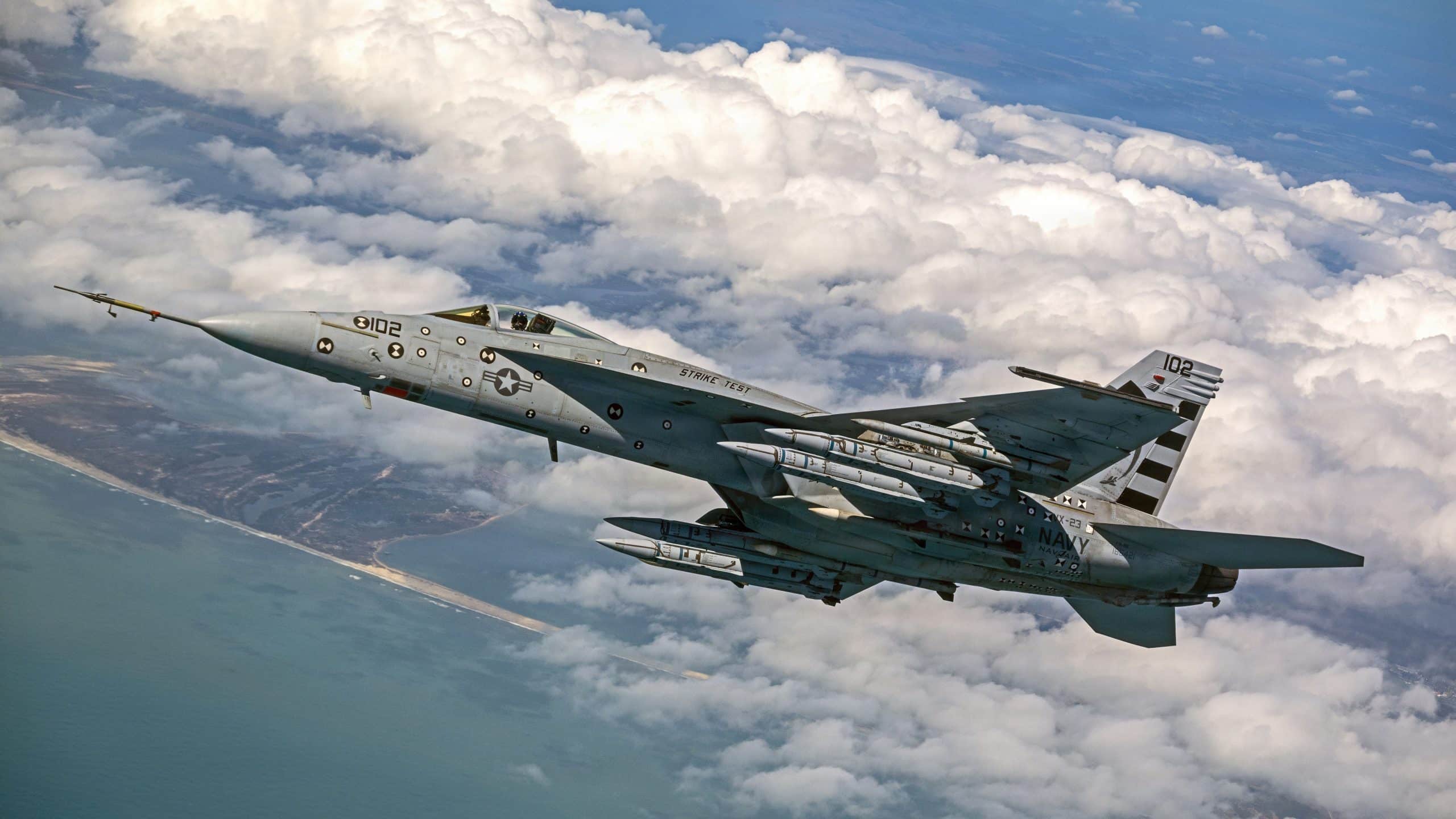
Photos of F/A-18Es and F-35Cs belonging to Air Test and Evaluation Squadron 23 (VX-23) carrying the new munition appeared on DVIDS (Digital Visual Information System) that same day. Of the two images, the one featuring a Strike Test F/A-18E in flight, which shows the jet carrying four CATM-424s (Captive Air Training Missile, identifiable by the blue lines on the missile’s fuselage) on Stations 3, 4, 8, and 9, and four CATM-120s on Stations 2, 5, 7 and 10, was taken in Apr. 2026.
The other, which shows the missile in the weapons bay of the F-35C Lightning II along with an AMRAAM (Advanced Medium Range Air-to-Air Missile) mounted on the bay door, was taken earlier this month.
A close-up of the CATM-424s installed on the F/A-18E. | Source: U.S. Navy

The Navy’s Long-Range Air-to-Air Missiles
According to the Navy, the LRAAM is being developed “to strengthen fleet defense and maintain a decisive air domain overmatch against advanced threats”. The missile, which is developed by Raytheon, is expected to arm the Navy’s F/A-18E/F Super Hornets, F-35C Lightning II, and future F/A-XX once operational.
The AIM-424 is the latest in a string of new air-to-air missiles developed by the US Navy, including the AIM-174B Gunslinger, which was first seen operationally in Jul. 2024, and the AIM-260 JATM (Joint Advanced Tactical Missile), which was captured in flight for the first time in May. 2026.
A U.S. Navy F/A-18F assigned to Air Test and Evaluation Squadron (VX) 9, flies over the Point Mugu Sea Range in Southern California during Gray Flag 2024 on Sept. 24, 2024. | Source: U.S. Navy photo by Lt. Cmdr. Kory Hughs edited by The Aviationist
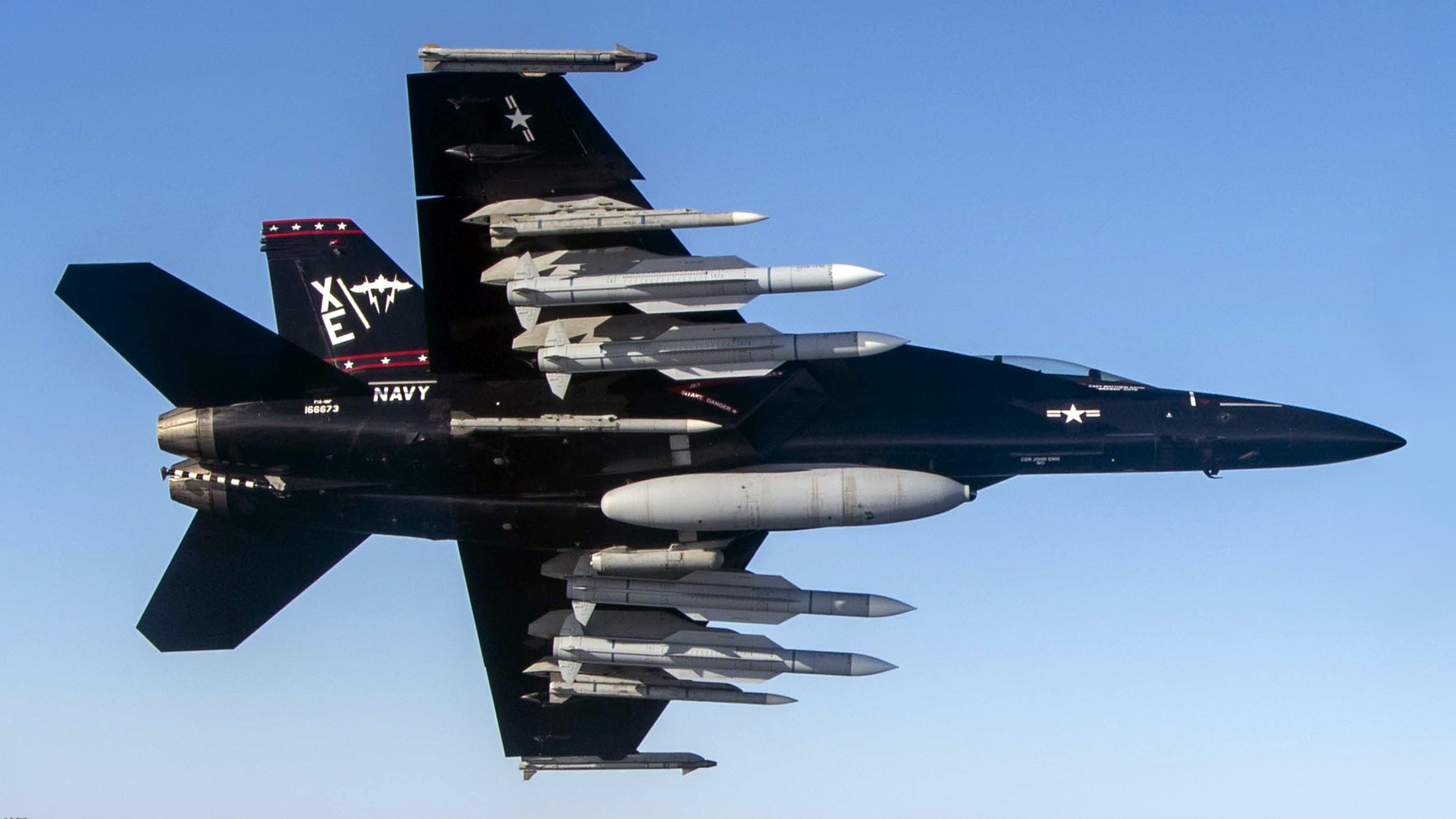
The Malice is slightly shorter than the Gunslinger, with the officially acknowledged length of 13.5 feet (or 4.11 meters) compared to the Gunslinger’s 16.5 feet (or 5.03 meters) according to the Navy’s Fact Files. The two missiles share a diameter of 13.5 inches (or 0.34 meters), but the AIM-174B’s wingspan is much larger at 42.7 inches (1.08 meters) to the AIM-424’s 26.2 inches (0.67 meters), due to the large ‘dorsal fins’ on the former.
The Gunslinger’s large wingspan puts forward a significant issue in terms of operational capability; it is confirmed to be capable of being carried and launched only by the F/A-18E/F, and is unable to be carried internally by the Navy’s stealthier F-35C. The Malice, on the other hand, is already confirmed to be able to fit within the jet’s internal weapons bays.
An AIM-424 Long Range Air-to-Air Missile (LRAAM) is mounted in the internal weapons bay of an F-35C with an AIM-120 Advanced Medium Range Air-to-Air Missile (AMRAAM) mounted on the weapon bay door. | Source: U.S. Navy

Nonetheless, both missiles have a significant acknowledged range; the Navy’s Fact Files lists the AIM-424’s range as “in excess of 250 nautical miles” or 463 km, and the AIM-174B is also expected to have an operational range of over 200 nautical miles. The Aviation Week reports that the new munition is a two-stage missile – and the missile seems to feature an inlet for a solid-fuel dual-mode ramjet – which implies the munition is capable of flying at very high speeds across a very large distance.
It is currently unclear whether the Malice will replace the Gunslinger entirely, or serve alongside it for the foreseeable future. The Navy has never confirmed whether the AIM-174 represented an interim capability until the deployment of a new, more advanced weapon.
It is also unclear whether the U.S. Air Force (USAF) will also induct the new missile into service, as it has done with several munitions developed by the Navy in the past – including the AIM-9 Sidewinder, AIM-7 Sparrow, AGM-84 Harpoon, and AGM-88 HARM. It is important to note that the USAF is also actively looking to design and field a VLRAAM (Very Long Range Air-to-Air Missile) for themselves.
The long-range nature of these missiles in part helps to counter the increasingly longer-range air-to-air missiles fielded by potential adversaries – including Russia’s R-37M, which has seen extensive use in the invasion of Ukraine, the PLA’s (People’s Liberation Army) PL-15, made infamous in the May 2025 skirmish between Pakistan and India, and the more secretive PL-16 and PL-17. However, the AIM-424 provides the U.S. Navy the ability to employ such a long-range missile from the internal weapons bays of a stealth fighter, something the PLA is yet to achieve – at least publicly.
Although the capabilities of the large missiles aren’t clear when it comes to engaging hostile fighters over long distances, they will certainly be effective in targeting high-value targets including the likes of AEW&C (Airborne Early Warning and Control), EW (Electronic Warfare), and ISR (Intelligence, Surveillance, and Reconnaissance) aircraft in the early phases of a potential conflict.