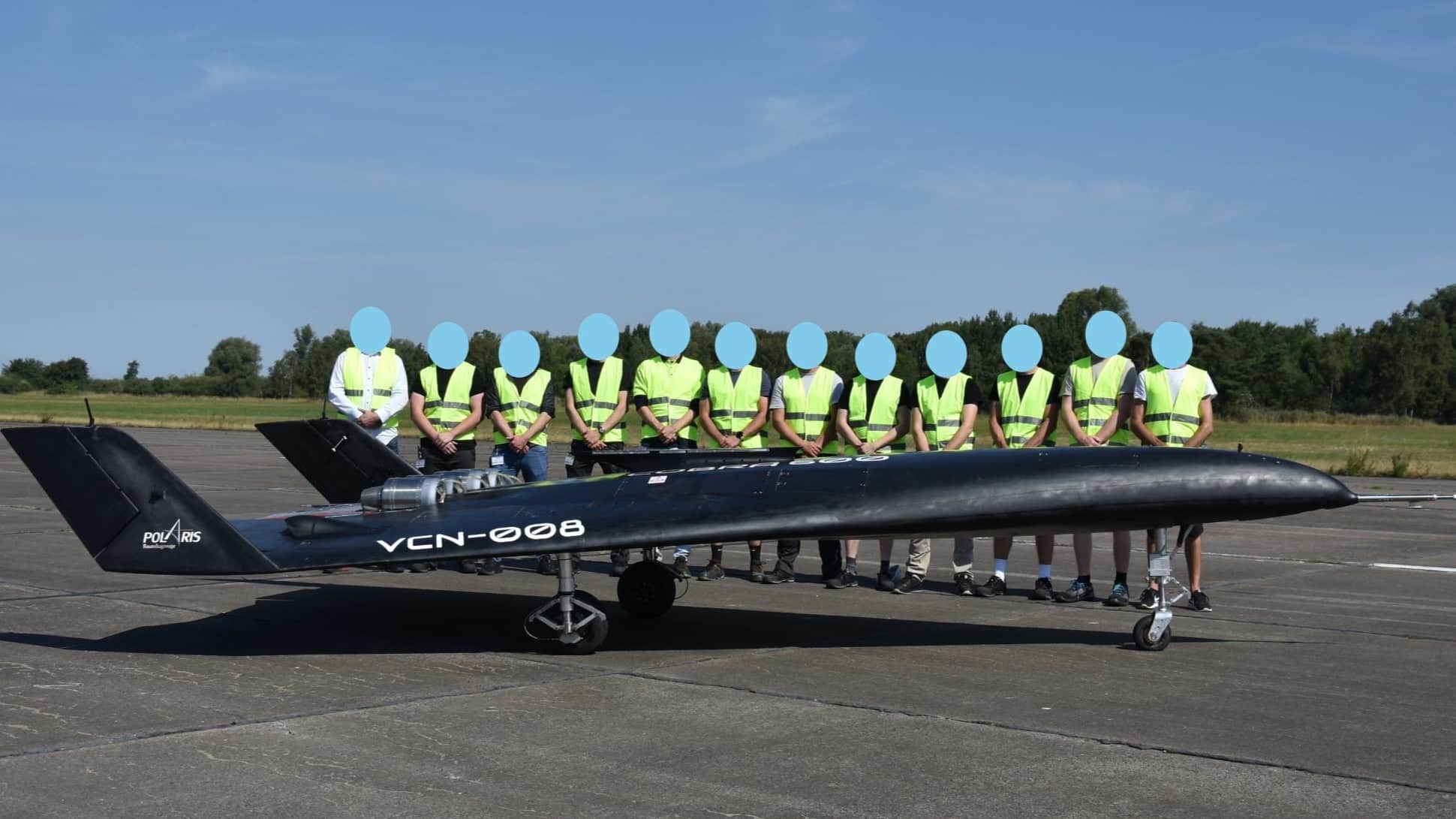
Cobra 600 Air Defense Drone Completes First Flight
Unveiled at the recent ILA Berlin air show, the Cobra 600 is a jet-powered uncrewed aircraft developed by Polaris to carry and launch a Diehl Defense IRIS-T air-to-air missile.
The prototype for Diehl Defense’s Cobra 600 drone-based air defense system has made its first flight, the German aerospace startup Polaris Raumflugzeuge announced on Aug. 22, 2026. Polaris, which is developing the small flying-wing aircraft, said the “perfectly smooth first flight covered a distance of 20 km,” with more trials planned in the coming months.
Unveiled at the recent ILA Berlin airshow under the Airborne Launching and Attack System (AirLAS) program, the Cobra 600 envisages a jet-powered drone carrying Diehl Defense’s IRIS-T air-to-air missile (AAM) on a top-mounted rail launcher. The base platform from which the Cobra 600 is being developed is Polaris’ MIRA III demonstrator
Polaris is also the same company developing Germany’s reusable hypersonic vehicle program, under contract from the Federal Office of Bundeswehr Equipment, Information Technology, and In-Service Support (BAAINBw). As part of the Hypersonic Test and Experimentation Vehicle (HYTEV) program, the company has been testing the small-scale demonstrator MIRA II with a linear aerospike engine in support of a larger demonstrator that will fly by 2027.
Cobra 600 test flight
The image released by Polaris showed the MIRA III with the pylon which will carry the IRIS-T missile on top of the aircraft. The drone is shown with four small jet engines, which in earlier close-up photographs from ILA Berlin were identified as JetCat P1000-PRO micro turbojets, although on that occasion only two engines were installed instead of the four of the final version.
Diehl Defence showcased Cobra 600 unmanned aerial vehicle (UAV) armed with its air-to-air missile at ILA Berlin Airshow 2026. @DiehlDefence
The Cobra 600 drone on display was equipped with a missile rail, on top of the fuselage, armed with Diehl Defence’s IRIS-T air-to-air… pic.twitter.com/kcWgdPEl9n
— DefPost (@defpostmedia) June 11, 2026
Other concept illustrations from Polaris also showed the MIRA II with the IRIS-T on top. The MIRA II has four large protruding air inlets above the wing’s leading edge.
The four-engine MIRA III configuration appears better suited to carrying the IRIS-T’s roughly 85 kg weight. It should be noted that the Cobra 600 is not the first drone to carry an air-to-air missile on top, as Russian Geran-type One-Way Attack (OWA) drones emerged in Ukraine with R-60 AAMs and Man-Portable Air Defense Systems (MANPADS) mounted on top.
Video of a Russian Shahed / Geran-2 OWA UAV equipped with an R-60 air-to-air missile downed by the 412th Nemesis Brigade’s Darknode battalion with a Sting interceptor from @wilendhornets. https://t.co/QkWH79sXfHhttps://t.co/w3BS2MaRwq pic.twitter.com/f6VE4uNmu2
— Rob Lee (@RALee85) December 1, 2025
Polaris further said in its statement: “With a take-off mass of less than 600 kg, COBRA is a light uncrewed aircraft that POLARIS is developing in cooperation with Diehl Defence within the joint AirLAS project (Airborne Launching and Attack System). COBRA is primarily designed to carry and launch IRIS-T air-to-air missiles for air defence missions.”
Operational concept
The operational concept for the Cobra 600 has not been disclosed by Polaris or Diehl Defense. The system is nevertheless being developed around the idea of using an inexpensive uncrewed aircraft to carry an IRIS-T air-to-air missile, potentially providing an additional layer of protection against aerial threats.
The concept has some parallels with recent Russian experiments involving Geran-series one-way attack UAVs equipped with air-to-air missiles or MANPADS. These systems have demonstrated how relatively inexpensive unmanned aircraft can be adapted to engage other aerial targets, although the capabilities and intended roles of the Russian systems differ from those of Cobra 600.
And another mesh network-enabled air-to-air variant of the Geran-2. This time with a MANPAD. pic.twitter.com/7MQDKCyoZG
— Fabian Hinz (@fab_hinz) January 4, 2026
It is not known whether the operational system will carry its own electro-optical or infrared sensors, or whether targeting information will instead be provided by external platforms and ground-based air-defense networks and counter-drone systems. The latter approach could allow the relatively simple drone to operate as a distributed interceptor within a wider integrated air-defense architecture.