F-22 Raptor Spotted Again With Stealth Pods and Unusually Colored Underside
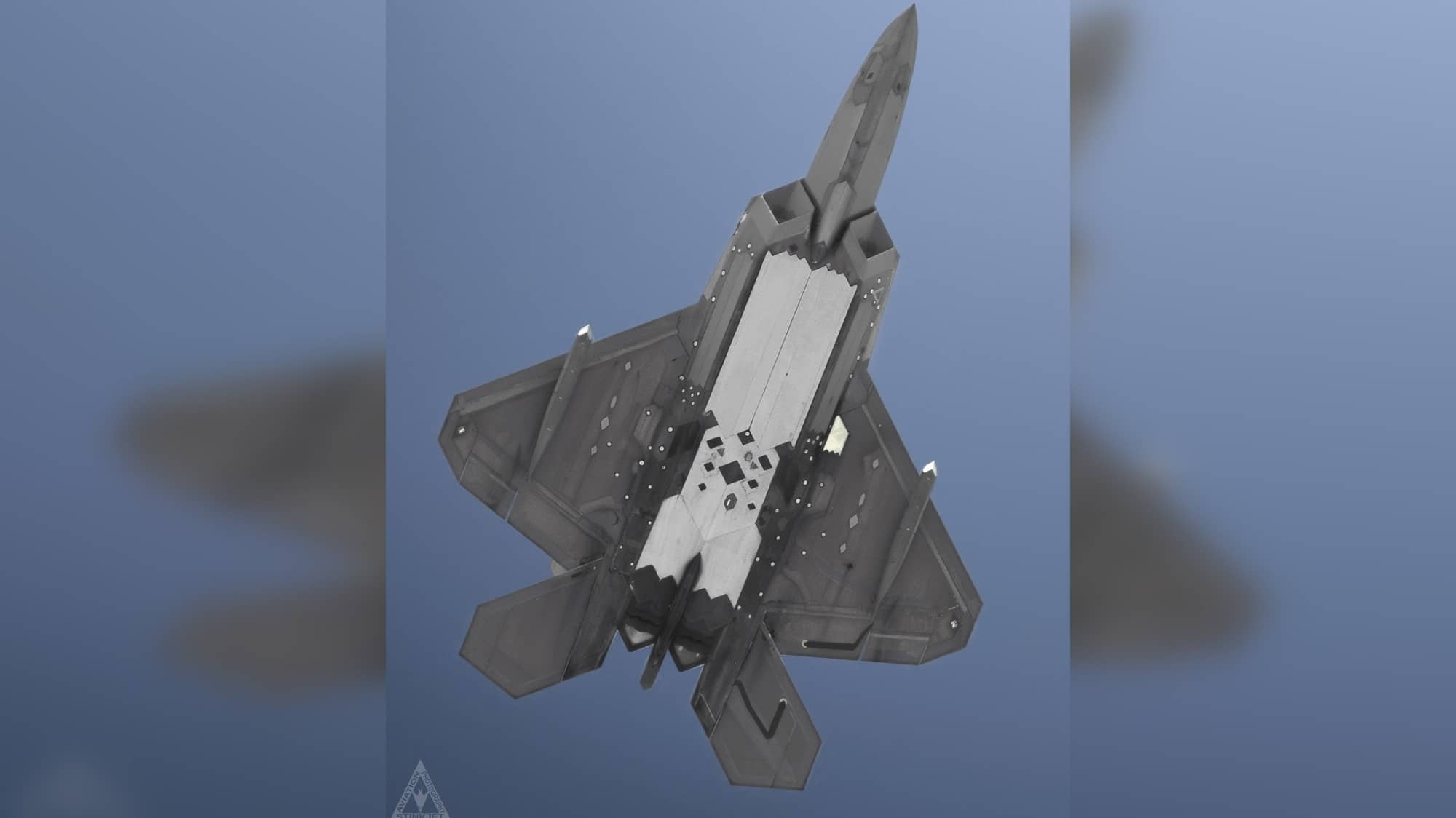
New photos provide another look at an F-22A Raptor carrying the external sensor pods, while also revealing distinctive light-colored panels on the aircraft’s underside.
Newly emerged photos provide another look at an F-22A Raptor carrying the external sensor pods which are currently being developed for the stealth fighter. Interestingly, distinctive light-colored panels can be seen on the aircraft’s underside, although their function is unknown.
The photos which you can see in this article were shared with us by our friend and contributor @stinkjet, who shared them on social media on Sept. 19, 2026. The F-22, callsign “FEVER21,” was flying over the Aerospace Valley of California at the time.
The F-22 was later spotted, accompanied by an F-16 Fighting Falcon, while refueling from the NKC-135 tanker “GHOST81.” The specialized tanker, assigned to Edwards Air Force Base, California, is modified with equipment that allows it to support test and evaluation activities.
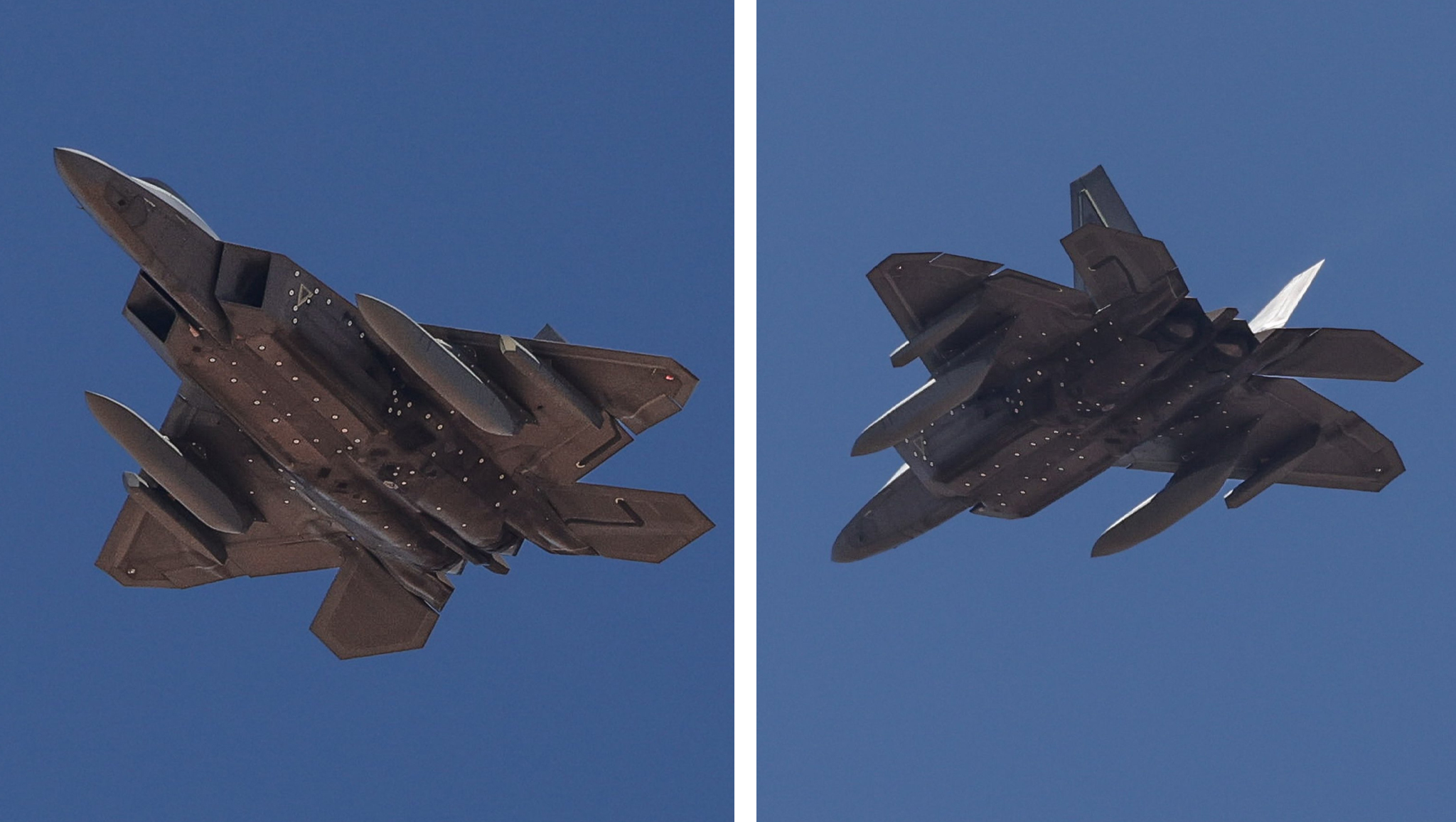
The Raptor can be seen with the two pods installed beneath its outer wing stations. This is possibly the best view of the pods on the F-22 since their appearance in March 2026 alongside the new stealth external fuel tanks.
The equipment has previously been associated with the development of an infrared search and track (IRST) capability for the F-22, although the exact configuration and purpose of the individual pods have not been publicly disclosed. At least one of the pods appeared to feature a transparent section at its forward end, consistent with an infrared or other optical sensor.
The photos are particularly interesting because of the appearance of the aircraft’s underside panels. Their light coloration is clearly visible in some of the images, but it is not possible to determine from the photographs alone whether they represent a new coating, temporary test instrumentation, or another modification.
An IRST Capability for the Raptor
The F-22 was originally designed with provisions for an integrated Infrared Search and Track System (IRST), but the capability was removed during development as a result of budget constraints. The production aircraft thus does not have an equivalent to the F-35 Lightning II’s integrated Electro-Optical Targeting System (EOTS), which also limited the Raptor’s air-to-ground capability to GPS-guided munitions only.
The F-22 Raptor captured in March 2026 with both the pods and the new stealth external fuel tanks. | Source: Jarod Hamilton/jmh.creates
Integrating an EOTS-like solution is however not feasible for a host of reasons, starting from the heavy and expensive modifications required by the airframe. The external pod solution thus appears to offer a way to introduce new sensing capabilities without undertaking the extensive structural modifications that would be required to install a new internal sensor.
The addition of a passive optical sensing capability would represent a significant enhancement to the F-22’s ability to detect and track airborne targets, complementing the AN/APG-77 radar. Being a passive system, the IRST has also the advantage of not alerting an adversary of a target lock, contrary to the radar which can be picked up by a Radar Warning Receiver (RWR).
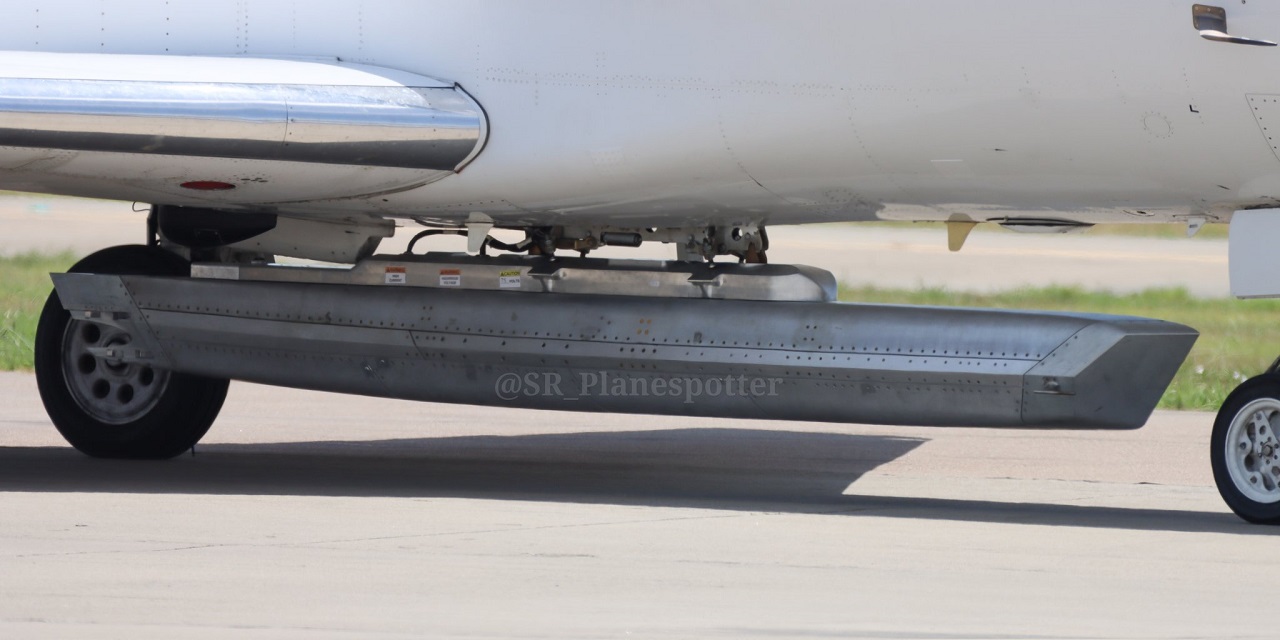
The new pods have been spotted during flight testing on an F-22 at the Air Force’s since February 2022. They also made an appearance under the fuselage of a Rockwell Sabreliner 65 used as airborne testbed.
Budget documents mention an InfraRed Search and Track (IRST) sensor being developed for the F-22, which could be the sensor housed inside the two pods, although they could host also other capabilities in addition to the IRST. Among these could be electronic warfare (EW) capabilities or even networking for collaborative combat aircraft (CCA).
A close-up of the stealthy pod installed under the Rockwell Sabreliner 65 airborne testbed. | Source: @SR_Planespotter
The Raptor’s Light-Colored Underside
Another particularly interesting detail visible in the new imagery is the markedly lighter appearance of portions of the F-22’s underside, specifically the weapons bays’ doors and engines’ underside. The apparent difference in surface finish is sufficiently pronounced to raise questions about whether these areas have been modified.
One possibility is that the aircraft is carrying replacement or temporary panels associated with the ongoing flight-test campaign. However, the positioning and extent of the lighter areas also make it worth considering whether they could be related to testing of new low-observable materials or surface treatments.
The F-22’s radar-absorbent material (RAM) system is an integral part of its low-observable characteristics. Even relatively small changes to the aircraft’s external materials can have implications for radar signature, maintainability and environmental durability.
In the past, the F-22 was spotted with a “mirror-like” coating, which was attributed to either RAM or IR testing, although it has never been officially confirmed. However, the new images shows notable differences compared to that coating, including the reflective surface and the pattern of tiles, which here appear to be absent.
At present, however there is no evidence to conclusively link the light-colored panels to a new round of testing on surface coatings.
Thanks again to our friend @StinkJet for allowing us to use the photos. Make sure to follow him on Instagram or X for more!