X-BAT Accelerating Toward First Flight with New Funding
New U.S. Navy funding and company investment bring the announced X-BAT investment to $400 million as Shield AI prepares the VTOL aircraft for flight testing later this year.
Shield AI’s X-BAT Vertical Take-Off and Landing (VTOL) drone now has reached a total investment of $400 million, ahead of a flight testing campaign scheduled to begin later this year, the company announced on Oct. 8, 2026. The development follows a new $150 million contract modification to an existing Other Transaction (OT) agreement from the Office of the Under Secretary of War for Acquisition and Sustainment through its Defense Exportability Features program.
This was preceded by $50 million in funding committed in August by the Department of the Navy’s Portfolio Acquisition Executive (PAE) Aviation Rapid Capability Cell (RCC), in partnership with the Defense Innovation Unit (DIU). At the time, “Shield AI [had] independently committed $50 million of private capital alongside that effort,” the company said.
A $150 million investment of Shield AI’s own capital brings the total funding for the program to $400 million. The company said it is rapidly accelerating the fighter-class drone’s testing to reduce risk.
https://t.co/S1poJPKlZi
— Shield AI (@shieldaitech) October 8, 2026
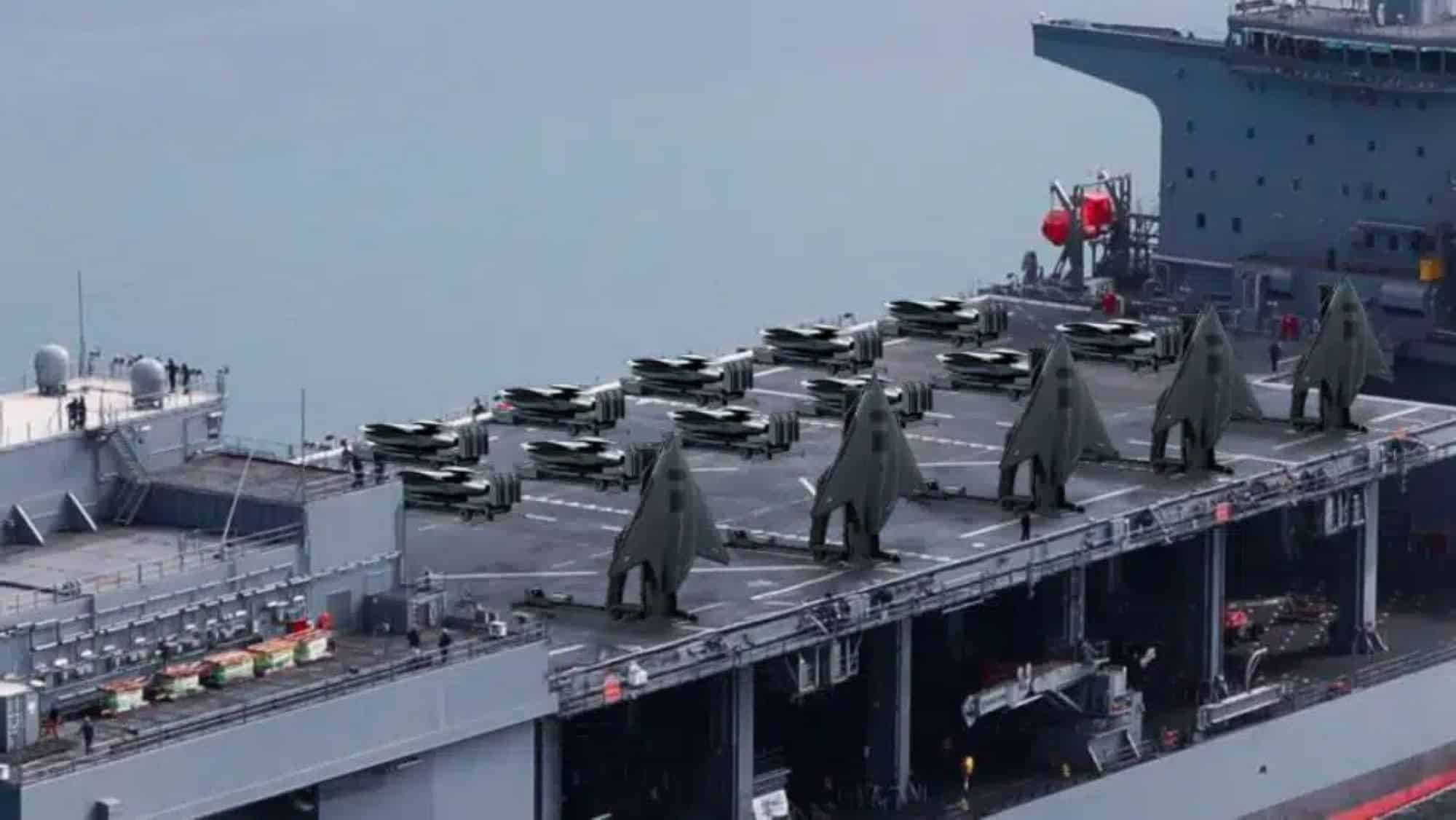
Together with the announcement, Shield AI has released a new rendering showing X-BAT aircraft deployed on an Expeditionary Sea Base (ESB) vessel. In August, the Navy’s PAE Aviation office said that, “to maintain maritime superiority, agility in acquisition is just as critical as the technology itself.”
Preparations towards first test flight
Shield AI also announced on Sept. 30 the selection of Newton, Kansas, and Des Moines, Washington, as sites for the X-BAT’s production, flight testing and sustainment. The two locations have been named X-Forge 2 and X-Forge 3, respectively.
“X-Forge 3 will be our first production site in the Puget Sound region, with plans to expand our footprint there as X-BAT production grows,” Shield AI said. X-Forge 2 in Newton will also “support development flight testing and serve as the center for maintenance, repair and overhaul (MRO) for the fleet.”
The Artificial Intelligence (AI)-powered stealth fighter-class drone is powered by a General Electric F110-GE-129 engine. Shield AI’s signature Hivemind autonomous flight software is planned to fly the drone in environments without Satellite Navigation (SATNAV) and communication links.
The F110-GE-129 has so far been tested with an Axisymmetric Vectoring Exhaust Nozzle (AVEN), while scale models of the X-BAT have undergone wind tunnel tests, wing structural stress trials and radar-cross section testing. Other videos released by the company have also shown its unique Launch and Recovery Vehicle for Tethered Flight (LRVTF) docking mechanism, developed for runway independent operation.
The X-BAT is expected to be pitched for the CCA program’s Increment 2 phase. Other contenders for this stage are expected to be Northrop Grumman’s YFQ-48 Talon Blue and Lockheed Martin’s Vectis.
Full release: https://t.co/gLurcVOAAC
— Shield AI (@shieldaitech) September 30, 2026
In its latest statement, Shield AI said the broader X-BAT program involves a team of 500 engineers at the company and key suppliers, including GE Aerospace, is building flight-test aircraft. “The team has completed engine light-off and thrust-vectoring nozzle integration and validated weapons bay aerodynamics in low- and high-speed wind-tunnel testing,” the release added.
Operations from CVNs, LHAs, LHDs and ESBs
As mentioned earlier, Shield AI’s latest press release also shows a graphic illustration of X-BATs carried on a U.S. Navy Expeditionary Sea Base (ESB)-class ship, with five aircraft on raised LRVTFs ready-to-launch. The ESB is also carrying eleven additional X-BATs with folded wings on lowered LRVTFs.
Previous concept art and videos by the company had shown the X-BAT being launched and recovered on remote islands, austere sites, the main decks of amphibious assault ships (LHDs/LHAs), aircraft carriers (CVN) and even helicopter decks of regular surface combatants.
Shield’s senior vice president of aircraft engineering Armor Harris said the company is “testing early and often while working on the aircraft, mission systems, ship suitability and production in parallel.” He further added: “That approach helps us identify and resolve issues earlier, reduce development risk and move more quickly toward flight testing.”
No runway, no problem.
Shield AI and @GE_Aerospace just cleared a critical path to vertical flight, completing engine light-off testing of the Axisymmetric Vectoring Exhaust Nozzle (AVEN) for X-BAT.
Engineers from both companies integrated the AVEN into GE Aerospace’s F110-GE-129E engine, then completed functional checkouts and engine light-off to verify system performance.
Full release in thread
Autonomy for the world. The greatest victory requires no war.
— Shield AI (@shieldaitech) July 20, 2026
Shield AI described the DIU’s RIMES Project as “a multifaceted effort across industry intended to provide Combatant Commanders with long range strike assets capable of taking off and landing vertically from ships, islands and austere sites.” This extends the “strategic reach of surface and expeditionary assets without dependence on fixed runways.”
The company further described the X-BAT as a “low-observable, multirole aircraft” that is “designed to take off and land vertically from ships, islands and austere sites, extending long-range airpower without dependence on fixed runways.”
See you in Washington, D.C. at @AUSAorg’s annual meeting & expo, booth #1661.
Talk to our team about X-BAT for @usarmy deep sensing and attack-recon, V-BAT’s proven operational record now available through the Army UAS Marketplace, and Hivemind mission autonomy for launched effects, base defense, and collaborative teaming.
Autonomy for the world. The greatest victory requires no war.
— Shield AI (@shieldaitech) October 5, 2026
Former U.S. Navy officer and TOPGUN graduate JJ “Yank” Cummings, who also commanded the USS Gerald R. Ford carrier and is currently the head of mission solutions at Shield AI, described the X-BAT’s potential impact on U.S. naval aviation:
“Its runway-independent design and small deck footprint can increase sortie generation and extend long-range air combat power from CVNs, LHAs, LHDs and ESBs. Just as important, we are designing it for safe, high-tempo manned-unmanned flight deck operations and integration with the missions and capabilities of the carrier air wing, so X-BAT can add combat power without compromising existing operations.”
The afterburner is lit.
We successfully completed afterburner testing with @GE_Aerospace’s AVEN on the F110 engine, validating the thrust and control X-BAT’s propulsion system requires for vertical flight.
X-BAT development continues.
Autonomy for the world. The greatest victory requires no war.
— Shield AI (@shieldaitech) September 9, 2026