U.S. Air Force Awards CCA Production Contracts
The U.S. Air Force has awarded contracts for both the production of CCAs and the mission autonomy software as part of the program’s Increment 1.
The U.S. Air Force awarded several contracts for the Collaborative Combat Aircraft program, including production contracts for the Increment 1 aircraft as well as mission autonomy software. The move represents a further step forward in the service’s effort to rapidly field these advanced combat capabilities which would support crewed aircraft during missions.
The award of these contracts is also a part of the new acquisition transformation principles, which aim to decouple hardware from software. The service explained that treating mission autonomy as “software sold separately” allows to field “state-of-the-art physical platforms alongside agile, easily updatable software, effectively breaking traditional procurement molds.”
“Collaborative Combat Aircraft change how we project power and generate mass in highly contested environments,” said Air Force Chief of Staff Gen. Ken Wilsbach. “Delivering this capability to our warfighters faster ensures our forces maintain the tactical edge required to deter and, if necessary, defeat any adversary.”
The service further explained that CCA represent the next critical evolution of airpower, and are designed to seamlessly integrate with crewed fighters to extend reach, awareness and survivability in contested environments.
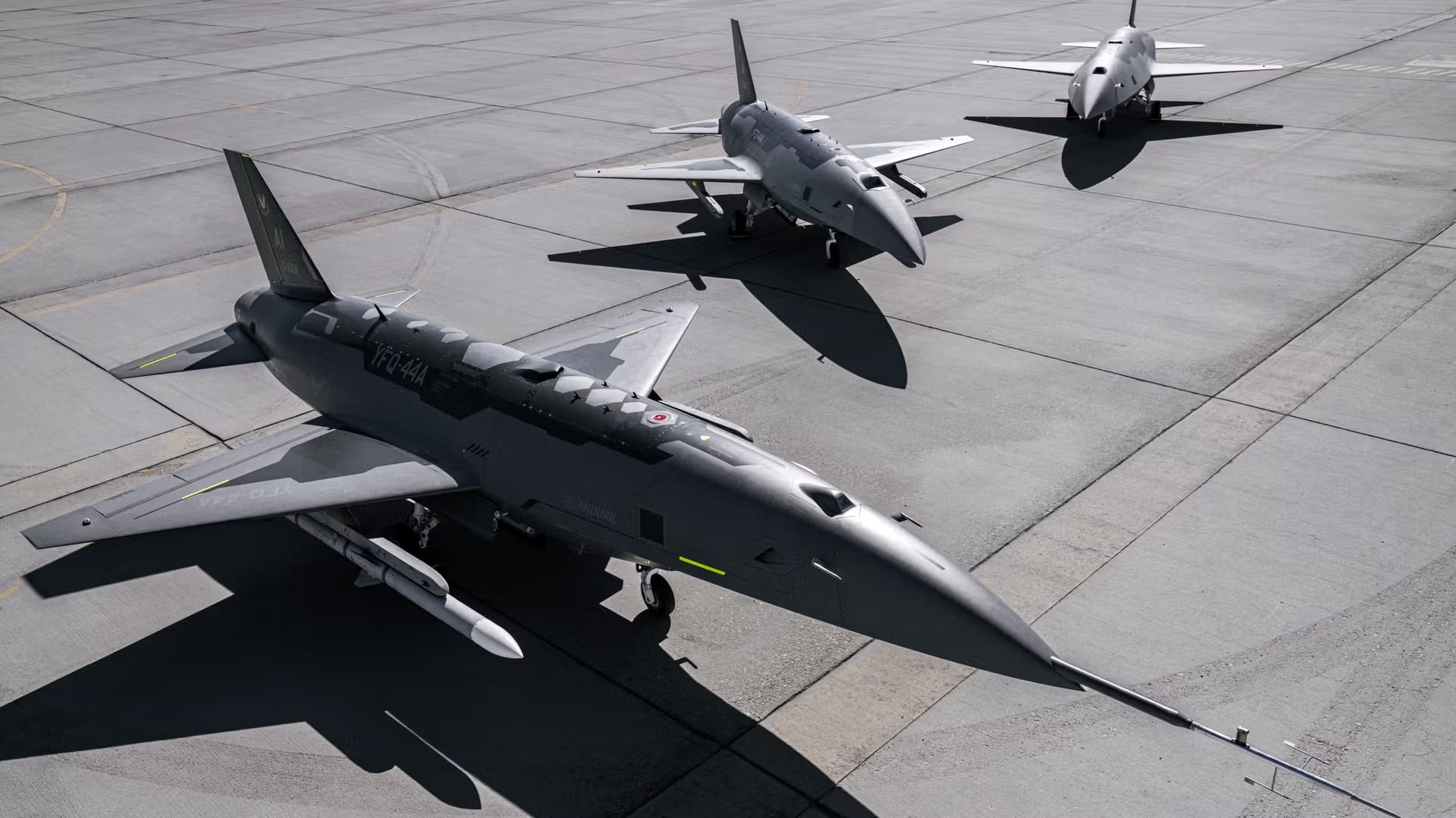
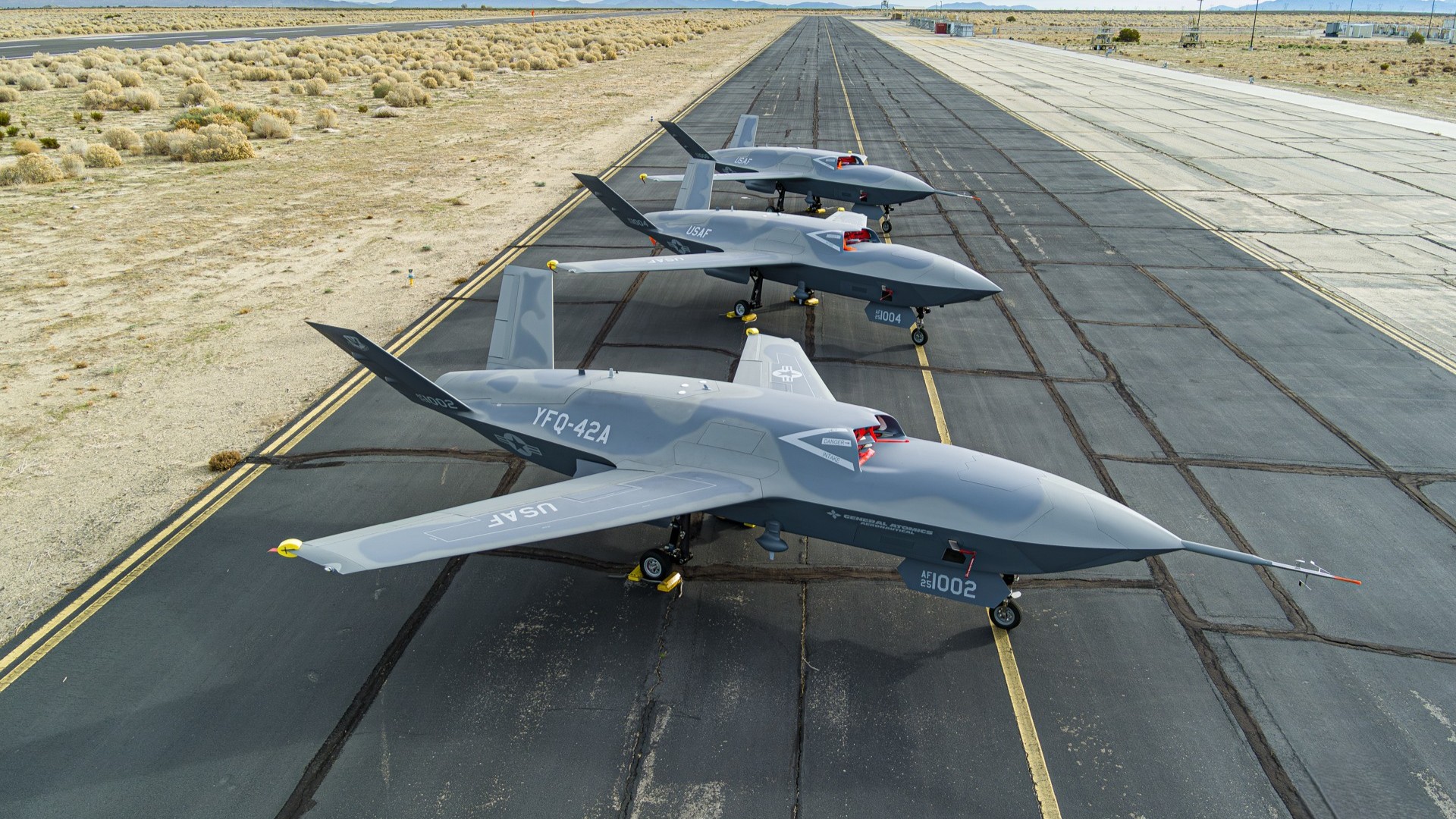
YFQ-42 aircraft sit on the flightline at a California test location as part of the Air Force’s Collaborative Combat Aircraft flight test campaign. | Source: Courtesy photo
Hardware
For the hardware-side of the program, the Air Force awarded engineering and manufacturing development and production contracts to both General Atomics Aeronautical Systems (GA-ASI) and Anduril for their FQ-42 and FQ-44, respectively. The service explained that the award arrived months ahead of scheduled because the two uncrewed assets already met rigorous mission requirements and are ready for full-scale manufacturing.
Notably, the two designs are now dropping the ‘Y’ designation which indicated prototypes, while maintaining the designation of UAVs (as denoted by the ‘Q’ vehicle type code) with the intended role as a fighter (indicated by the ‘F’ basic mission).
“By moving fast from competitive selection into full-scale manufacturing, we position ourselves to field highly credible and combat-ready semi-autonomous systems to stay ahead of the pacing challenge,” said Secretary of the Air Force Troy Meink. “These contracts reaffirm our confidence in the strategic path forward for the program to procure over 150 combat capable CCA by the end of the decade.”
The service intends to field approximately 1,000 combat-capable CCA throughout multiple Increments. Work is already ongoing for the Increment 2, which will build on the lessons from Increment 1.
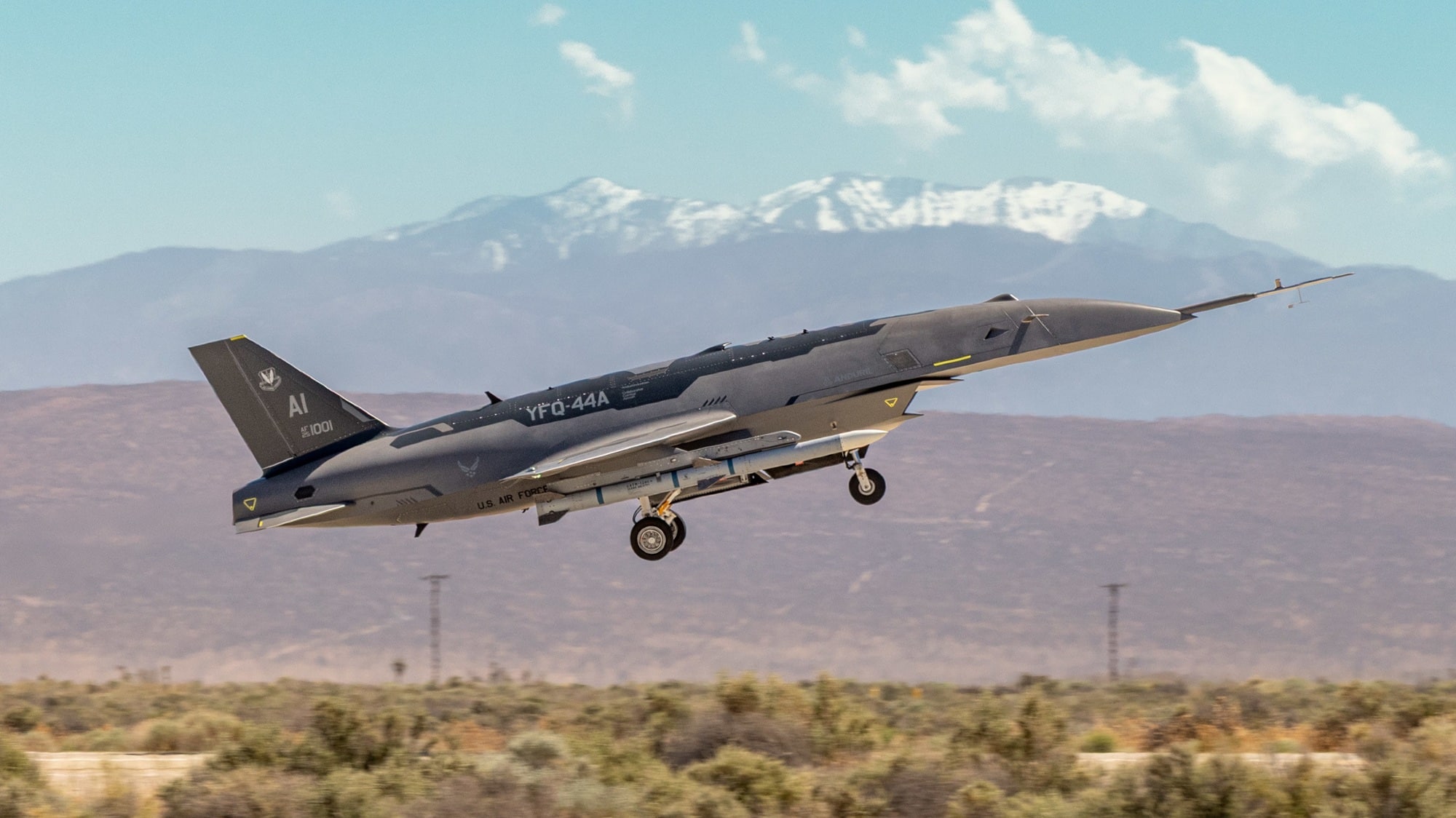
A YFQ-44A takes off from the runway at Edwards Air Force Base, Calif., during a Collaborative Combat Aircraft exercise. | Source: U.S. Air Force photo by Ariana Ortega
Both GA-ASI and Anduril are noting the speed of the program, which saw the move from prototype award to production in just two years. Anduril further noted that, unlike traditional fighters, CCAs can be built more quickly and with larger scales.
Software
For the software, the Air Force awarded mission autonomy production contracts to a pool of six vendors, including Anduril, General Atomics, Lockheed Martin, Northrop Grumman, RTX Collins Aerospace and Shield AI. Each of them has been awarded a baseline six-year contract which provides the framework for continuous competition and rapid software development.
Additionally, Anduril, RTX Collins Aerospace, and Shield AI, have also received a competitive contract to accelerate the delivery of critical mission autonomy software. The service explained this will fund the first of two six-month competitive phases designed to speed the fielding of operational software to the warfighter.
Following this six-month period, the Air Force will evaluate the vendors’ progress and execute a second competitive award period, leading to the selection of a primary mission autonomy provider for CCA Increment 1 by summer 2027.
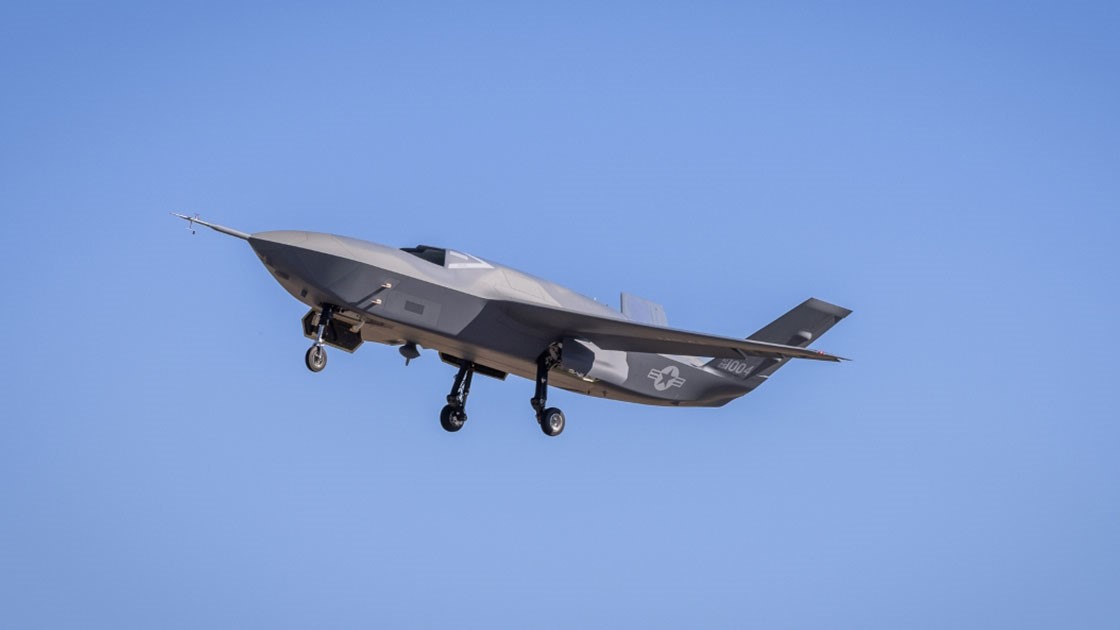
The second YFQ-42 in flight. | Source: GA-ASI
“Mission autonomy is the cornerstone of the CCA concept, and leveraging a competitive, multi-vendor environment ensures we capture the latest technology,” Meink said. “This approach guarantees our Airmen are equipped with state-of-the-art capabilities today but keeps the door open for the breakthroughs necessary to maintain air superiority.”
The service is also adopting a licensing approach which would allow to award licenses to any of the six vendors at any point over the next six years, procuring the best-performing and most affordable solutions as technology evolves. The Autonomy Government Reference Architecture (A-GRA) will be critical for this approach, ensuring that mission autonomy software from any vendor can be easily integrated, quickly updated, and ported across different physical aircraft platforms.
Collaborative Combat Aircraft
The development of the autonomous systems has advanced more rapidly than expected, leading some to suggest that NGAD’s crewed fighter might not be as essential as initially planned. The combination of CCAs with manned platforms like the F-35 and F-15EX could provide a more affordable and flexible solution to achieving air superiority.
The rise of CCAs reflects the Air Force’s shifting priorities, where a system-of-systems approach may take precedence over a singular focus on a high-cost manned fighter. The combination of manned and unmanned systems also allows for greater flexibility and the potential to deploy assets in more distributed and resilient ways.
The YFQ-44A in flight. | Source: Anduril
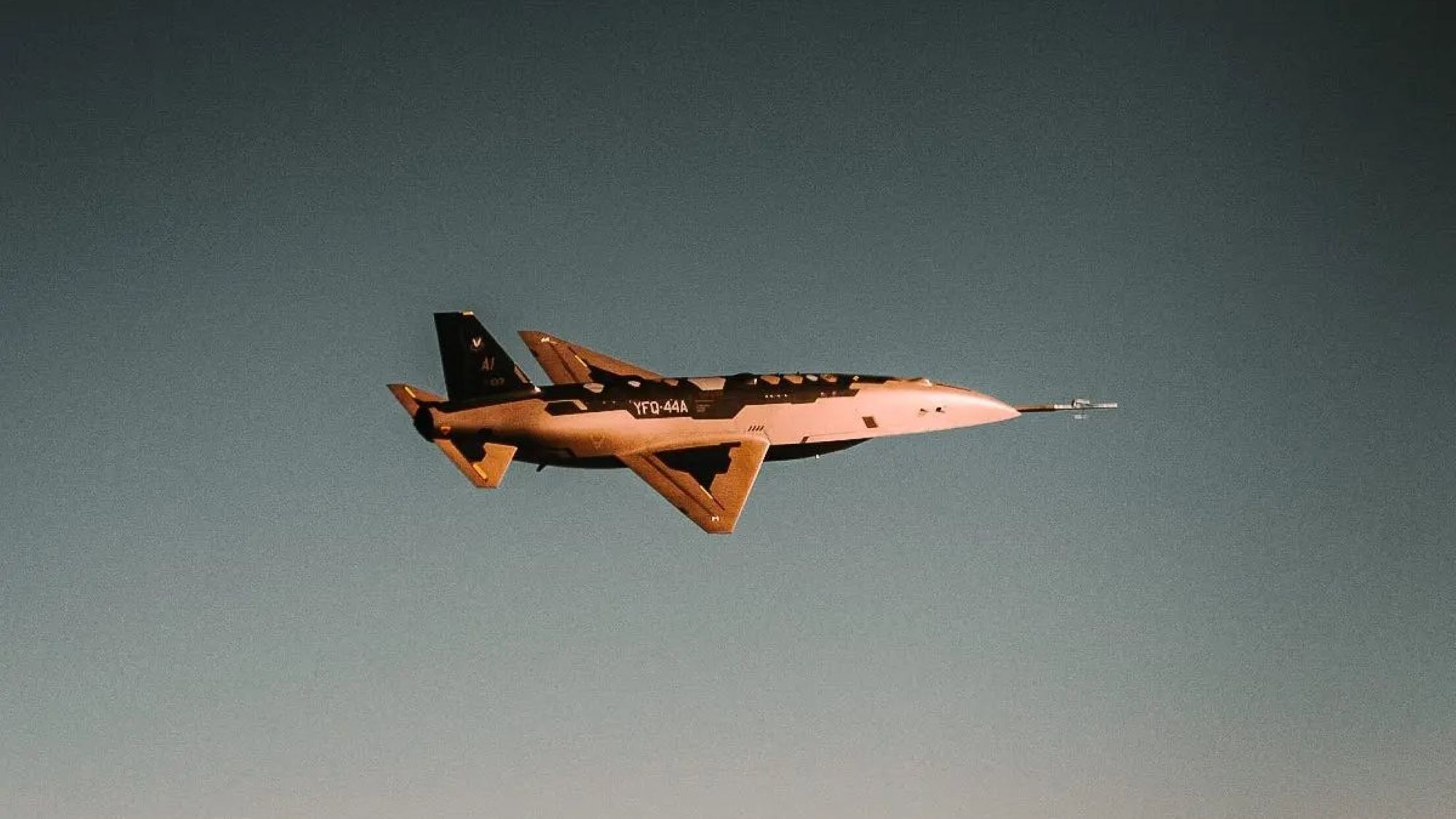
The Air Force is rapidly advancing the development of CCAs, with plans to begin deploying over 150 units in the next five years. These autonomous systems could take on a range of missions, from surveillance to direct combat, working as force multipliers in collaboration with manned platforms and taking on high-risk missions traditionally performed by manned fighters.
Unlike legacy fighters, CCAs feature modular designs, enabling rapid upgrades and streamlined maintenance. The modular design and open architecture, the latter becoming a staple in the design of modern military aircraft, allows to introduce new capabilities as they become available, allowing in turn to always field the latest technologies to keep an edge over rapidly evolving battlefields.
In early 2024, Anduril Industries and General Atomics were awarded contracts to design and test production-ready CCAs, marking a pivotal step in the program. Both companies are developing these unmanned aircraft to support both the upcoming NGAD fighters, as well as current F-35s and other manned aircraft, by sharing sensor data, executing coordinated maneuvers, and potentially carrying out combat roles.
In early 2025, the U.S. Air Force’s then Chief of Staff, General David Allvin, announced the official designation of the first two CCAs. The two aircraft by General Atomics and Anduril have been named YFQ-42A and YFQ-44A, respectively, marking the first use of the ‘Unmanned Fighter’ designation by the USAF.
The first YFQ-42 in flight. | Source: GA-ASI
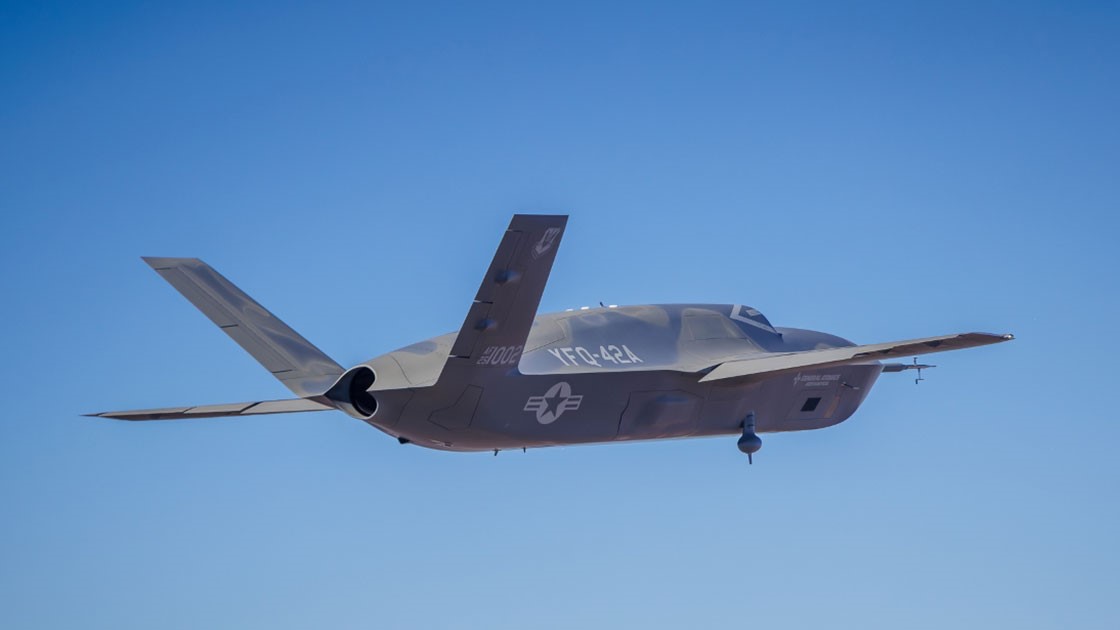
“We have two prototypes of Collaborative Combat Aircraft that were on paper less than a couple of years ago,” Allvin said. “For the first time in our history, we have a fighter designation in the YFQ-42 Alpha and the YFQ-44 Alpha – maybe just symbolic, but it’s telling the world that we are leaning into a new chapter of aerial warfare.”
These two aircraft flew for the first time in August 2025 and October 2025, respectively. Since then, they have been involved in a series of tests to demonstrate the required capabilities, working in close partnership with the service.
The Air Force is planning to field a diverse fleet of over 1,000 CCAs, designed with modular configurations for weaponry, sensor capabilities, and rapid adaptability to mission needs. One notable advancement in 2024 was the first flight of the XQ-67A, a low-cost drone designed by General Atomics under the Off-Board Sensing Station (OBSS) program, which occurred in February 2024.
This platform, along with the earlier XQ-58A Valkyrie, demonstrates a “common chassis” concept—using shared components for various drone models to streamline production and reduce costs. This approach aims to provide a scalable, cost-effective solution for enhancing combat capacity without relying on high-cost crewed jets, which is essential given the Air Force’s budget constraints and strategic emphasis on distributed, resilient forces.
“A competitive Increment 1 production decision is expected in fiscal year 2026,” says the Air Force, “with development for Increment 2 beginning that same year to expand mission applications and integrate emerging technologies.”