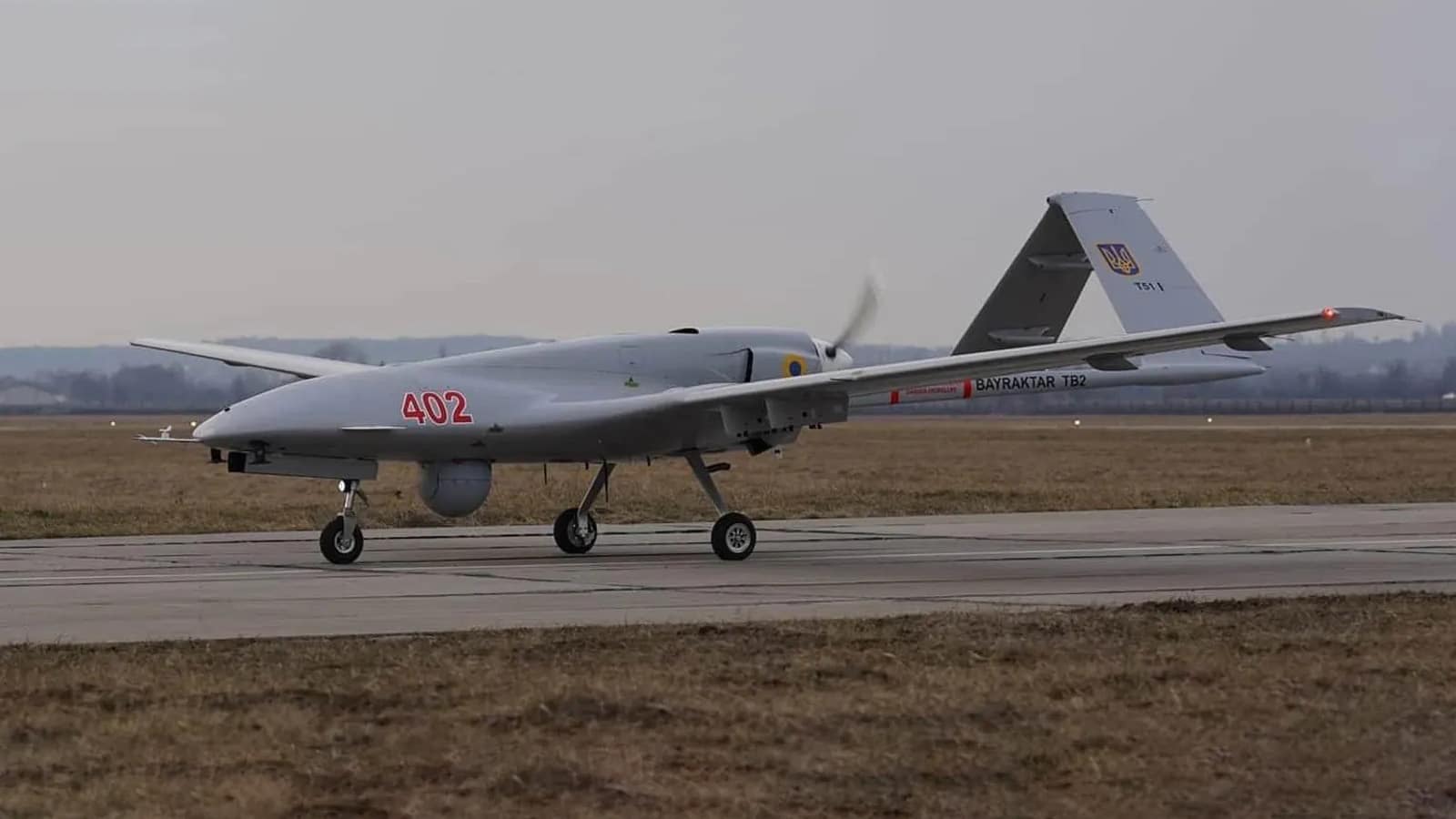
Ukraine’s Bayraktar TB-2 Breaks Hiatus and Destroys Russian Boats in the Black Sea
The Ukrainian TB-2 drone resurfaced once again after being nearly absent from the battlefield, striking what is believed to be Unmanned Surface Vessels.
Russia’s Black Sea Fleet lost two small boats, believed to be Unmanned Surface Vessels (USV), following aerial strikes captured in footage released by the Ukrainian Navy on Jun. 24, 2026. Defense observers and war trackers believe the Unmanned Combat Aerial Vehicle (UCAV) system employed by the Naval Forces of the Armed Forces of Ukraine was the Bayraktar TB-2.
The Turkish-made Medium-Altitude Medium Endurance (MAME)-class surveillance-strike drone, that Ankara supplied to Kyiv prior to the conflict, keeps emerging sporadically after nearly disappearing from the battlefield in the first few months of the war in 2022. The remotely piloted aircraft was completely withdrawn from use after large numbers were reportedly lost to Russian electronic warfare.
The possibility of the RPA in the new video being the TB-2 is likely, since the last time it surfaced after a long hiatus in September 2025 was again in the Black Sea region. That time, the drone had hit Russian boats and troops along the coast.
Similarly to the latest occurrence, analysts had concluded the system to be the TB-2, based on the distinctive interface and symbology from the electro-optical (EO) sensor’s video feed. The Ukrainian military did not officially identify the drone used on both occasions.
Bayraktar lives! The Ukrainian Navy has released footage showing the destruction of a Russian unmanned surface vessel by a drone whose interface looks like that used by the Bayraktar TB2.
According to the Navy, a total of three Russian unmanned surface vessels were destroyed in… https://t.co/4KaJHJgxB9 pic.twitter.com/GuVOyaxhrR
— Special Kherson Cat (@bayraktar_1love) June 24, 2026
What the video shows
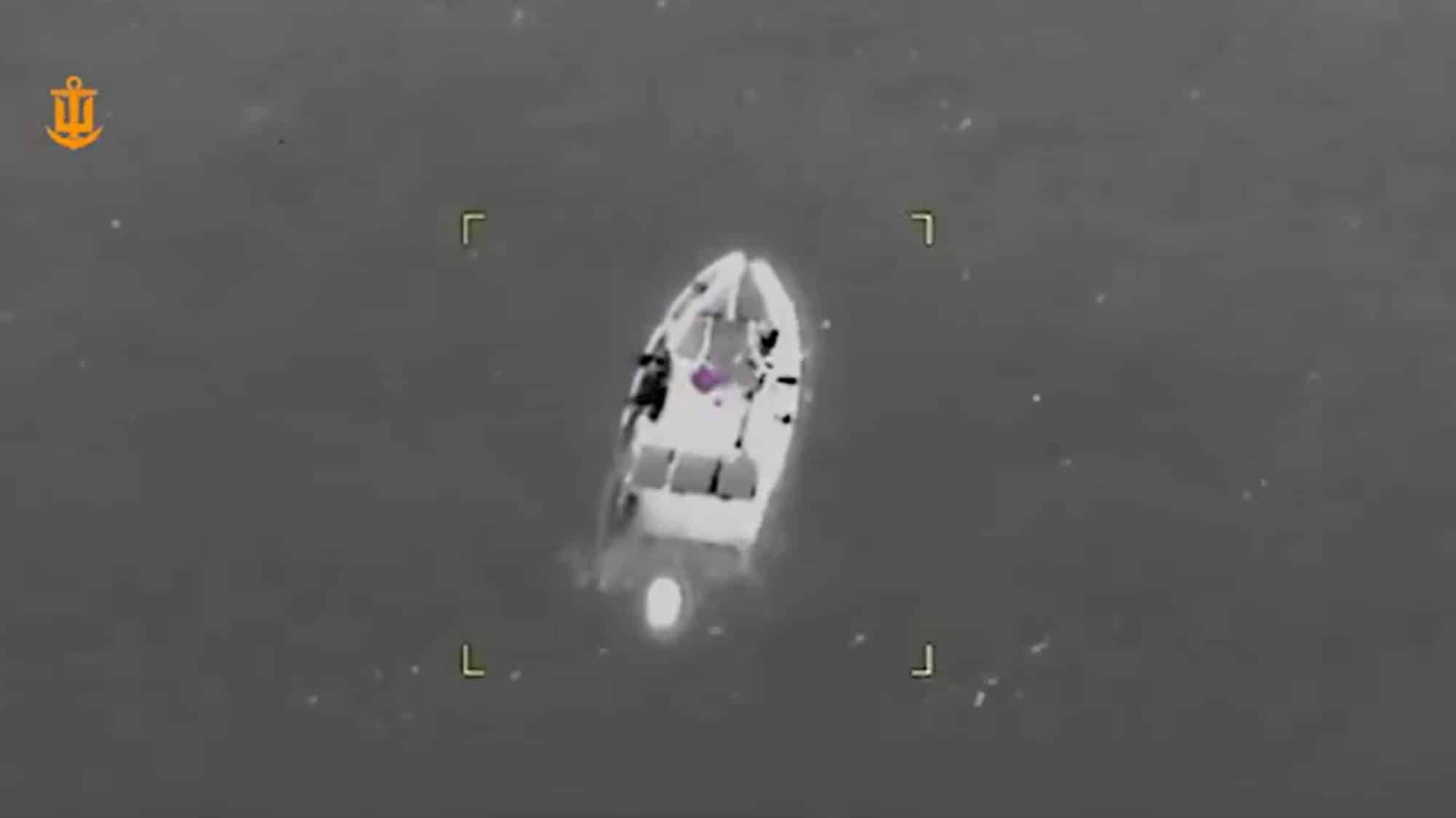
The infrared footage shows two boats being targeted, with the outlines of what could be two sensor masts or two personnel on one of them, and the laser illumination also visible on the first one. The second boat, which was not struck, also has an outboard motor.
The two vessels are believed to be USVs, although that was not verified. As an alternative, they could possibly be rubber dinghies or speedboats.
This would however raise the question why Russian Black Sea Fleet (BSF) commanders would mount a highly risky and largely unnecessary manned operation in heavily contested waters in the middle of the Black Sea. At the same time, there are scanty reports of Russia using its USVs in the Black Sea.
Screengrab of the video by the Ukrainian Navy showing the Russian boat before being struck. | Source: Naval Forces of Ukraine
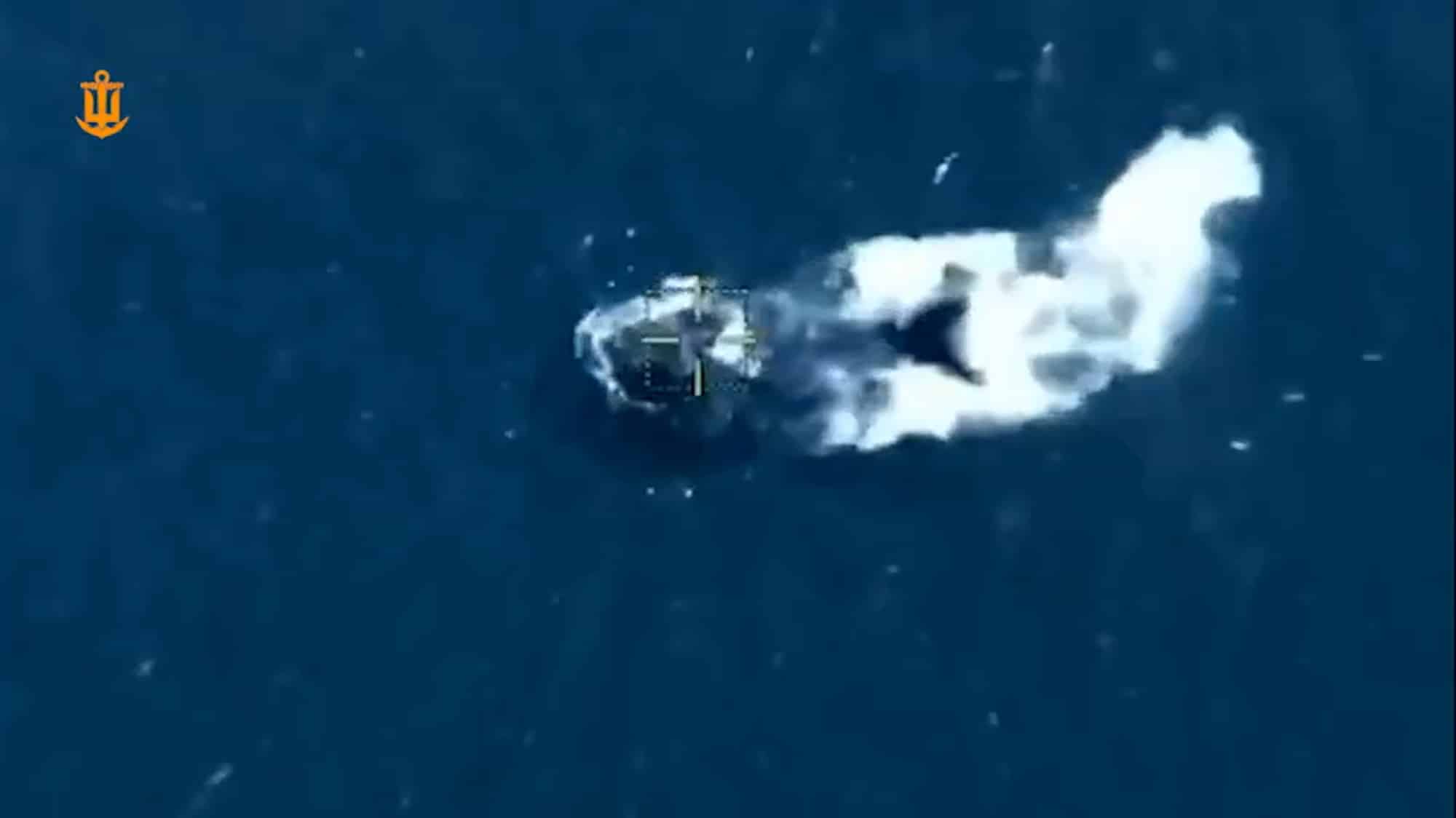
The munition used in the latest strike could have been the laser guided MAM-series of air-to-ground guided bombs developed by Roketsan. Ukrainian media said the military has used these in the past from the TB-2 in the opening months of the war.
The situation in the Black Sea largely remains in Ukraine’s favor, with Russia still at an overall asymmetric disadvantage using large patrol vessels, gun boats and naval utility helicopters like the Kamov Ka-27 to blow Ukrainian USVs out of the water. Ukraine’s leading Magura V5 and V7 USVs armed with repurposed air-to-air missiles have also shot down Mi-8 helicopters and Su-30SM fighters.
A second boat captured in the TB-2 EO footage. | Source: Ukrainian Naval Forces
From time to time, the Maguras and other U.S-made USVs keep going astray and end up being beached. The latest such incident involving a Magura V3 was reported in May in the Greek coastal region of Lefkada. Ukraine has also fielded a new USV called Barracuda.
A Ukrainian Magura V3 one-way attack unmanned surface vessel (USV) was discovered off the coast of Lefkada in Greece.
The USV was found by fishermen in a cave on the Ionian island of Lefkada late on Thursday. According to reports, it may have been carrying explosives at the… pic.twitter.com/ODMQGkVv3n
— Status-6 (War & Military News) (@Archer83Able) May 8, 2026
The lessons learned from the Ukrainian experience have also led the U.S. Navy’s Unmanned Surface Vessel Squadron 3 (USVRON-3) to incorporate uncrewed maritime systems in large multinational exercises and even operationally. In fact, drone boats were used to rescue downed pilots near the Strait of Hormuz.
Footage of a Ukrainian unmanned surface vessel getting blown out of the water in the Black Sea. pic.twitter.com/ROscrwbTMV
— Blackrussian (@Blackrussiantv) June 24, 2026
The unmanned surface system “Barracuda” of the 40th Marine Brigade of the Ukrainian Navy is now being used not only on rivers, but also in the bay near the Kinburn Spit. In addition to FPV drones, it can launch heavy bomber copters. pic.twitter.com/dyH8NWKJQD
— MilitaryNewsUA (@front_ukrainian) June 14, 2026
Previous TB2 employments
The Sep. 3, 2025 video released by the Ukrainian military showed the strike of a Russian speedboat beached on the coast in Kherson, with at least two injured personnel being offloaded from the vessel and two others evacuating them. The footage from the TB2 then also shows strikes on small encampments along the coastline, injuring another soldier.
Ukrainian Navy Bayraktar TB2 UCAVs destroyed a Russian Black Sea Fleet speedboat near Tendra Spit, Kherson region. pic.twitter.com/QjAOS56OlI
— Clash Report (@clashreport) September 3, 2025
A few weeks prior to that, Ukraine released a video of a TB2 strike on another small Russian boat, this time near Zaliznyi Port in the Kherson region. In June 2025, the Ukrainian Navy publicized a video of a TB-2 attack on a Russian landing craft on Kherson’s west coast.
Unconventional strikes using uncrewed systems are generally overseen by Ukraine’s Defense Intelligence Directorate (GUR). In the opening months of the war, Ukraine had lost at least 26 TB-2s, according to the Oryx open-source tracking forum.
Video from the Ukrainian Navy of a TB2 UCAV strike on a Russian landing craft on the west coast of Kherson oblast.https://t.co/iRuVldEFXA pic.twitter.com/Ux3MKcKNX7
— Rob Lee (@RALee85) June 24, 2025
United24 attributed the losses to enhanced Russian electronic warfare measures that nullified the TB-2 threat early on. “Russia began adapting to the TB2 threat,” said the publication. “Improved electronic warfare and layered air defense systems made it increasingly difficult for large, slow drones to operate safely. Ukrainian officials acknowledged that TB2s had become highly vulnerable to Russian systems like Pantsir-S1, Buk, and Tor.”