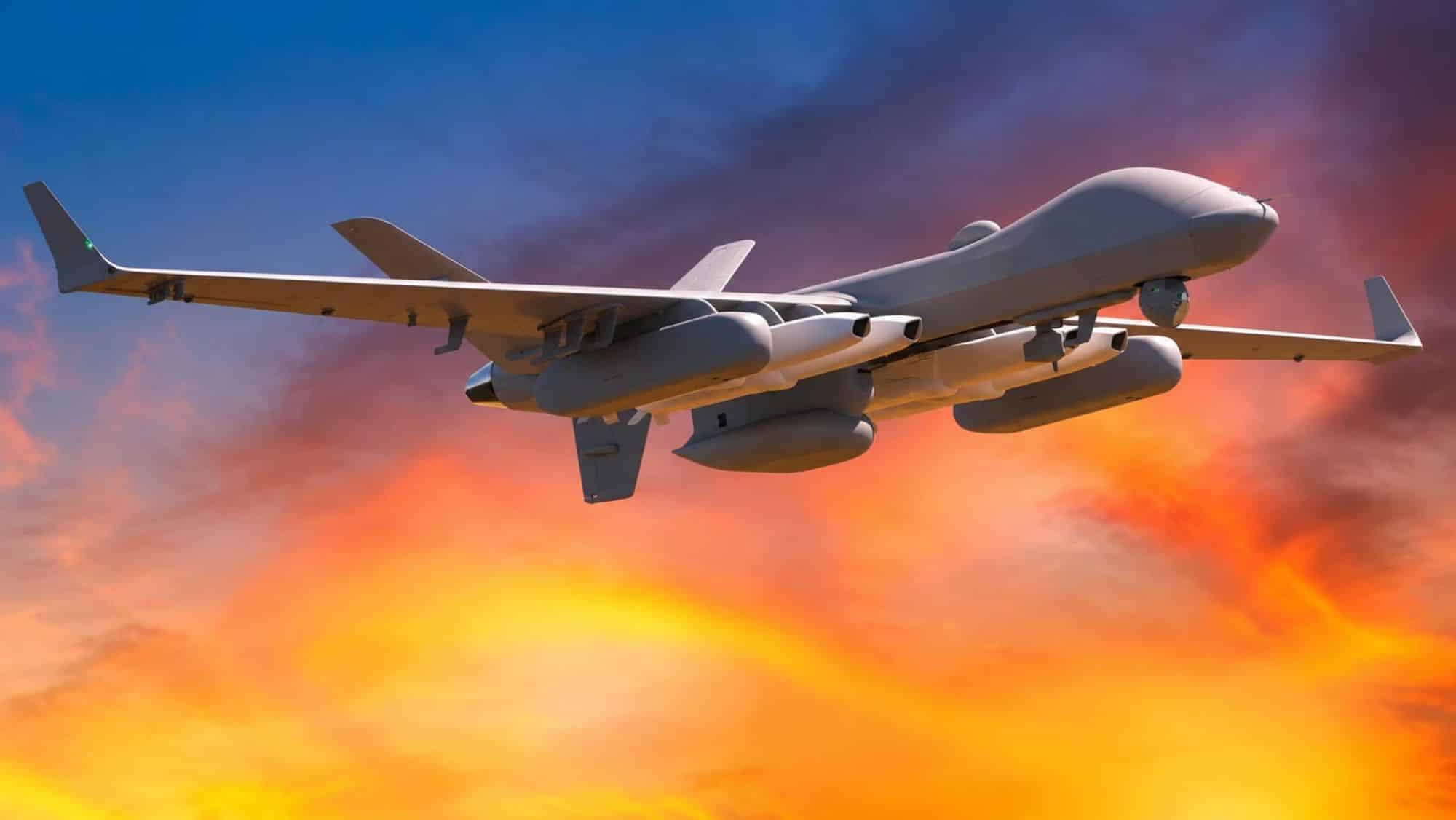
GA-ASI Completes Preliminary Technical Review for Joint Strike Missile on MQ-9B
GA-ASI and Kongsberg took another step towards the integration of the Joint Strike Missile on the MQ-9B family of Remotely Piloted Aircraft, which would give it a standoff strike capability.
Taking a step towards the integration of an air-launched standoff strike capability on the MQ-9B Remotely Piloted Aircraft (RPA), first announced a few months ago, General Atomics Aeronautical Systems (GA-ASI) has now announced the conclusion of the System Requirement Review (SRR) and Preliminary Design Review (PDR) for the integration of the Norwegian Joint Strike Missile (JSM) on the MQ-9B.
On the sidelines of the Farnborough International Airshow 2026, GA-ASI said that the SRR and the PDR were completed in Norway on Jun. 30, 2026. GA-ASI specified that the effort was funded by both companies, and will allow the new capability to be soon available to the MQ-9B and its users.
GA-ASI quoted Kongsberg’s senior VP for missiles and aerostructures Jens Gjestvang, who said the JSM’s integration with an uncrewed platform like the MQ-9B “enables a highly capable strike mission set that can be employed in conjunction with or independently of piloted aircraft.” He further added “this is an operational capability that we’re seeing greater interest in across the defence sector.”
GA-ASI and Kongsberg successfully completed reviews for integration of the Joint Strike Missile weapon system onto #MQ9B multi-mission #UAS.
Read the full release: https://t.co/yFx9QTaI3Z
#FarnboroughAirshow pic.twitter.com/KEKuifvKas
— General Atomics Aeronautical Systems, Inc (GA-ASI) (@GenAtomics_ASI) July 20, 2026
Despite witnessing large losses of the earlier MQ-9A variant in the current conflicts in the Middle East, the MQ-9B SkyGuardian and SeaGuardian family has found relevance in mission sets that require operating from standoff distance in a permissive environment but with a very long on-station capability. Beside long-range air-to-surface strike, the others include Anti-Submarine Warfare (ASW), Counter-Unmanned Aerial System (C-UAS), Airborne Early Warning (AEW) and electromagnetic spectrum warfare roles.
Drones also allow to unburden costlier manned systems of those roles. The air-to-air engagement is another evolving mission set, already seen in the MQ-28A Ghost Bat’s, Kizilelma’s and FQ-44A Fury’s development.
JSM integrated on the MQ-9B
GA-ASI vice president Niki Johnson stressed on the industry’s dynamism to combine the capabilities of two existing platforms to meet battlefield needs. “We recognize the value JSM brings to our MQ-9B platform. This integration effort shows how industry can effectively collaborate to integrate new capabilities and make them available quickly to our warfighters,” Johnson said.
GA-ASI called the MQ-9B SkyGuardian and SeaGuardian models “industry-leading uncrewed aircraft systems (UAS)” and Kongsberg’s JSM a “best-in-class weapon system for use against high-priority targets.”
Securing the Indo-Pacific requires aircraft that do more and go farther.
Learn how #MQ9B goes the distance at #Avalon2023 booth 3M11. pic.twitter.com/NJOYnUbw9s
— General Atomics Aeronautical Systems, Inc (GA-ASI) (@GenAtomics_ASI) February 28, 2023
“MQ-9B is a long-endurance uncrewed platform that can conduct missions over land and over water. JSM is a fifth-generation stealth air-to-surface missile for use against high-priority targets,” the press release further said.
In its February announcement about integrating the JSM, AGM-158B Joint Air-to-Surface Standoff Missile (JASSM) and the AGM-158C Long-Range Anti-Ship Missile (LRASM) with the MQ-9B, GA-ASI had said its engineers were already working on structural and kinematic aspects like the missiles’ impact on the drone’s airframe range, speed and stability.
Use cases
The company had also named the vast expanses of the Western Pacific as the theater warranting the new capabilities – holding targets at risk from longer ranges, for a longer amount of time in an independent yet mutually supporting role to manned aircraft.
The announcement’s press release additionally laid out a real-world use case. The MQ-9Bs can loiter at standoff distances outside adversary long-range anti-access/area-denial (A2/AD) weapons engagement umbrella and, with man-in-the-loop control from ground control stations and networking with other manned assets, the MQ-9Bs can employ these long–range missiles, upon receiving the command from either of these elements.
Concept rendition showing MQ-9Bs carrying JASSM, LRASM and JSM missiles. | Source: GA-ASI
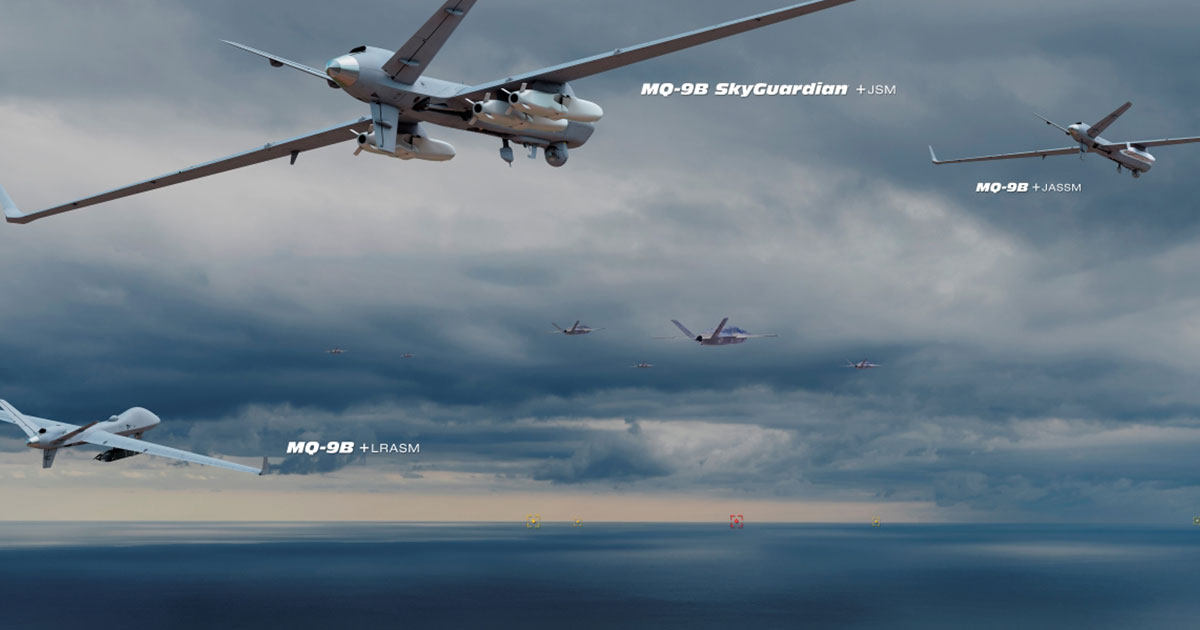
At the time, reflecting its confidence in integrating the admittedly heavy missiles on the High-Altitude Long-Endurance (HALE)-class RPAs, GA-ASI said it plans “to fly at least one of these new weapons as early as 2026.”
GA-ASI’s concept rendition at the time showed three MQ-9Bs, with one carrying three JSMs, and the other two with a single JASSM and one LRASM, respectively. The company has not specified if these configurations represent the MQ-9B’s actual payload capacity with these missiles.
The SkyGuardian and SeaGuardian can carry a payload of 2,155 kg (4,750 lb) on nine hardpoints – eight under the wings and one on the centerline. With the JASSM weighting 1,200 kg (2,600 lb), the LRASM weighting 1,250 kg (2,760 lb) and the JSM weighting 416 kg (917 lb), it can be said that the rendering reasonably reflects the actual configuration that will be used by the MQ-9B.
F-35A + Joint Strike Missile (JSM) = Maritime dominance for #Norway and #Japan The long-range JSM, is the only 5th-generation cruise missile designed to be launched from the internal weapons bay of an F-35. It was successfully tested last February. #avgeeks #aviation #news pic.twitter.com/VN3zzfVOv3
— Air Power (@RealAirPower1) December 16, 2022
Renditions from the 2023 iteration of the Avalon exhibition at Australia already showed an MQ-9B SkyGuardian with a pair of JSMs under each wing. That notional illustration also showed the maritime search radar on its underside and two Sledgehammer EW pods.
This might indicate that the latest effort would require both these payloads to be dropped for the JSM to be carried, and relying on the missile’s post-launch mission update capability for target guidance and updates. Each JSM weighs 416 kg (917lb), according to the manufacturer.