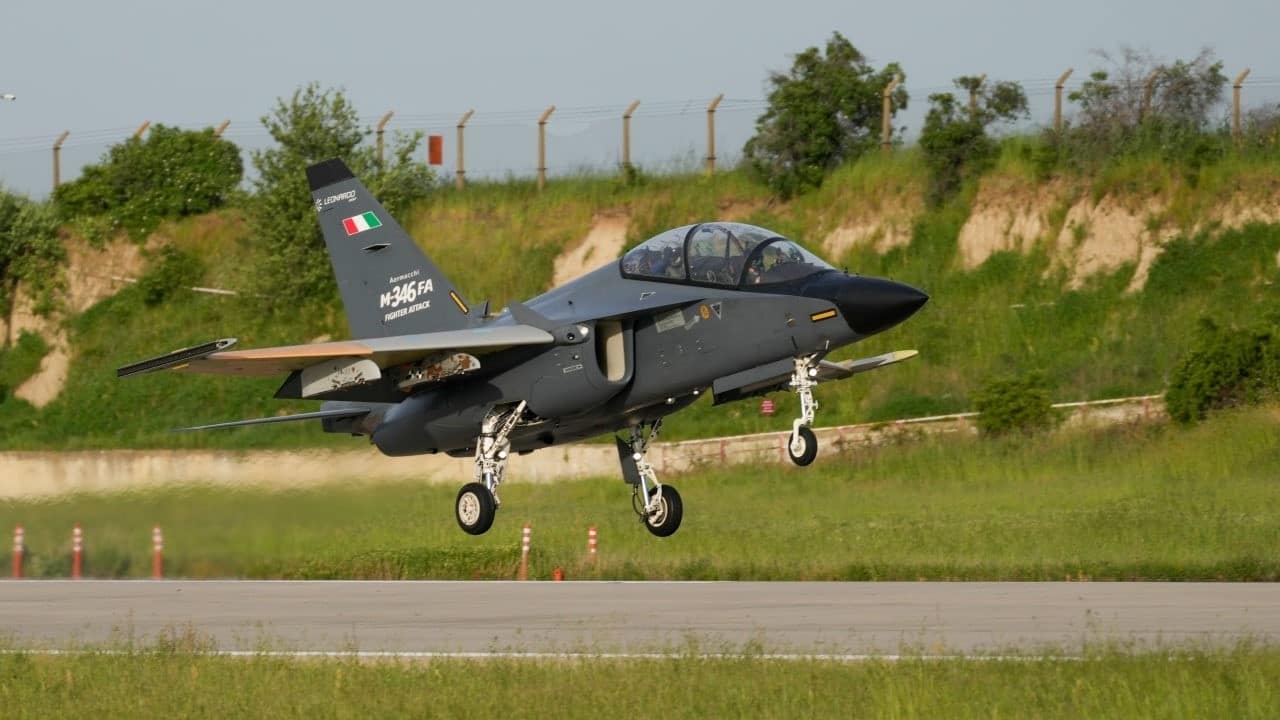
Leonardo and Baykar Share Details of K-SWARM Test with M-346F and Kizilelma UCAV
Following the recent tests, Leonardo and Baykar shared more details about the Crewed/UnCrewed Teaming (CUC-T) that saw the M-346F light fighter aircraft take control of the Kizilema UCAV.
In a briefing at this year’s edition of the Farnborough International Airshow, Leonardo and Baykar shared additional details about the recent tests as part of the K-SWARM program. The testing, meant to demonstrate the ‘loyal wingman’ concept, saw an M-346F – the light-fighter variant of the M-346 trainer – take control of two Kizilelma uncrewed fighter aircraft.
The testing
The flight campaign was conducted in May 2026, although only announced in June, at Baykar’s flight and test center in Çorlu, Turkey. The two companies said this represents only the first phase of the live testing, setting a major milestone in the development of Crewed/UnCrewed Teaming (CUC-T) capabilities.
At the @FIAFarnborough Airshow 2026, #Leonardo and @BaykarTech provided a comprehensive overview of the Crewed-Uncrewed Teaming testing recently carried out in Turkey, involving the #M346 and #KIZILELMA aircraft. The partners illustrated the development of the algorithms required… pic.twitter.com/0v3sXYSQoy
— Leonardo (@Leonardo_live) July 20, 2026
Two M-346s were flown from Italy to Turkey, including a company-owned M-346F and an Italian Air Force T-346A which acted as safety chase aircraft. Baykar employed two Kizilelma aircraft.
Before the live testing, the two companies worked together also in the lab to prepare software and hardware and simulate the CUC-T operations. Specifically, Baykar integrated advanced Smart Fleet Autonomy capabilities into the CUC-T algorithms while Leonardo assessed algorithms and procedures in its Avionic, Flight Control Innovation Labs and product capability and concept laboratory (PC2LAB) linked with an M-346 Full Mission Simulator.
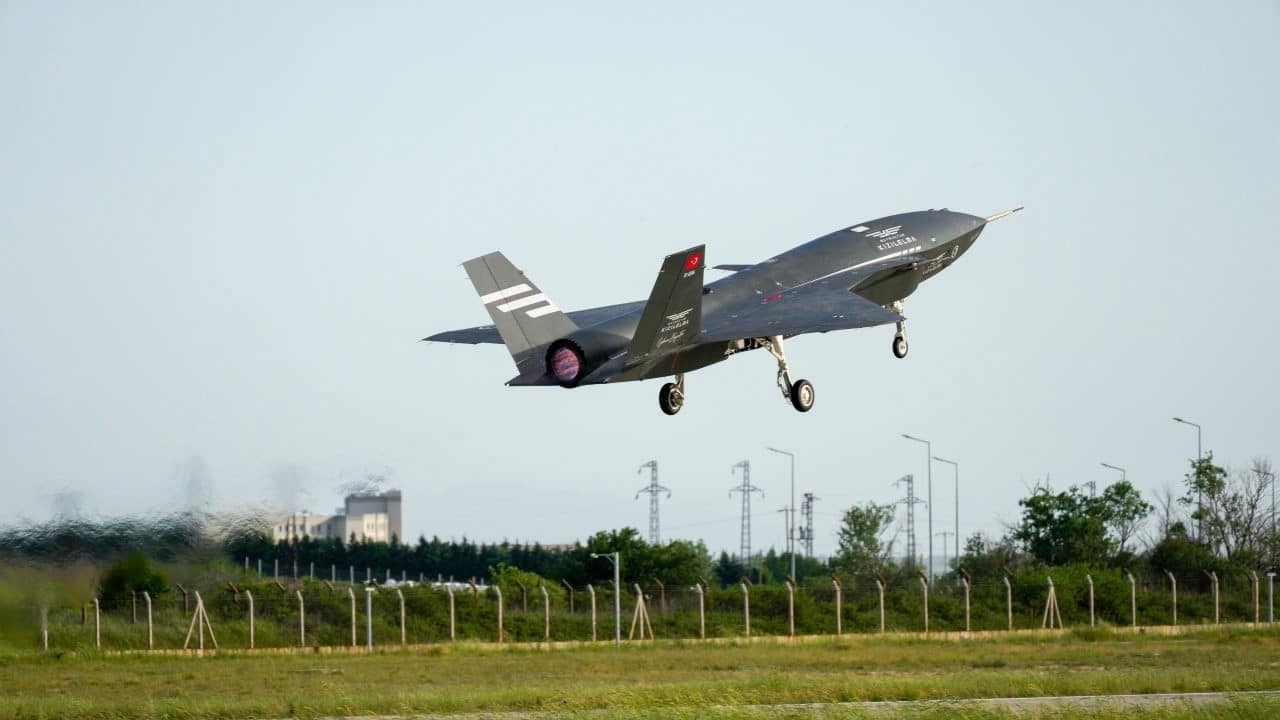
A Kizilelma takes off to rejoin the M-346F for a Crewed-Uncrewed Teaming test mission. | Source: Leonardo
Leonardo says the build up approach adopted for the CUC-T development and testing was based on step-by-step criteria, with a progressive risk reduction through simulation-based validation, an assessment of safety-critical scenarios, including link-loss separation manoeuvres. This allowed a seamless transition from virtual to live operations with both crewed and uncrewed aircraft.
An unspecified number of live flights were then conducted, putting to the test several months of work by pilots and technicians of the Leonardo and Baykar teams. This was also made possible by an advanced radio frequency data exchange system allowed for the synchronization of all data shared between the M-346 and Kizilelma platforms, with the NATO Standard Interface for Manned-Unmanned assets enabling communications.
The datalink was protected by Leonardo’s Tactical Cybersec Platform, a proprietary cyber defense platform built on multi-agentic AI architecture which protects and monitors systems in real time. Cyber security is considered as an important part of the CUC-T operations to prevent disconnection of the uncrewed platforms and spoofing by an adversary.
During the live testing, Kizilelma autonomously conducted taxi, take-off and rejoin thanks to Smart Fleet Autonomy algorithms developed by the Baykar’s Hardware-in-the-Loop (HIL) Laboratory. Then, upon Ground Control Station approval, the M-346F assumed full control of the uncrewed Kizilelmas.
The M-346 light fighter variant during a test flight. | Source: Leonardo
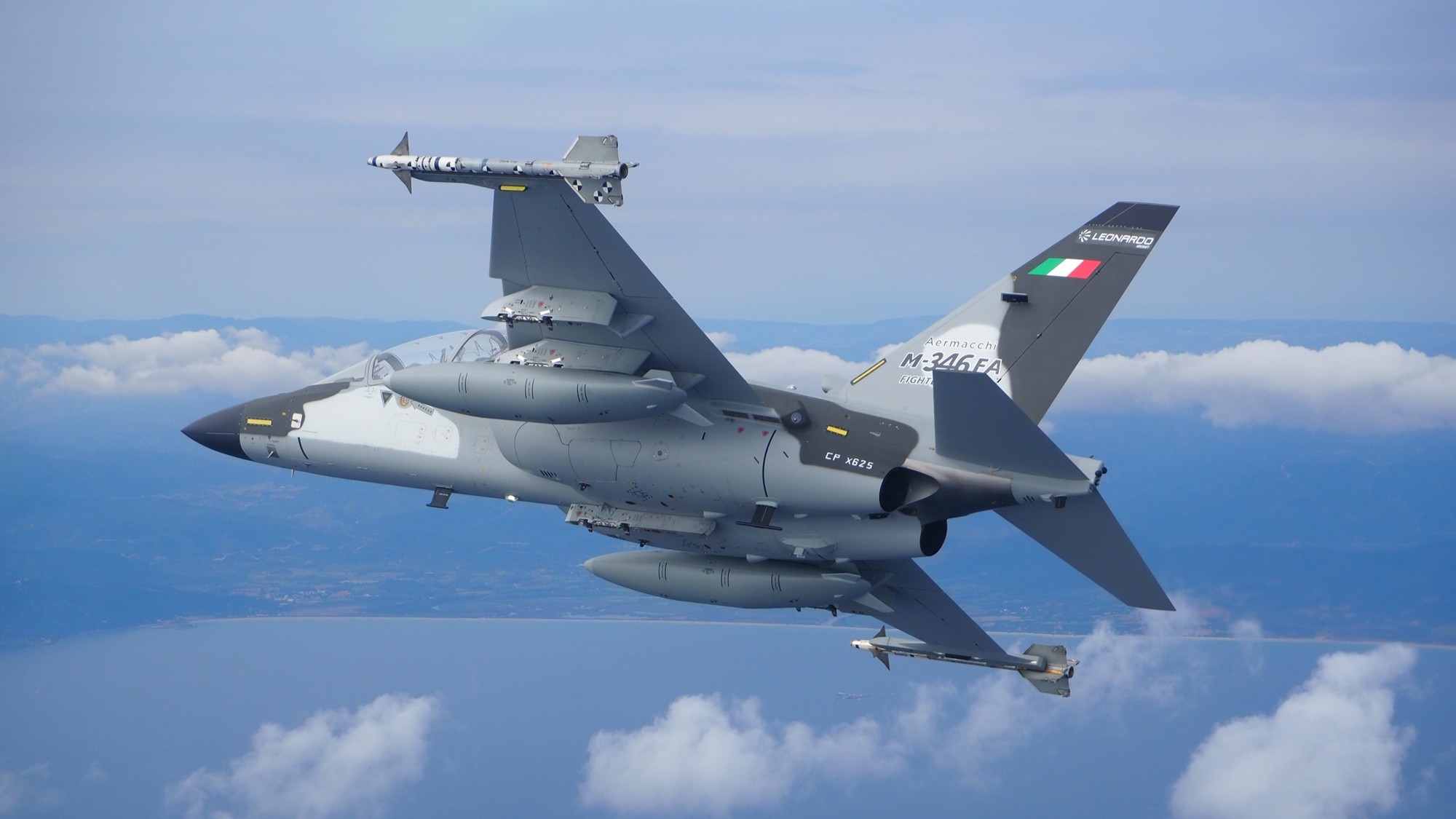
The test pilots aboard the M-346F used a ‘newly developed fully integrated onboard avionic suite’, said the joint press release. Leonardo further detailed that the dedicated user interface was integrated into the M-346F’s avionics and also featured HMI enhancements.
An image shared during the briefing provided a glimpse into the user interface, with the datalink providing the positions of the UCAVs on the Multi-Function Display’s Horizontal Situation Display (HSD) screen, while the two other MFDs were used for the selection of the formation and the training scenario, respectively. The modifications allowed full command and control of uncrewed assets, continuous situational awareness, reduced pilot workload and an effective human oversight of autonomous operations.
The M-346’s pilots were able to command different formations, which were autonomously executed by the Kizilelma. Additional maneuvers included position changes, separations and rejoins.
Future
Leonardo and Baykar say that data and analysis gathered have been crucial in defining the next steps in the K-SWARM program. The two companies are now planning to move into more complex operations “requiring greater situational awareness and assets working together ‘as one’ towards mission objectives.”
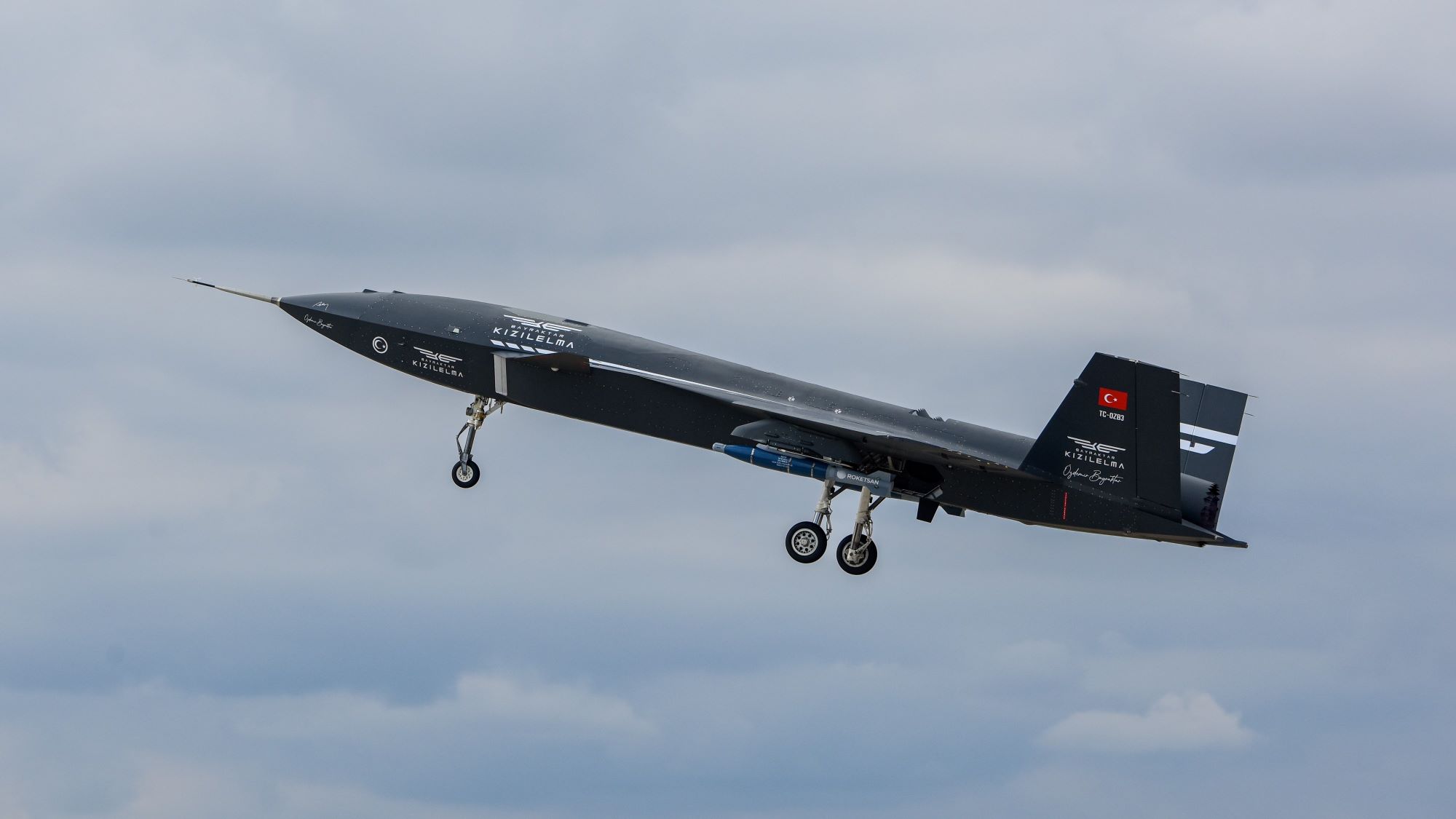
The Kizilelma taking off with a TEBER-82 guided bomb for its first live-fire test in 2025. | Source: Baykar
These activities have also been linked to the Global Combat Air Programme (GCAP) and its Collaborative Combat Aircraft (CCA), which already sees the involvement of Leonardo. The vision is for a high number of aircraft, currently as many as six but possibly more, to be assigned to each crewed aircraft.
The joint press release notes that this “refinement and maturity of AI technology, algorithms and collaborative procedures will enable the uncrewed systems to incrementally shift from remote piloting to autonomy, with the aim of reducing pilot workload and increasing mission efficiency while maintaining full control and decision-making.”
New tests are now planned in the coming months, with increasing complexity and additional functions. It is unclear if Leonardo plans to include in the activities also other aircraft such as the Eurofighter Typhoon.
The Aviationist’s contributors Kai Greet and James Gray helped in the preparation of this article.