
Sikorsky Details Armed Black Hawk and U-Hawk Plans, Including Optional Piloting and Export Interest
Sikorsky details plans to bring optional piloting into production, expand the Black Hawk’s payload and range, and offer armed configurations to both existing and new-build aircraft.
During the recent Farnborough International Airshow 2026, The Aviationist had the opportunity to discuss the future of one of Sikorsky’s most iconic aircraft, the Black Hawk, with Jason Wrigley, Director of Business Development for Army and Air Force Systems at Sikorsky.
The conversation explored how the company is working to keep the Black Hawk relevant on the future battlefield through a series of upgrades aimed at increasing its range and payload, integrating new weapons and launched effects, introducing greater levels of autonomy and simplifying the integration of future systems through an open-architecture approach.
Wrigley provided some interesting details about the Armed Black Hawk concept, including its potential weapon configurations and its application to both new and existing aircraft, as well as the fully unmanned U-Hawk, the cockpitless variant of the helicopter first unveiled at the end of last year.
Here’s what Wrigley told us.
The Aviationist: What are you showing here with the Armed Black Hawk, and how does this concept reflect Sikorsky’s broader plan to keep the Black Hawk relevant on the future battlefield?
Jason Wrigley: We’re thinking about how to ensure the aircraft remains missionized and relevant to future operational needs, so we’re focusing on several areas. How do we make it fly farther? How do we enable it to carry more? How do we bring in autonomy, including through our other fully autonomous variants? And how do we introduce an open-architecture solution that makes upgrades and new system integration easier?
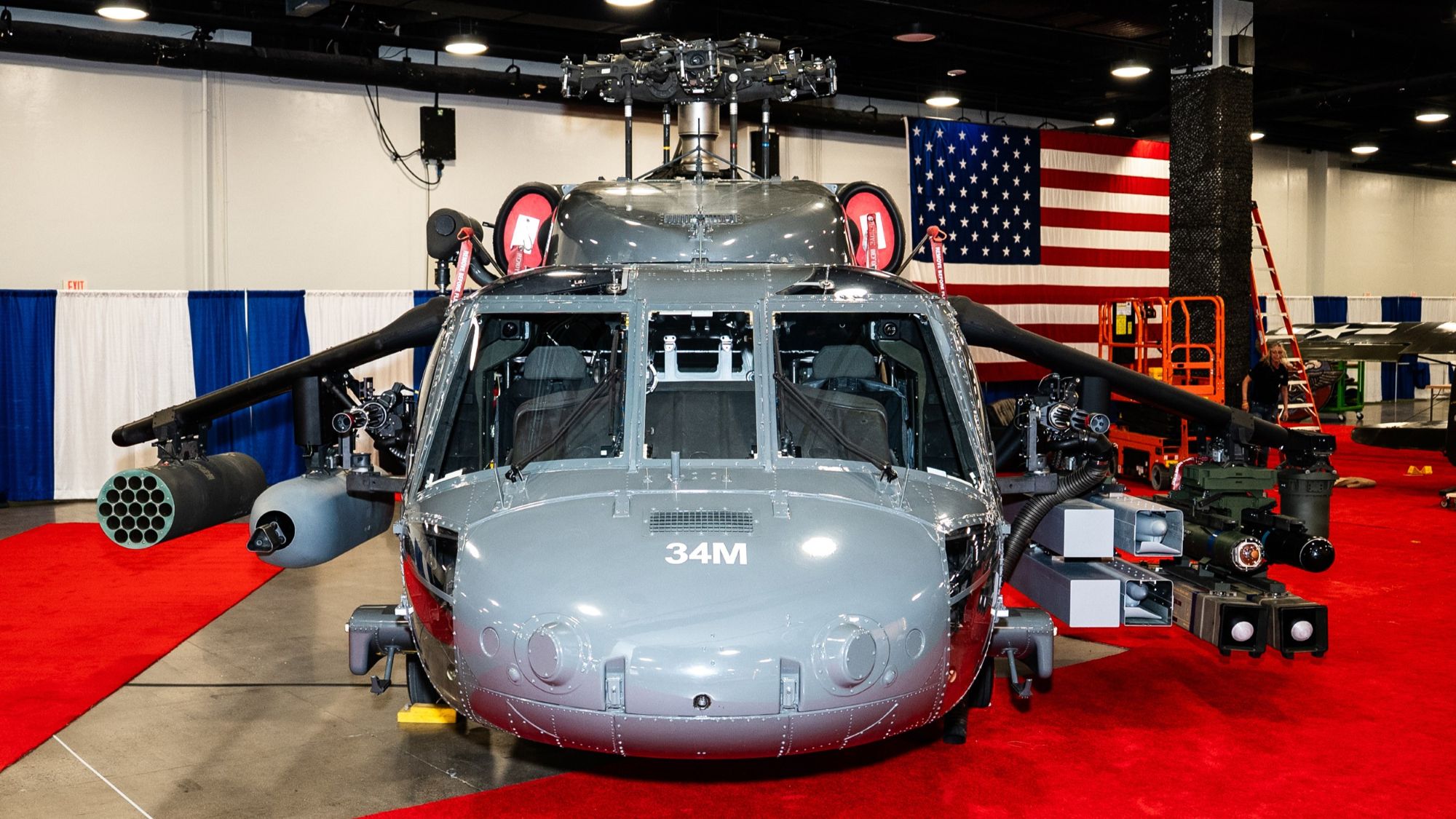
What we’re showing here with the Armed Black Hawk is really the culmination of that missionization effort. We want to demonstrate that the Black Hawk, which has always been a utility and multirole aircraft, can take on additional missions and perform attack missions much more cost-effectively than a dedicated attack helicopter.
Essentially, it involves adding a mission kit to a utility helicopter that already performs a wide range of missions and has lower acquisition and lower supportability costs than most dedicated attack helicopters.
What enables that capability? The equipment itself, including the launched effects, missiles and guns, is obviously operationally useful. But the key enabler is the expansion of the Black Hawk’s payload capacity.
We’re introducing a new engine, the Improved Turbine Engine from GE Aerospace, which provides 50 percent more horsepower. We are currently conducting the flight-test program with the new engine. We’ve flown it for about 50 hours and taken it up to 17,000 feet above sea level.
We’re making significant progress with the engine test program. At the same time, we’re enhancing the Black Hawk airframe to allow it to carry an additional payload of 1,000 pounds or more, and we’re expanding the fuel tank to extend its range by 135 nautical miles.
See farther. Sense more. Act faster.
The U.S. Army’s air-launched effects testing from the UH-60M Black Hawk is helping shape future missions—giving soldiers new ways to extend reach, gain awareness and stay ahead of emerging threats. pic.twitter.com/wQawx8GZSw
— Sikorsky (@Sikorsky) June 19, 2026
In terms of weapons, is it going to carry everything? Is there something that we can say about the payload and the weapons that can be carried?
The way we envision it is through multiple configurations or packages, ranging from an initial weapons capability with guns and similar systems to a longer-range precision-strike package.
Another major focus of our development is what the U.S. Army calls launched effects. This involves carrying drones that can perform surveillance, carry weapons or support a wide range of other missions.
We see these systems as a way to expand both the mission capability and the operational reach of the platform, even beyond the improvements we are making to extend the aircraft’s own range.
The Armed Black Hawk kit unveiled by Sikorsky at the Army Aviation Warfighting Summit in Nashville, Tennessee. (Image credit: Sikorsky) | Source: Sikorsky
Among all the things that you are doing with the aircraft, are you also looking at some kind of manned-unmanned teaming with other platforms?
Yes, that’s a great question. First, it really starts with those launched effects, because we do not envision employing just one at a time. We expect multiple systems to be operating simultaneously, and the future battlespace will include large numbers of drones that need to communicate back to a mothership or another control node. The Black Hawk will be capable of performing that role.
That communication could also be managed by ground systems, and the Black Hawk could serve as an airborne relay for the data.
We have also invested in and demonstrated Black Hawk autonomy for a very long time. We have flown, I think, around 1,000 hours with autonomous Black Hawks. We therefore see the aircraft as an autonomous node within that network, but also as a cooperative node when it is operated as a piloted platform.
A close up of the modular armament wings of the Armed Black Hawk kit. (Image credit: Author) | Source: David Cenciotti

Is this “optionally manned,” or is it manned?
That’s exactly right. What we’re doing with the Black Hawk is making it optionally piloted, or, to use another term adopted by the U.S. government, optimally piloted, because the level of crew involvement can be selected according to the mission.
It can be flown by a standard crew of two, by a single pilot with autonomy features reducing the workload and allowing the second crew member to focus more on mission tasks, or with no pilots at all.
Although we have demonstrated these capabilities for years, we are now working to transition them into production so that they can become part of the standard Black Hawk capability in the future.
And then over here is the U-Hawk. This is a variant of the Black Hawk that is totally unmanned, right?
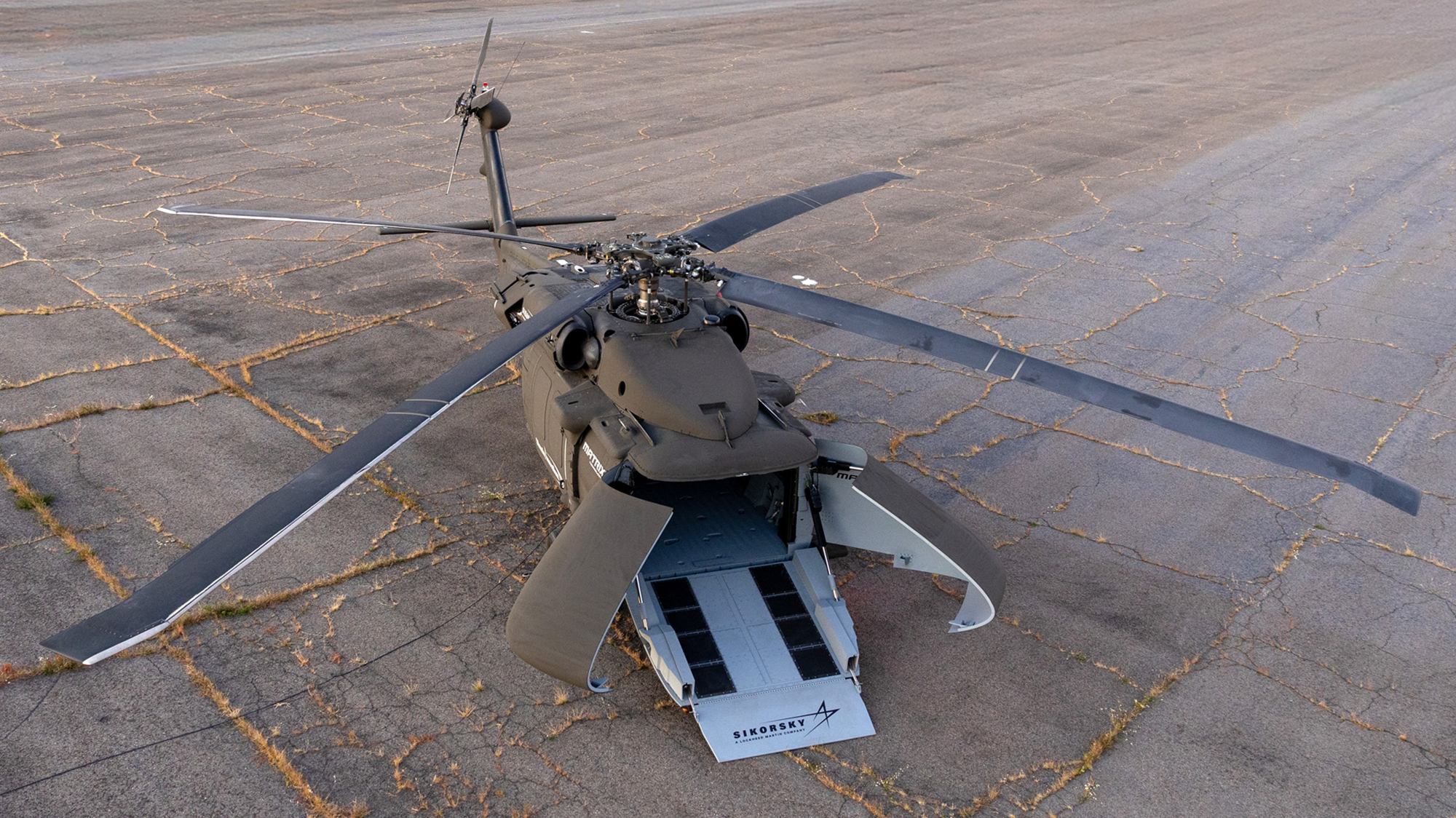
Unmanned, yes. We have removed the cockpit, so this variant is truly unmanned.
We built it around our MATRIX autonomy stack, which has already been proven on Black Hawks and on many other platforms.
This configuration also demonstrates the different ways in which the additional payload capacity can be used. By removing the cockpit and all the equipment associated with piloting the aircraft, we free up a significant amount of internal volume.
We have therefore installed clamshell doors at the front to make loading and unloading easier.
We are also showing here an internal launching system, which provides a way to carry launched effects inside the aircraft. On the Armed Black Hawk, they are carried externally on the wings, while on this variant they can be housed internally.
We are very excited about this variant.
By removing the cockpit, seats and crew stations, the Sikorsky S-70UAS U-Hawk helicopter becomes the first fully autonomous Black Hawk helicopter. (Photo courtesy, Sikorsky, a Lockheed Martin company.) | Source: Sikorsky
Could you provide some additional details about the two variants from a commercial perspective? Are you in discussions with customers outside the United States that may be interested in the Armed Black Hawk? And are there similar discussions regarding the U-Hawk?
There are, yes. We are in discussions regarding both variants.
From an Armed Black Hawk perspective, we formally launched the product earlier this year, and since then we have had a significant number of engagements and discussions.
As for the U-Hawk, we unveiled it at AUSA last year, and we have also had many conversations about the platform since then.
So there are ongoing discussions about both variants, including with potential customers outside the United States. Has the U.S. Army committed to either platform as a launch customer, or are you still seeking an initial contract?
With the U.S. Army, we are working through its modernization program and conducting a number of demonstrations to introduce and validate the capability.
Just last month, the Army employed multiple launched effects during a demonstration event called Capstone. It is an annual exercise designed to develop concepts and tactics, so the Army is now demonstrating the capability, gathering soldier feedback and working toward transitioning it into service.
The U.S. Army is also already working with several international customers through Foreign Military Sales to arm the Black Hawks they are acquiring. In parallel, we are working commercially to make the capability available across our S-70 fleet as well.
So there are multiple pathways and options for customers to acquire the kit.
One last question: can the kit be installed on existing airframes? Aside from the engine, are any additional modifications required to the airframe or onboard systems?
Exactly. The kit can be installed on existing aircraft, and it can also be incorporated into newly built aircraft.
The new engine is not strictly required. There are trade-offs in terms of available payload capacity and overall performance, but customers can already arm their existing platforms.
What we are showing here is the continued refinement of the design toward what we consider the optimal configuration.
Thank you very much for your time and for sharing these insights with us!
The Aviationist would like to thank Jason Wrigley for answering our questions, and Melissa Chadwick of Sikorsky Communications for arranging the interview and welcoming us to the Lockheed Martin chalet.