Davis-Monthan AFB Inactivates its Last A-10C Thunderbolt II Units
The 355th Operations Group, 357th Fighter Squadron, 357th Fighter Generation Squadron, and 355th Training Squadron were inactivated during a ceremony, marking the end of A-10 operations at Davis-Monthan.
The U.S. Air Force took another step towards the drawdown of the A-10C Thunderbolt II fleet when the last units to operate the type at Davis-Monthan Air Force Base (AFB), Arizona, were inactivated on Sep. 18, 2026. The 355th Wing’s 355th Operations Group (355th OG), 357th Fighter Squadron (357th FS), 357th Fighter Generation Squadron (357th FGS) and 355th Training Squadron (355th TRS) were inactivated in a ceremony “marking the official end of the A-10 legacy at Davis-Monthan AFB.”
The ceremony follows the final flight of a Warthog, as the A-10 is called by its crews, assigned to the 355th Wing at Davis-Monthan AFB in July, bringing to an end 50 years of A-10 operation at the base, which began with the type’s arrival in 1976. The ceremony was attended by senior officers, Airmen, retired pilots, local civic leaders and community members, who recognized each of the above units’ service and contributions.
The imminent drawdown of the legendary ground-attack and close-air support aircraft, which Congress has sought to delay, has also seen the Air Force winding down other A-10 units and activities, particularly at Davis-Monthan AFB. This includes the final A-10 Range Day in June 2026 at the Barry M. Goldwater range, the shuttering of the 40th Flight Test Squadron’s Detachment 1 in December 2025, and the deactivation of the 924th Fighter Group in September 2025.
The aircraft also recently completed its final training flight with the U.S. Air Force Weapons School at Nellis AFB, Nevada.
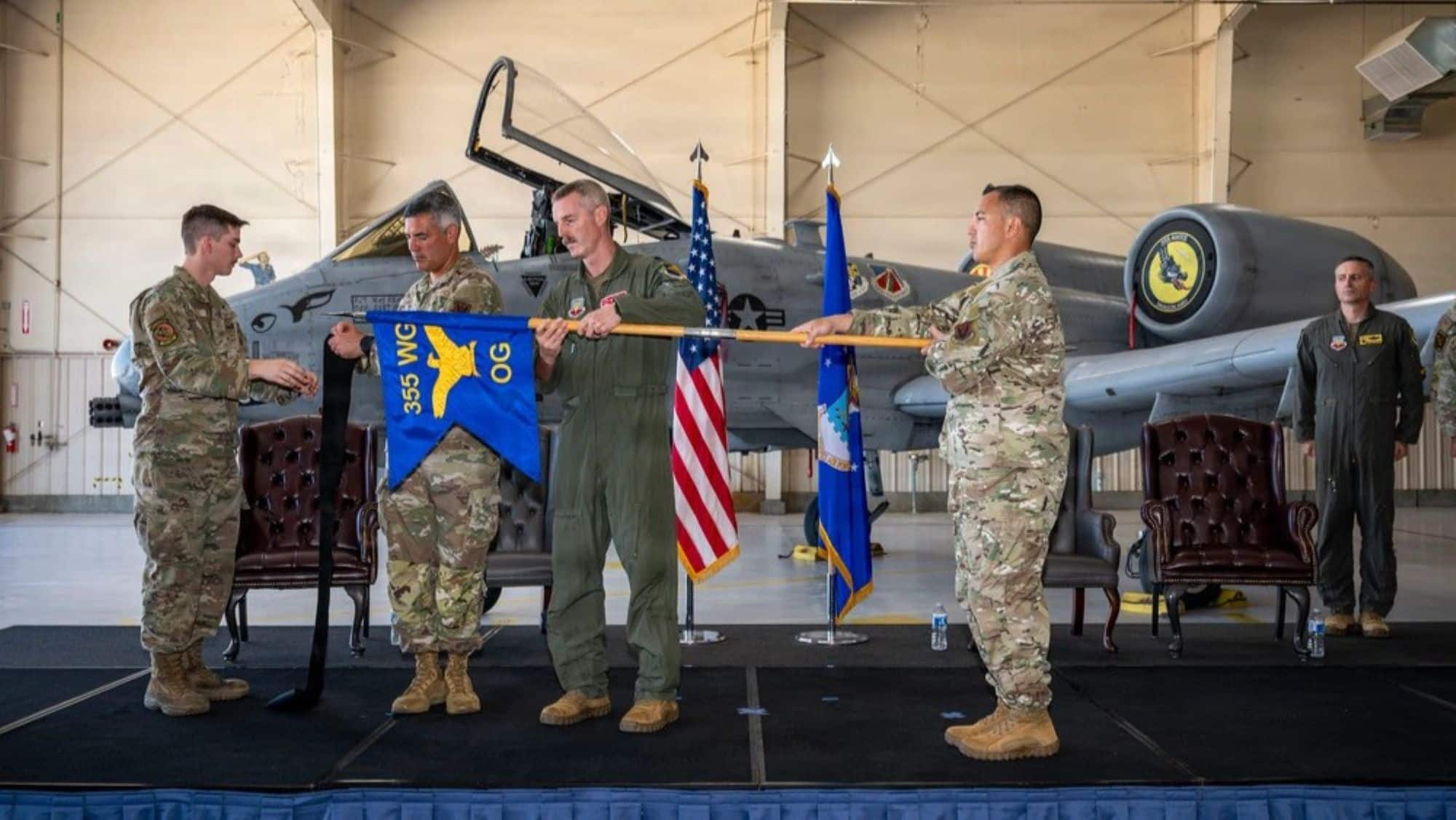
U.S. Air Force Col. Jose Cabrera, 355th Wing commander, and Lt. Col. Rodney Dwyer, 355th Operations Group and Training Squadron commander, furl the 355th OG guidon during the A-10 Unit Inactivation Ceremony at Davis-Monthan AFB. | Source: U.S. Air Force photo by Airman 1st Class Samantha Melecio
A-10 legacy at Davis-Monthan AFB ends
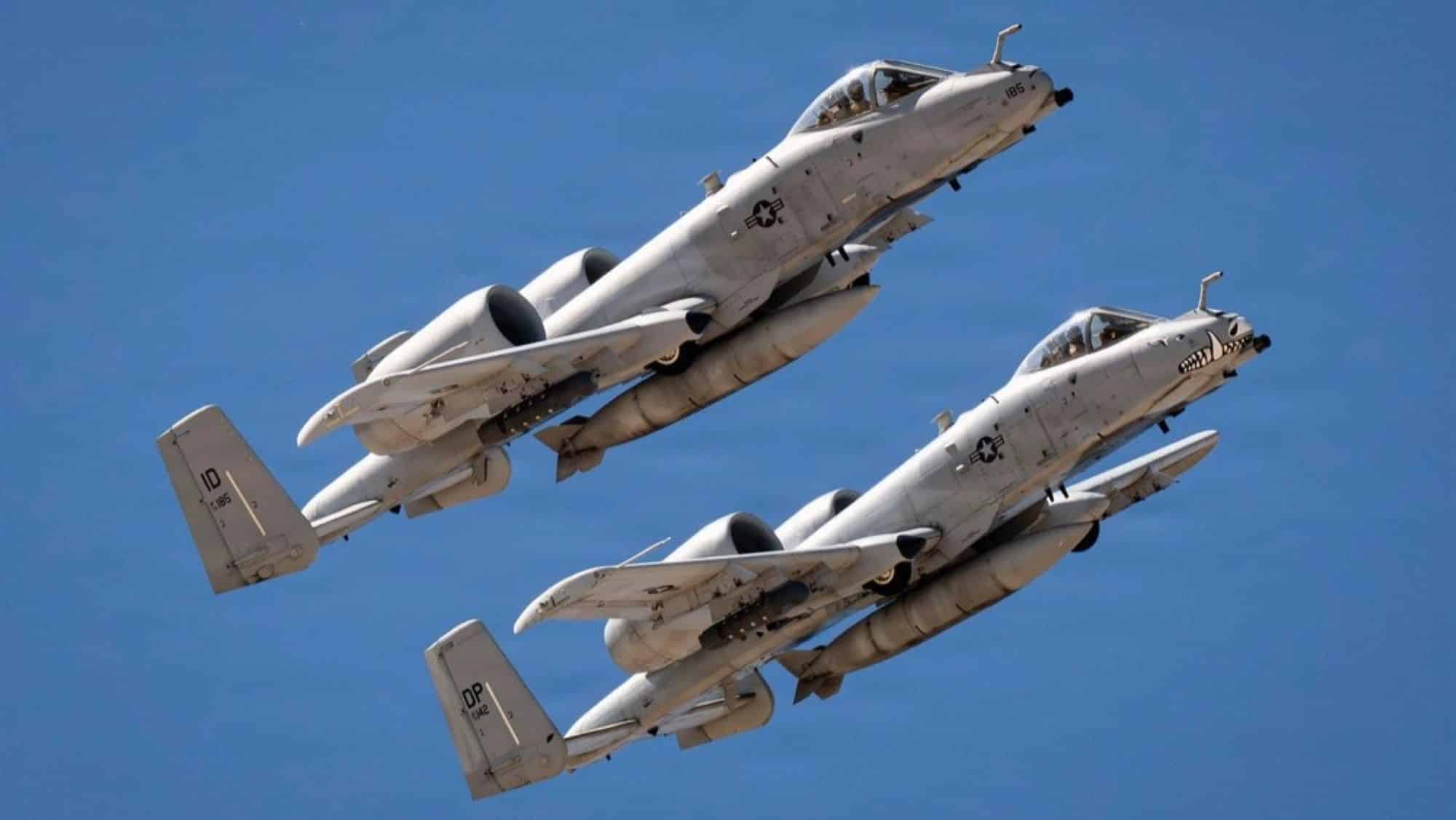
Images released on the DVIDS network showed two Warthogs assigned to the Idaho Air National Guard (ANG) and the ANG Air Force Reserve Test Center conducting a two-ship flyover during the inactivation ceremony. The aircraft honored the “legacy of the Thunderbolt II and the Airmen who supported its mission at Davis-Monthan,” a caption said.
These jets are sporting the new Probe Refueling Adapter on the nose, which the ANG AFRTC tested earlier this year for compatibility with probe-and-drogue refueling operations. A-10Cs equipped with the new feature were also later captured in photos in May while deployed in West Asia in support of Operation Epic Fury.
To signify the inactivation of each A-10 unit, the respective guidons were rolled and cased by their last commander and the 355th Wing commander, Col Jose Cabrera. Meanwhile, all important historical documents and memorabilia from 355 OG, 357 FS, 357 FGS, and 355 TRS are being packed into containers which will be sent to the National Museum of the U.S. Air Force at Wright-Patterson AFB.
Davis-Monthan just said goodbye to the Warthog.
Yesterday, the Tucson base inactivated its remaining A-10 units and marked the end of a presence that began in the 1970s. The last jets are headed to Moody Air Force Base in Georgia or to the Boneyard. The 355th Operations Group… pic.twitter.com/6psV8H1Yoe
— A-10 Thunderbolt II “Warthog” (@A10TheHog) September 19, 2026
The release by the 355th Wing said that the 355th OG was activated on May 1, 1992, and controlled the flying units assigned to the 355th Wing. “From 1992-2026, the group provided the capabilities of the A-10 Thunderbolt II for the missions of close air support, forward air control and combat search and rescue,” the statement said.
The group also deployed aircraft and personnel across the globe, and oversaw “all formal A-10 pilot initial qualification and requalification training.” Cabrera credited the formation for building “every single active-duty [A-10] pilot who flew into harm’s way.”
“For nearly 50 years, the A-10 Thunderbolt has occupied a sacred place in American air power,” said Cabrera. “It was never just an airplane. It was a promise. Davis-Monthan was part of that promise.”
Lt. Col. Rodney Dwyer, the final commander of the 355th OG and 355th TRS, discussed the A-10’s association with the “word ‘attack’” and how the personnel’s “distinct mentality” and “aggressive state of mind” underpinned the mission set.
Retired A-10 pilot Lt. Gen. Glen “Wally” Moorhead recalled his first flight with the aircraft on Nov. 7, 1975, at Davis-Monthan. He described himself “as the last and youngest member of the A-10 testing” program at Edwards AFB, and was subsequently appointed as the “first A-10 pilot at DM.”
Today, the Dragons take their final flights at Davis-Monthan AFB. It’s been an honor documenting this final A-10 chapter in Arizona. pic.twitter.com/QIApTA3LX5
— jmh.creates (@JarodMHamilton) July 29, 2026
The last commander of the 357th FS, Lt. Col. Ryan Rutter, said: “I think about my time as a wingman, my job was to learn. As an instructor pilot, it was to teach. And now my charge [as a commander] is to leave.”
Congress’ and Air Force’s competing plans on A-10
The bipartisan BRRRT Act, which remains still a bill and has not yet become law, goes much beyond primarily to maintain 126 Warthogs through Fiscal Year 2033. It would require selected aircraft to be preserved in a recoverable condition – likely referring to the Type-1000 storage – restore A-10 training and sustainment capacity, explore potential foreign partners as customers and consider testing autonomous capabilities relevant to the A-10 mission set.
The Air Force’s force structure proposal, released in May 2026 and submitted to Congress, recommends divesting 49 A-10s in FY 2027, leaving 54 aircraft in service. No A-10s would be retired in FY 2028, while 18 would be removed in FY29 and the remaining 36 in FY30. If Congress accepts the schedule, the last aircraft would leave service by Sep. 30, 2026.
Following the FY 2027 divestments, the remaining 54-aircraft fleet would be split between two active-duty squadrons at Moody AFB, Georgia – one of which is slated to close in 2029 – and a Reserve squadron under the 442nd Fighter Wing at Whiteman AFB, Missouri. These would operate the final 36 A-10s into 2030.