FQ-42 Vengeance CCA Flies Alongside F-35 Lightning II and F-15E Strike Eagle
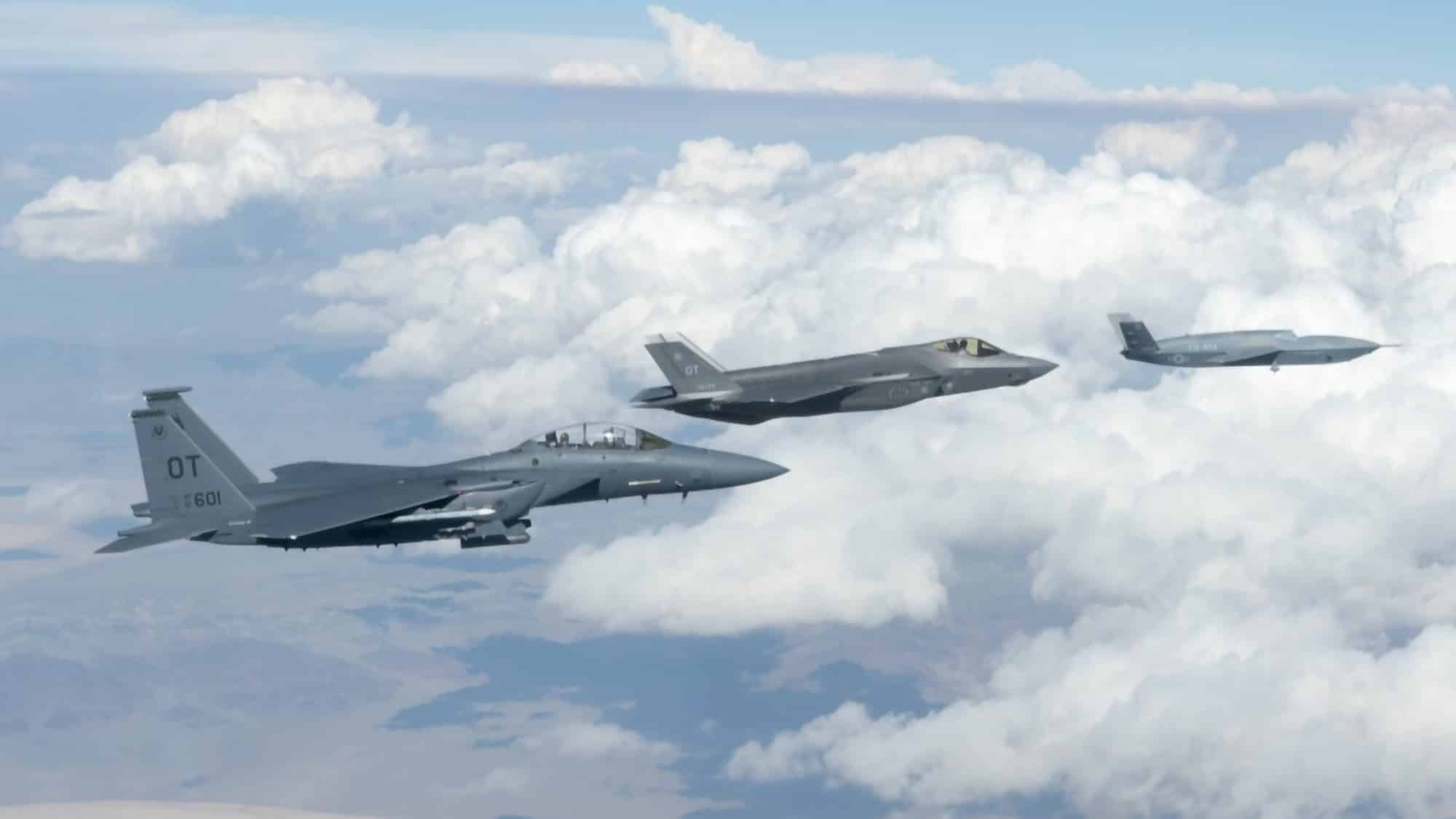
One of the FQ-42 Collaborative Combat Aircraft deployed at Creech AFB has flown alongside an F-35A and F-15E in preparation for collaborative control operations with manned aircraft.
General Atomics Aeronautical Systems has released a photo showing a prototype of its FQ-42 Vengeance Collaborative Combat Aircraft (CCA) flying in formation alongside an F-35A Lightning II and an F-15E Strike Eagle. The image was accompanying the announcement of the delivery of a new FQ-42 to Creech Air Force Base, Nevada on Sept. 18, 2026.
Both the FQ-42 and FQ-44 are deployed at Creech AFB, where they are working with the U.S. Air Force’s Experimental Operations Unit. Last week, during the Air, Space & Cyber Conference, Anduril has similarly released a photo of a prototype of the FQ-44 flying alongside an F-35.
While Anduril said the flight in question was part of an exercise in July, GA-ASI did not disclose when the formation flight of the FQ-42 took place. It is however likely that the GA-ASI’s photo was similarly captured during this summer.
The new FQ-42 Vengeance will continue regular test and evaluation operations aimed at experimentation with the #UAS to advance USAF collaborative combat aircraft development. #Airpower
Read the news: https://t.co/0xfwZo9keq pic.twitter.com/p3jMROCmFs
— General Atomics Aeronautical Systems, Inc (GA-ASI) (@GenAtomics_ASI) September 21, 2026
As we said for the FQ-44, there is an important distinction between flying alongside an F-35 and being controlled or tasked by an F-35. In fact, both the CCAs are currently using their own mission autonomy system while sharing the battlespace with crewed fighters, other CCAs and other aircraft.
The collaborative flights are the next step, which will arrive after testing of the hardware and software required for the uncrewed aircraft to execute the tasks sent by the crewed aircraft. According to Anduril, the first live-flight demonstrations are expected within the coming weeks or months.
“The CCA program’s rate of progress has been incredible,” said Mike Atwood, GA-ASI Vice President of Advanced Programs. “Every week, the Air Force is pushing forward with new and more impressive accomplishments using Vengeance. It’s amazing to think of how far this program has come in such a short amount of time.”
The future of air superiority — FQ-42A Collaborative Combat Aircraft delivers uncrewed #airpower for the U.S. Air Force.
https://t.co/r4gqQv4YTO
#FQ42A #AFANational https://t.co/diBqpj2Due
— General Atomics Aeronautical Systems, Inc (GA-ASI) (@GenAtomics_ASI) September 16, 2026
The company explained the FQ-42 that arrived at Creech will continue regular test and evaluation operations with the Air Force aimed at experimentation with the new aircraft. “Those experiments will replicate company demonstrations previously flown by GA-ASI using MQ-20 as a CCA surrogate to advance CCA operations in parallel to the primary U.S. Air Force development program,” said the press release.
CCA Increment 1 program advances
The delivery of a new FQ-42 to Creech AFB follows the recent announcement of the popular names for both the FQ-42 and FQ-44, which will now be known as Vengeance and Fury, respectively. While for the FQ-44 the service confirmed the name “Fury” already used internally by Anduril, for the FQ-42 it decided to replace the name “Dark Merlin” chosen by GA-ASI.
The service said that “revealing popular names was a natural next step for the CCA program as the Air Force modernizes the nation’s aerial combat fleet.” Secretary of the Air Force Troy Meink, who announced the names, additionally confirmed that the service would have 500 CCAs by 2032, out of the 1,000 planned by the end of the decade.
A U.S. Air Force YFQ-42A Dark Merlin aircraft assigned to the Collaborative Combat Aircraft Experimental Operations Unit descends in the air before landing at Creech Air Force Base, Nevada, July 22, 2026. | Source: U.S. Air Force photo by Staff Sgt. Jake Jacobsen

The development follows the production contracts announced earlier this summer for the CCA Increment 1 program. As we reported in June, the Air Force awarded engineering and manufacturing development and production contracts for the FQ-42 and FQ-44, as well as mission autonomy production contracts.
The service explained that the award arrived months ahead of scheduled because the two uncrewed assets already met rigorous mission requirements and are ready for full-scale manufacturing. One of the changes with the award of the production contracts was the two designs dropping the ‘Y’ designation which indicated prototypes.
On that occasion, Secretary of the Air Force Troy Meink said the goal was “to procure over 150 combat capable CCA by the end of the decade.” With the latest announcement, this goal now changed to 500 aircraft by 2032.
In August, the Air Force also tested portable ground control stations for CCAs, called Portable Command and Control Enclave (C2E). The evaluations featured ground operations demonstrations from leading industry partners, said a statement.
The demonstration, hosted by the Ohio Air National Guard’s 178th Wing at Springfield Air National Guard Base, provided an ideal operational setting for testing these next-generation systems. The system is meant to support Agile Combat Employment operations in austere environments anywhere in the world.
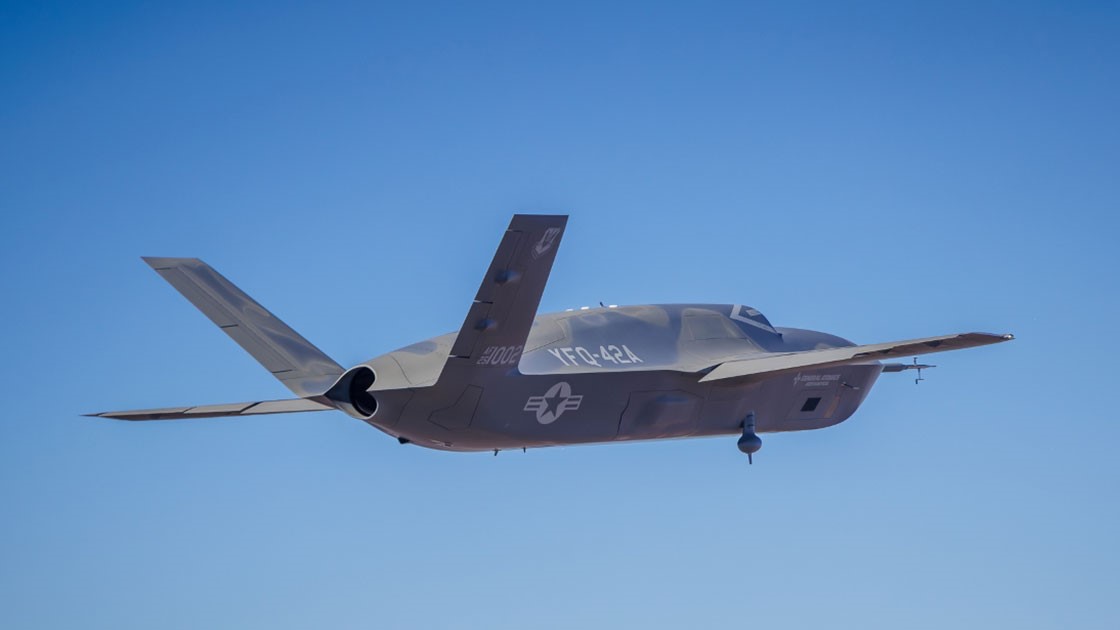
The first YFQ-42 in flight. | Source: GA-ASI
The FQ-42 Vengeance
The FQ-42A is designed for semi-autonomous air-to-air operations and draws on the “genus-species” approach pioneered with the XQ-67A Off-Board Sensing Station (OBSS). GA-ASI says it leveraged advanced model-based digital engineering to accelerate the aircraft’s development while optimizing capabilities for future air dominance.
The YFQ-42 prototype has flown for the first time on Aug. 27, 2025, followed by a second one on Oct. 31, 2025. It is unclear how many aircraft are currently flying, with at least four visible in recent photos and one crashed in an incident in April 2026.
Compared to the XQ-67, the YFQ-42A features an engine air inlet with serrated edges, similar to the B-2 Spirit stealth bomber, as well as apparently slightly modified fuselage mold lines. The nose is also different, changing from the XQ-67’s ‘shovel’-like design to a more conventional one.
Differences can be seen in the wings’ design, with the YFQ-42 showing a higher sweep angle and a higher taper ratio, as well as a larger surface. The V-tails, although they have an angle similar to the XQ-67’s, appear to be shorter, with higher taper ratio and no clipped tips.
These design changes might be the result of attempts to reduce the airframe’s radar cross-section to match stealth requirements of the CCA program. The company has described it as a “5th-generation uncrewed fighter with an internal weapons bay and other features designed for low observability and increased survivability.”
Central to the program is the autonomy core that will make the YFQ-42 able to operate together with manned aircraft. The company says this core has been refined through more than five years of testing on the MQ-20 Avenger, which is also being used to test multiple autonomy agents for the Air Force.
By combining a stealthy, air-to-air-focused design with this AI-driven autonomy, the YFQ-42A is intended to provide warfighters with an advantage in future combat scenarios. Originally intended to complement the Next Generation Air Dominance manned fighter, the Boeing F-47, the CCAs will also fly with the current 5th gen platforms, the F-22 Raptor and the F-35 Lightning II.