USAF Maintainers Restore Vital F-22, B-2 AMAD Testing Capability
After the only test stand capable of validating Aircraft Mounted Accessory Drives failed, maintainers overcame supply-chain challenges, fixed technical problems and cleared a major aircraft maintenance backlog.
The 530th Commodities Maintenance Squadron (530th CMMXS) at Hill AFB, Utah, helped preserve the U.S. Air Force’s ability to sustain its F-22 Raptor and B-2 Spirit fleets by undertaking complex in-house repairs of a test stand used to inspect and repair a component known as the Aircraft Mounted Accessory Drive (AMAD).
The effort to repair the equipment used to inspect and repair aircraft components required the team to work through supply-chain constraints, validate the test stand’s new motor, identify additional deficiencies and update the technical documentation.
For a year, the team put in “563 hours of overtime to restore multiple aircraft to mission-capable status,” and saved a “potential sustainment gap” for two of the U.S. Air Force’s frontline stealth platforms, a Sept. 18, 2026 release from the 75th Air Base Wing said. The 530th Commodities Maintenance Squadron is the Air Force’s depot-level repair facility for aircraft secondary power systems.
AMAD and the test stand
An accessory drive is a gearbox mounted on the outside of a gas turbine engine, typically on the upper or lower part of the engine casing. It drives components like jet fuel starters, air turbine starters, hydraulic pumps, fuel and lubrication oil pumps, AC generators and air compressors.
A test stand may appear to be a relatively simple structure made of welded and fabricated steel bars and beams. However, test stands are essential for testing and repairing components and systems used in vehicles ranging from cars to aircraft. Although test stands are support equipment rather than aircraft systems themselves, their availability is essential to maintaining the components they are designed to validate.
The team also repaired and rebuilt another critical B-2 component in-house, saving tens of thousands of dollars and months of potential aircraft downtime. The 530th CMMXS demonstrated “ingenuity, engineering precision and hundreds of hours of overtime” to restore “a capability vital to America’s stealth airpower,” the release said.
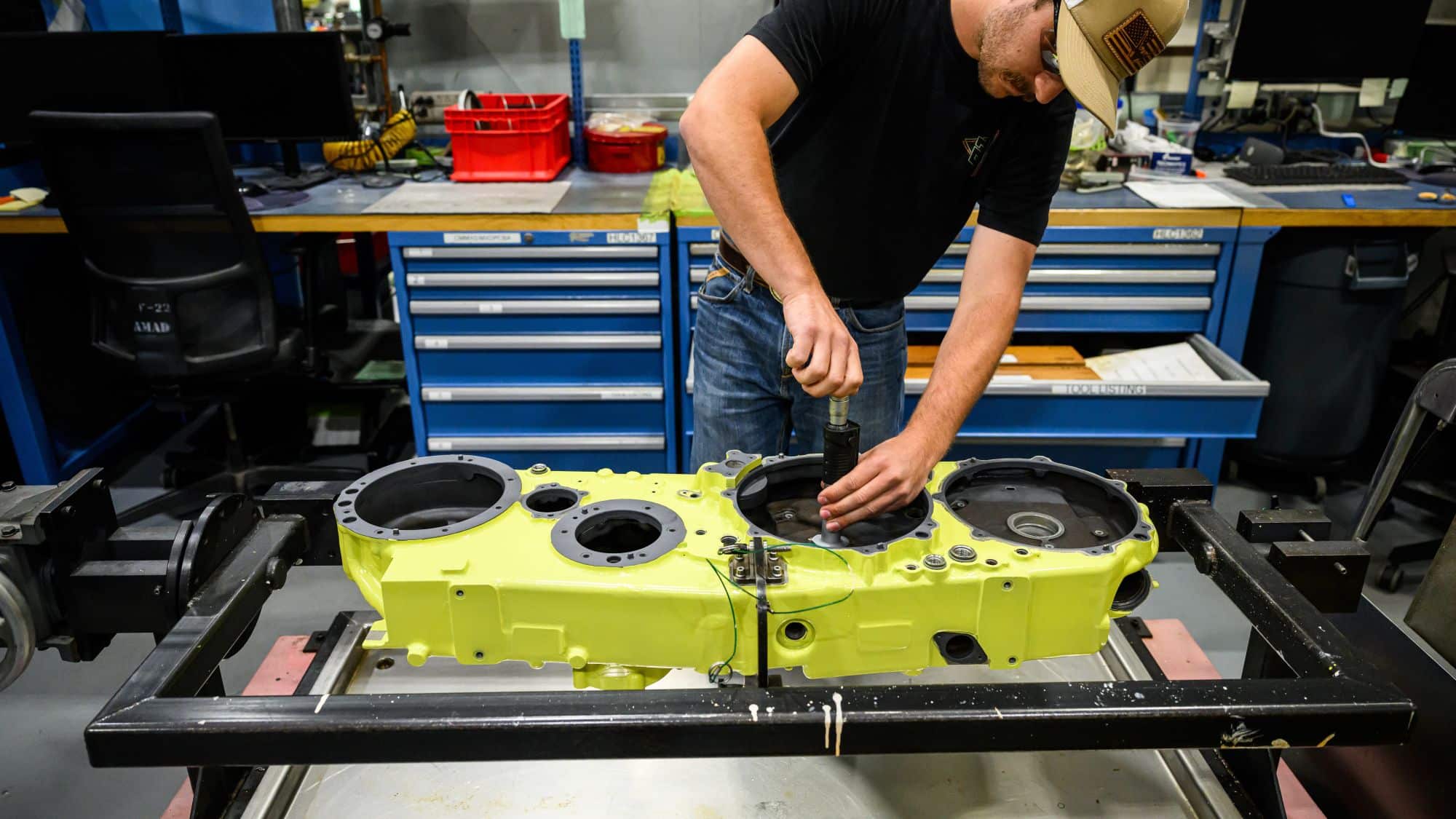
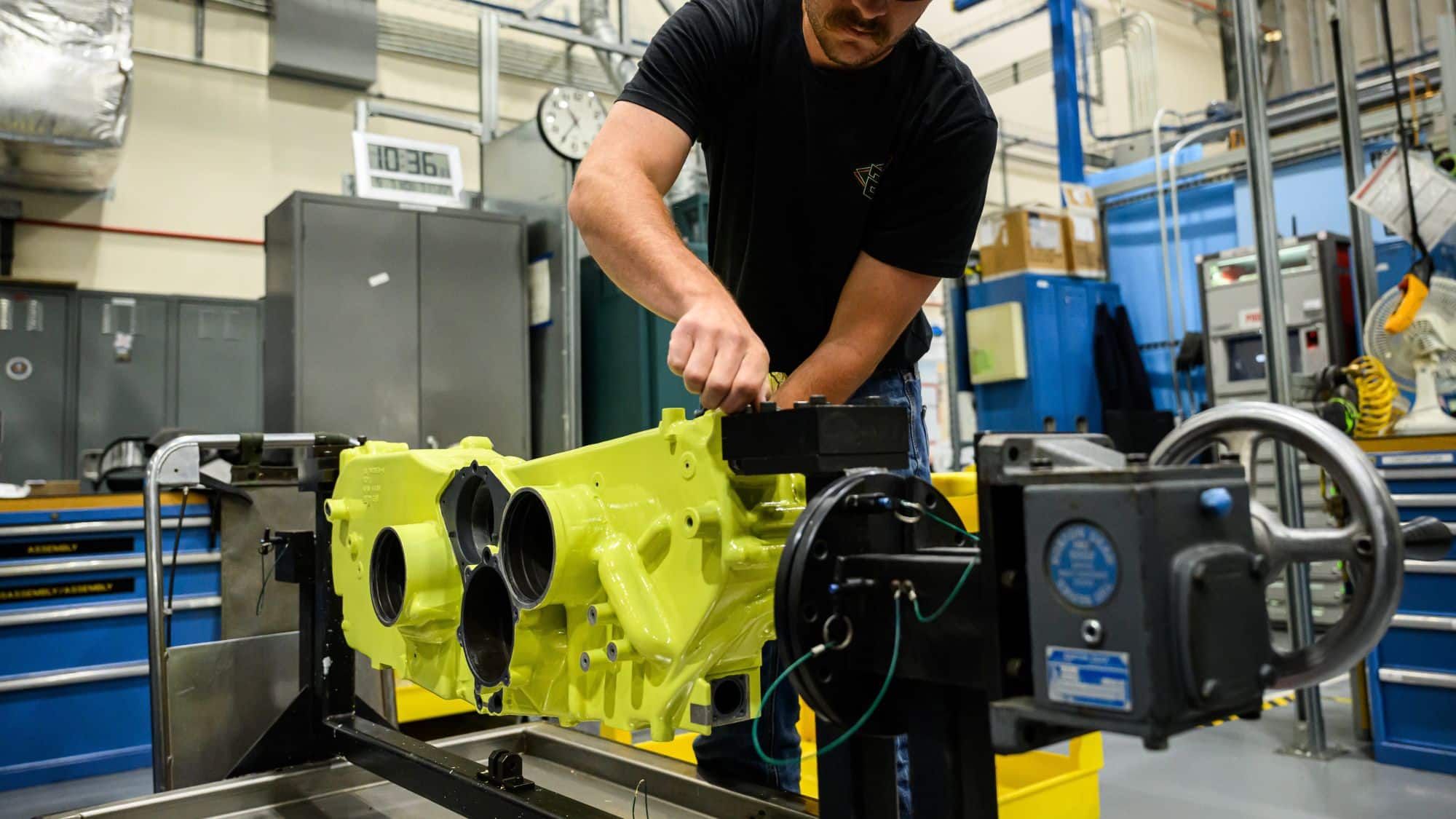
The official release however does not mention whether the AMAD featured in the photo belongs to the F-22 or the B-2.
Joshua Hooker, 530th Commodities Maintenance Squadron, works on an Aircraft Mounted Accessory Drive housing at Hill Air Force Base, Utah. | Source: U.S. Air Force photo by R. Nial Bradshaw
Test stand motor damage and repair
The release described the test stand as “a unique capability” and identified its primary motor failure as the central problem, because “overheating bearings caused repeated burnouts.” The director of operations at the 530th CMMXS, Capt. Douglas Teutsch, said the motor “literally pitched flames at one point.”
The team faced an “out of business” manufacturer and the absence of “technical blueprints or replacements,” leading to an “outage stretched for months impacting the organizations’ ability to sustain weapon system readiness.” The 530th CMMXS maintainers then accelerated the warranty repair process, and “worked through weekends to install, align, vibration‑check, and calibrate the new motor – finishing in just seven days instead of the standard 14.”
However, new issues cropped up. Upon visiting the motor’s original equipment manufacturer, the team learned that “oiler nozzles weren’t properly lubricating the bearings, prompting design changes to keep temperatures below 130 degrees.”
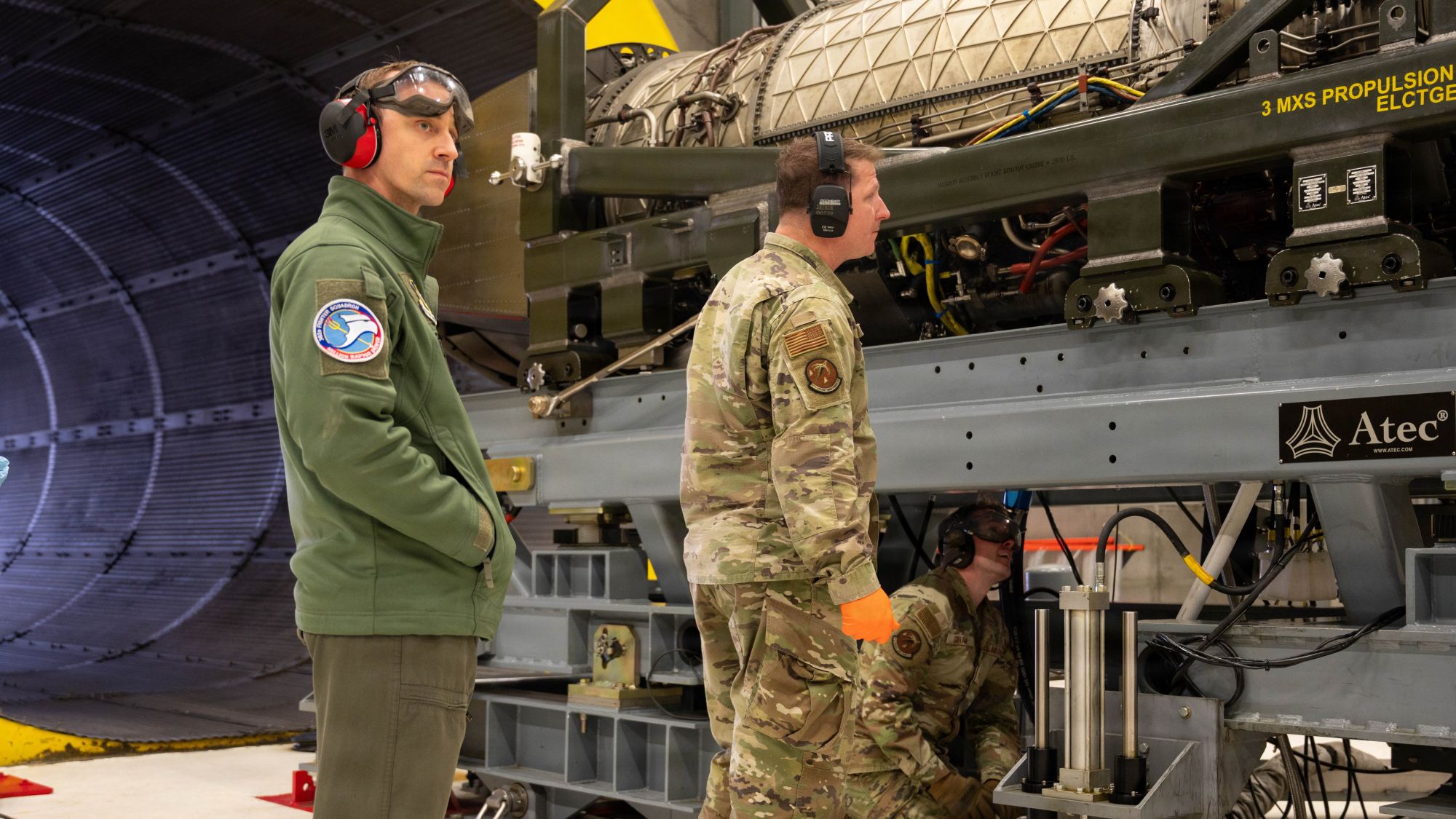
U.S. Air Force Master Sgt. James Kukuk, 477th Aircraft Maintenance Squadron flight chief, and U.S. Air Force Master Sgt. Christopher Graham, 477th AMXS crew chief, are joined by a U.S. Air Force F-22 Raptor pilot during an engine run on Joint Base Elmendorf-Richardson, Alaska, April 8, 2026. | Source: U.S. Air Force photo by Tech. Sgt. Joseph Miller
“Production and engineering teams then conducted a full technical requirements analysis, uncovering 30 deficiencies in the outdated tech data,” resulting in a “detailed review of mounds of paperwork,” Teutsch said. One major improvement, a redesigned spline adapter, reduced vibration during AMAD testing by 37 percent.
The team also implemented a new two‑person operating concept for all test operations, where “one monitors system levels while the other makes fine-tuning adjustments.” With the test stand now operational, personnel logged 563 hours of overtime to clear the “immense backlog” and “restore multiple aircraft to mission‑capable status.”
The team also identified a failed integrated drive generator gearbox on the B-2 in time to prevent further delays. “With no replacement available […] five mechanics and engineers dismantled and rebuilt it by hand, saving $39,000 and preventing an eight‑month outage,” the release added.
They also reconfigured two gearboxes and four hoses with new fittings to prevent B‑2 and F‑22 configurations from being “mistakenly interchanged, eliminating a $7 million risk.”
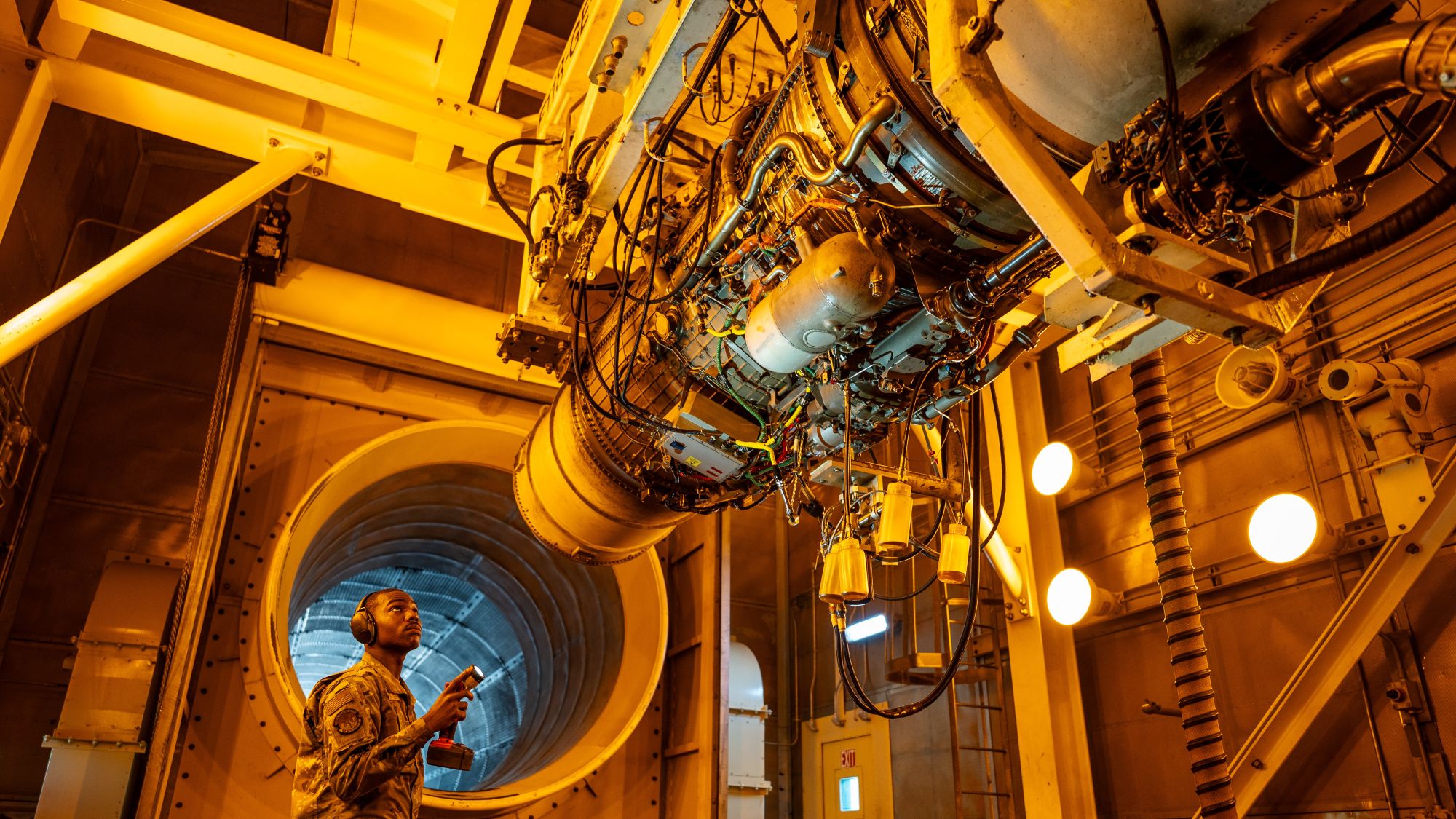
U.S. Air Force Airman 1st Class Tavi Carter-Smith, 509th Maintenance Squadron aerospace propulsion journeyman, performs a leak check on a running B-2 Spirit aircraft engine in the test cell at Whiteman Air Force Base, Missouri, Aug. 20, 2025. | Source: U.S. Air Force photo by Staff Sgt. Joshua Hastings
“We’ve taken steps to bolster what we have,” Teutsch said. “We have backups of critical parts and are working to obtain a second motor; so, if something goes down, it won’t stay down long.”
Tied to larger industrial issues
The U.S. military has also undertaken in-house sustainment work on other major aviation components, including the repair of damaged panels of a C-17 Globemaster III and the lift-fan clutch and the three-bearing swing module (3BSM) of an F-35B STOVL aircraft. These efforts also illustrate how maintainers sometimes have to work around unavailable suppliers, limited sources for specific components, and reviewing extensive technical data and engineering documentation from the Original Equipment Manufacturer (OEM).
The latest engine-related work also reflects larger changes in the aerospace industrial base. GE Aerospace made headlines recently after it acquired Consolidated Precision Products (CPP) for $11.75 billion, aiming to break the supply chain bottlenecks of precision metal turbine blades in the jet engine industry.
The vertical integration helps the company secure uninterrupted supply of critical parts, reduce vendor dependence and increase production capacity to address delivery backlogs. These industrial and manufacturing considerations can also influence weapons design and acquisition, with potential effects extending to the tactics and strategy employed in the battlespace.