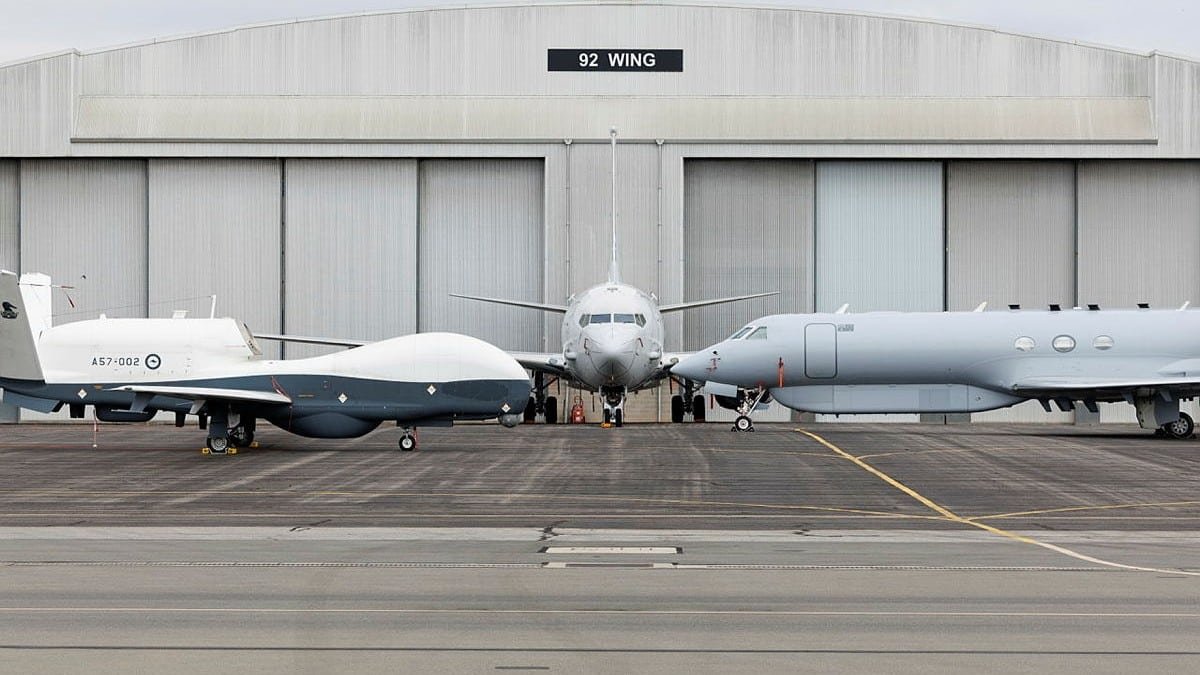
RAAF Declares Initial Operational Capability for MQ-4C Triton and MC-55A Peregrine
Australia’s long-range ISR and airborne electronic warfare capabilities reached a major milestone as the MQ-4C Triton and the MC-55A Peregrine achieved IOC.
The Royal Australian Air Force (RAAF) has declared Initial Operational Capability (IOC) for its MQ-4C Triton unmanned aircraft and MC-55A Peregrine Intelligence, Surveillance, Reconnaissance and Electronic Warfare (ISREW) aircraft. The announcement, arrived on Sept. 22, 2026, also mentions the completion of the ongoing upgrades in the U.S. for the first two P-8A Poseidon maritime patrol aircraft.
The milestone follows extensive Operational Testing and Evaluation (OT&E) and marks a significant step in the country’s efforts to strengthen its airborne intelligence-gathering and maritime surveillance capabilities across the Indo-Pacific. The two platforms form part of a broader effort to provide the Australian Defence Force (ADF) with complementary crewed and uncrewed capabilities, including persistent surveillance, intelligence collection and electronic warfare effects.
A major step forward for Air Force’s ISR fleet. With the MQ-4C Triton and MC-55A Peregrine now operational, and P-8A Poseidon upgrades underway, Australia is strengthening its ability to monitor and respond across the region. pic.twitter.com/eCBHkxpUHo
— Royal Australian Air Force (@AusAirForce) September 22, 2026
“Our people have been at the heart of delivering the air intelligence, surveillance and reconnaissance capability for Australia, demonstrating exceptional skill, professionalism and dedication in bringing these complex systems into service,” said the Chief of Air Force, Air Marshal Stephen Chappell. “I congratulate our whole Air Domain team, from across industry, the public service and Air Force for their exceptional work to deliver these cutting-edge capabilities for Australia.
MQ-4C Triton
Australia is acquiring four MQ-4C Triton unmanned aircraft, of which three have been already delivered and the final one is planned for delivery in 2028. All four aircraft will be based at RAAF Base Tindal, and operated by RAAF’s No. 9 Squadron, under No. 92 Wing, located at RAAF Base Edinburgh, South Australia.
A Royal Australian Air Force MQ-4C Triton taxies at RAAF Base Tindal. | Source: Australian Defence Force/AC Ashley Onslow
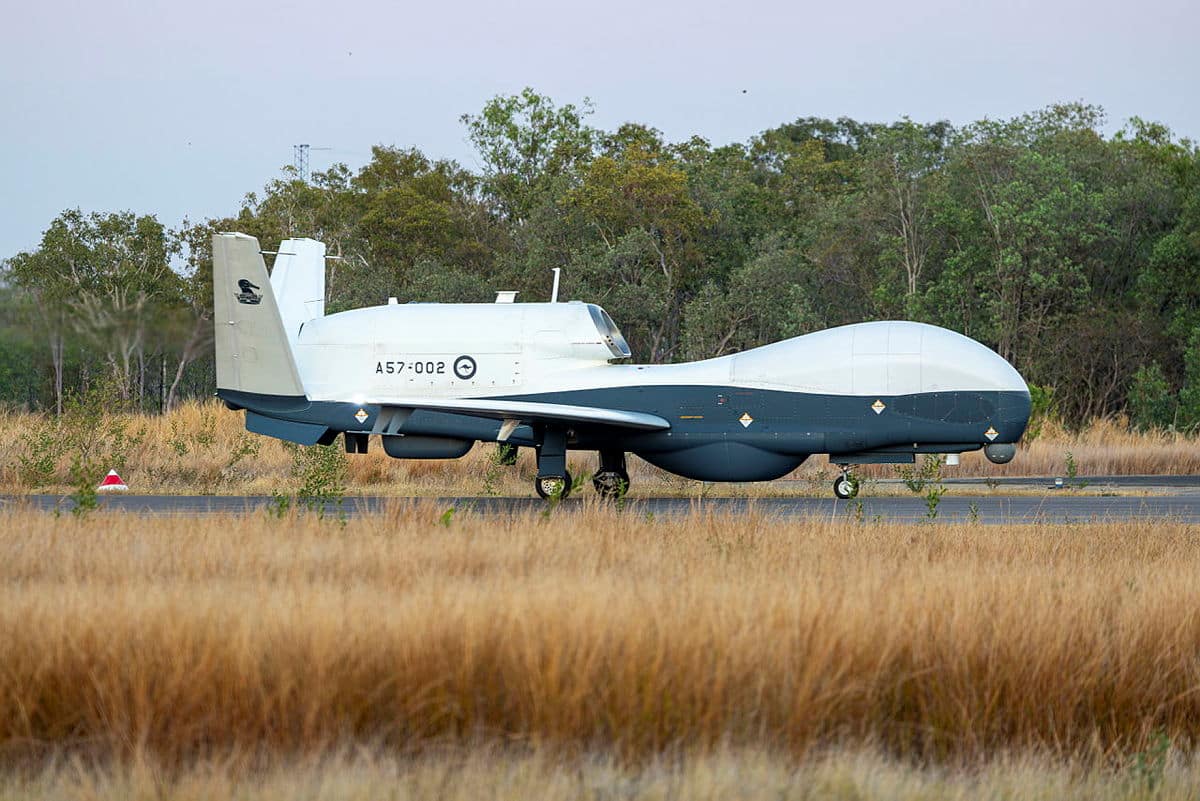
The high-altitude, long-endurance unmanned aircraft is designed to provide persistent intelligence, surveillance and reconnaissance (ISR) coverage over extensive maritime areas. “It delivers unprecedented persistence and awareness over Australia’s extensive maritime domain in support of the integrated focused force,” Air Marshal Chappell said.
According to the Australian Department of Defence, the achievement of IOC strengthens the RAAF’s ability to deliver long-range, persistent and networked surveillance and reconnaissance across Australia’s primary area of military interest. The Triton is intended to complement the RAAF’s crewed maritime patrol fleet, including the P-8A Poseidon, as a “family of systems” that will provide support to national security response activities, both domestically and abroad.
The Australian MQ-4C program is part of the country’s investment in long-range surveillance capabilities, allowing the RAAF to monitor large areas while integrating information gathered by different airborne and maritime platforms. The RAAF is the only operator of the type outside of the U.S., while NATO recently announced the acquisition of its own fleet of Tritons.
The MQ-4C, which was also known as Broad Area Maritime Surveillance (BAMS), is believed to be a sort of Block 20 and Block 30 Global Hawk hybrid, carrying a payload including an AN/ZPY-3 multi-function active-sensor (MFAS) radar system. This gives the Triton the ability to cover more than 2.7 million square miles in a single mission that can last as long as 24 hours at a time, at altitudes higher than 50,000 ft, with an operational range of 8,200 nautical miles.
MC-55A Peregrine
Alongside the Triton, the RAAF has also declared IOC for the MC-55A Peregrine. Australia is acquiring four MC-55A aircraft, of which three have been delivered earlier this year and the final aircraft will be delivered by the end of the year.
A Royal Australian Air Force MC-55A (A51-003) Peregrine conducts its first fully crewed mission as part of No. 10 Squadron at RAAF Base Edinburgh, South Australia. | Source: Australian Defence Force/AC Ivan Smotrov
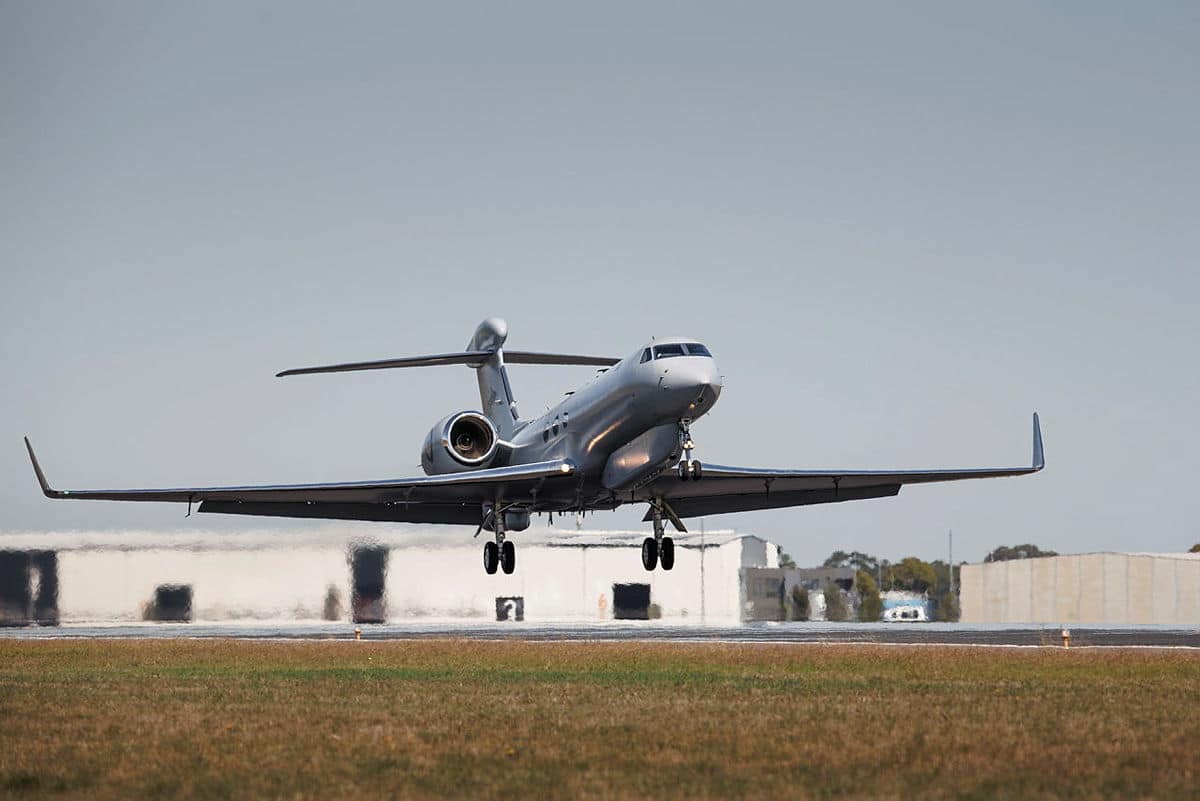
The aircraft, based on the Gulfstream G550 business jet airframe, is operated by No. 10 Squadron from RAAF Base Edinburgh, South Australia. The Peregrine has been developed as a specialized airborne ISREW platform, intended to provide intelligence collection and electronic warfare capabilities in support of Australian Defence Force operations.
Its introduction expands the RAAF’s ability to conduct airborne intelligence missions and contributes to the service’s broader electronic warfare architecture. The ADF says it “will integrate seamlessly into the broader ISR enterprise at RAAF Base Edinburgh, complementing platforms such as the P-8A Poseidon and MQ-4C Triton, and forming a link in Australia’s sovereign network of surveillance and electronic warfare assets.”
The specific suite of sensors fitted to the MC-55A has not been revealed, but the aircraft is said to be equipped with an array of advanced signals intelligence (SIGINT) capabilities, as well as ISR and Electronic Warfare. The large canoe-shaped fairing under the forward fuselage likely contains Leonardo’s Osprey 50 Active Electronically Scanned Array (AESA) radar, as the company disclosed in 2022.
Part of a Broader ISR Modernization Effort
The IOC declarations for the MQ-4C Triton and MC-55A Peregrine were announced alongside additional milestones involving Australia’s maritime patrol and ISR capabilities.
An Air Force P-8 Poseidon aircraft performs a handling display at Nobby’s Beach during the Newcastle Williamtown Air Show 2023. | Source: Australian Defence Force/FSGT Ricky Fuller
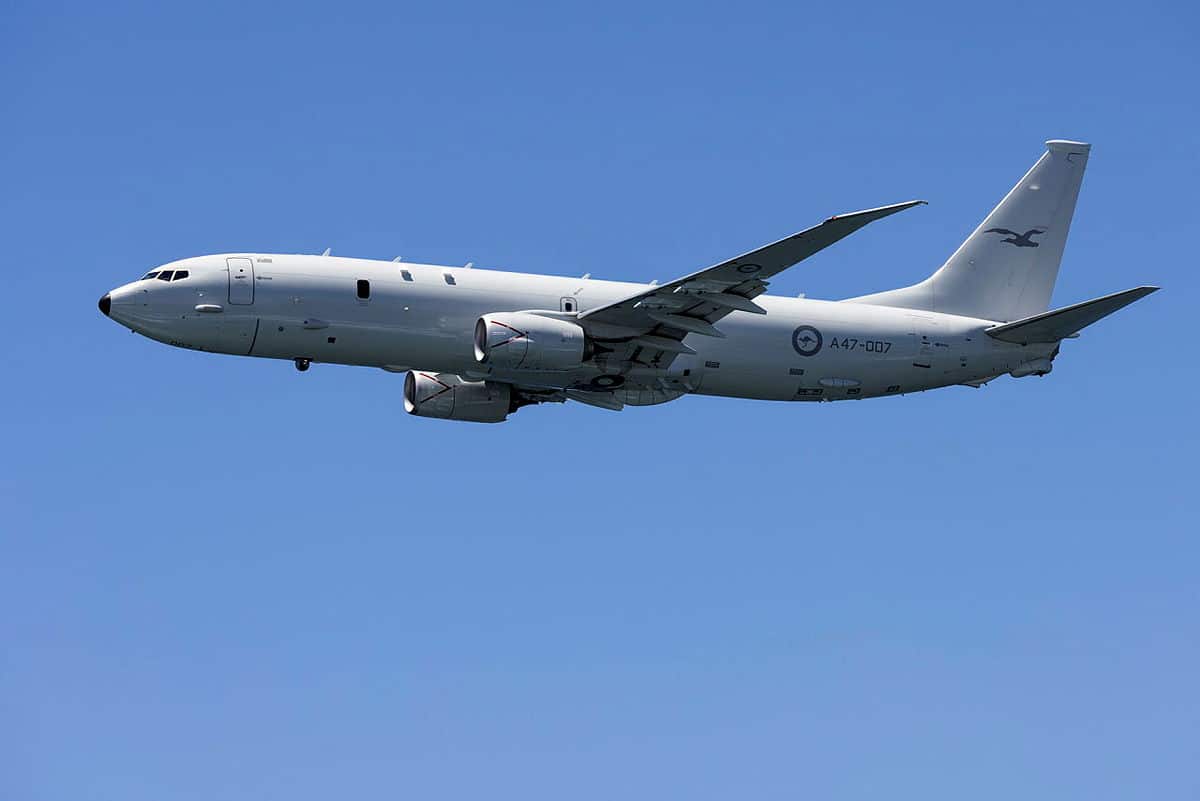
In addition to the IOC, the Australian Department of Defence also highlighted the completion of the planned 14-aircraft Boeing P-8A Poseidon fleet, with the final aircraft delivered in May 2026. Meanwhile, the aircraft are now being upgraded with Increment 3 Block 2 enhancements.
The first two Poseidons were upgraded in the U.S., with the work now completed. The remaining aircraft will be upgraded in Australia, supported by Boeing Australian and the new Deep Maintenance and Modification Facility at RAAF Base Edinburgh.
Together, these developments for the three platforms are intended to strengthen the ADF’s maritime patrol, anti-submarine warfare, anti-surface warfare and intelligence-gathering capabilities.
“The Albanese government is investing approximately $5.5 billion over the decade to continue to enhance the ADF’s air intelligence, surveillance and reconnaissance and maritime patrol and response capabilities that will create additional opportunities for Australian industry well into the future ,” said acting Prime Minister and Minister for Defence Richard Marles.