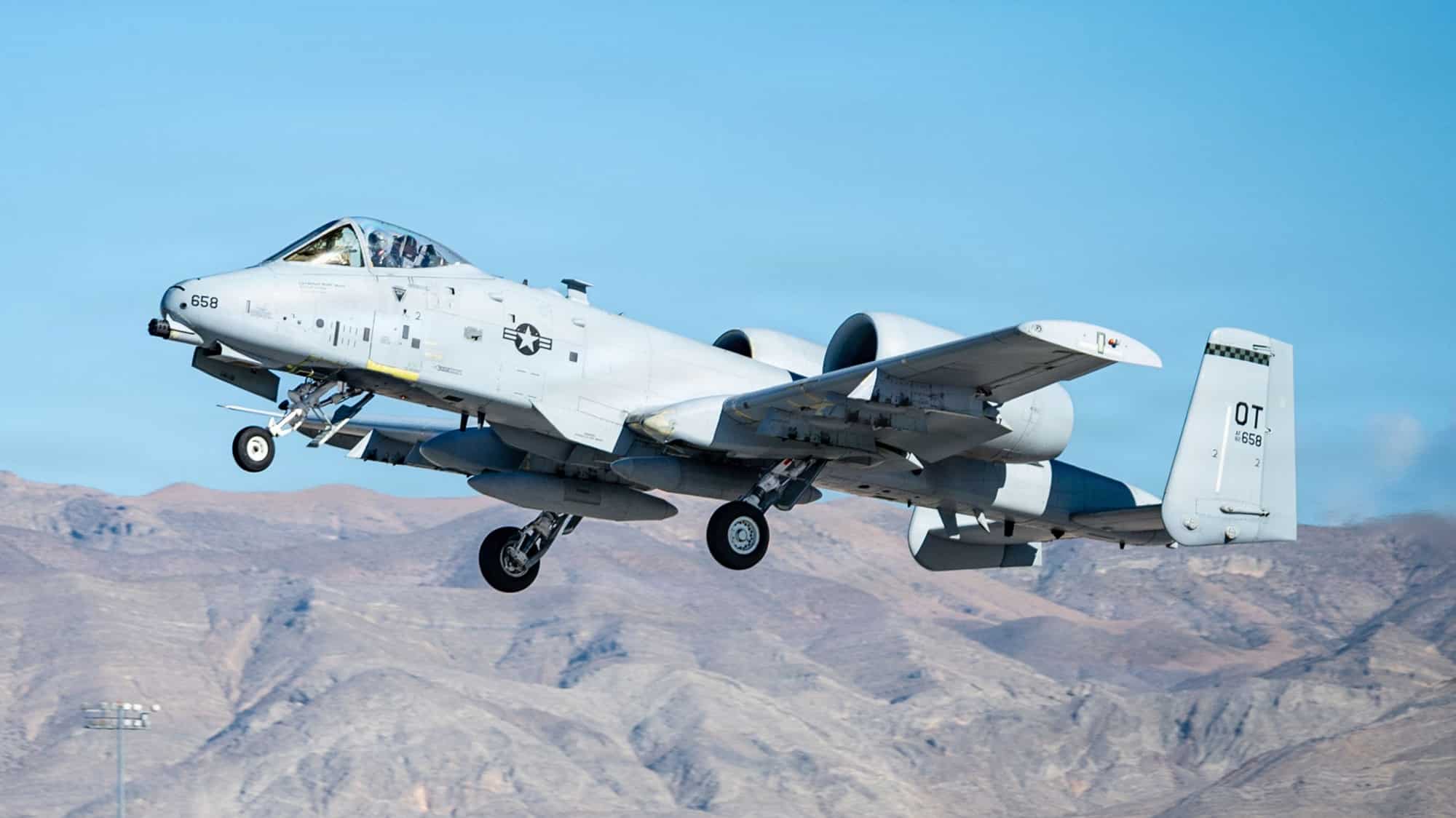
Final A-10C Thunderbolt II Leaves Nellis AFB
A month after the final training sortie with the 66th Weapons Squadron, the last A-10C Thunderbolt II assigned to Nellis AFB has left the base.
The last A-10 Thunderbolt II assigned to Nellis Air Force Base, Nevada, departed the base for the final time on Sept. 22, 2026, headed toward its new home. The departure comes a month after the final training sortie with the 66th Weapons Squadron on Aug. 18, which marked the end of the type’s operations with the U.S. Air Force Weapons School.
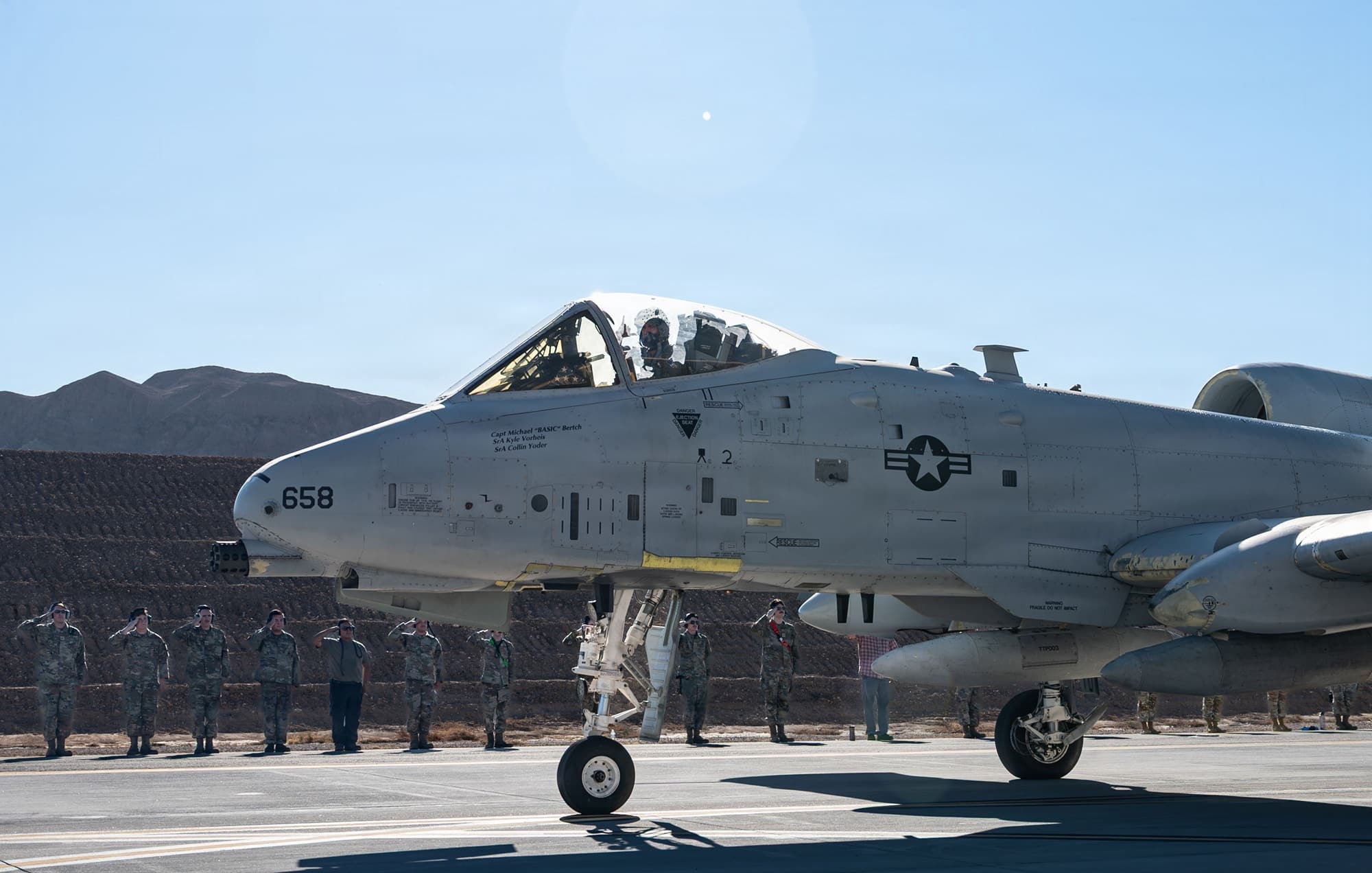
The service said that nearly 70 Airmen lined up on the flight line to give the Warthog, 82-0658, a final salute as it took off. During its time at Nellis, after it first arrived in 1977, the aircraft contributed to the training of more than 300 A-10 weapons officers across 100 classes.
The transition
The Air Force further said that, even after the conclusion of the type’s activities at Nellis, “the A-10’s impact will not soon be forgotten.” The A-10’s foundational tactical expertise, operational roles and personnel are now transitioning to multirole and advanced fighter platforms across the service.
“We are maintaining the culture of the A-10 by involving as many other fighter communities involved in the close air support mission,” said Lt. Col. Ridge Flick, the 66th WPS commander. “We are also training F-15 Eagle, F-35 Lightning II and F-16 Fighting Falcon pilots to take on some roles we have had in combat search and rescue.”
U.S. Air Force Brig. Gen. Scott C. Mills, left, 57th Wing commander, and Lt. Col. Ridge Flick, 66th Weapons Squadron commander, salute an A-10 Thunderbolt II aircraft at Nellis Air Force Base, Nevada, Sept. 22, 2026. | Source: U.S. Air Force photo by Staff Sgt. Lauren Clevenger
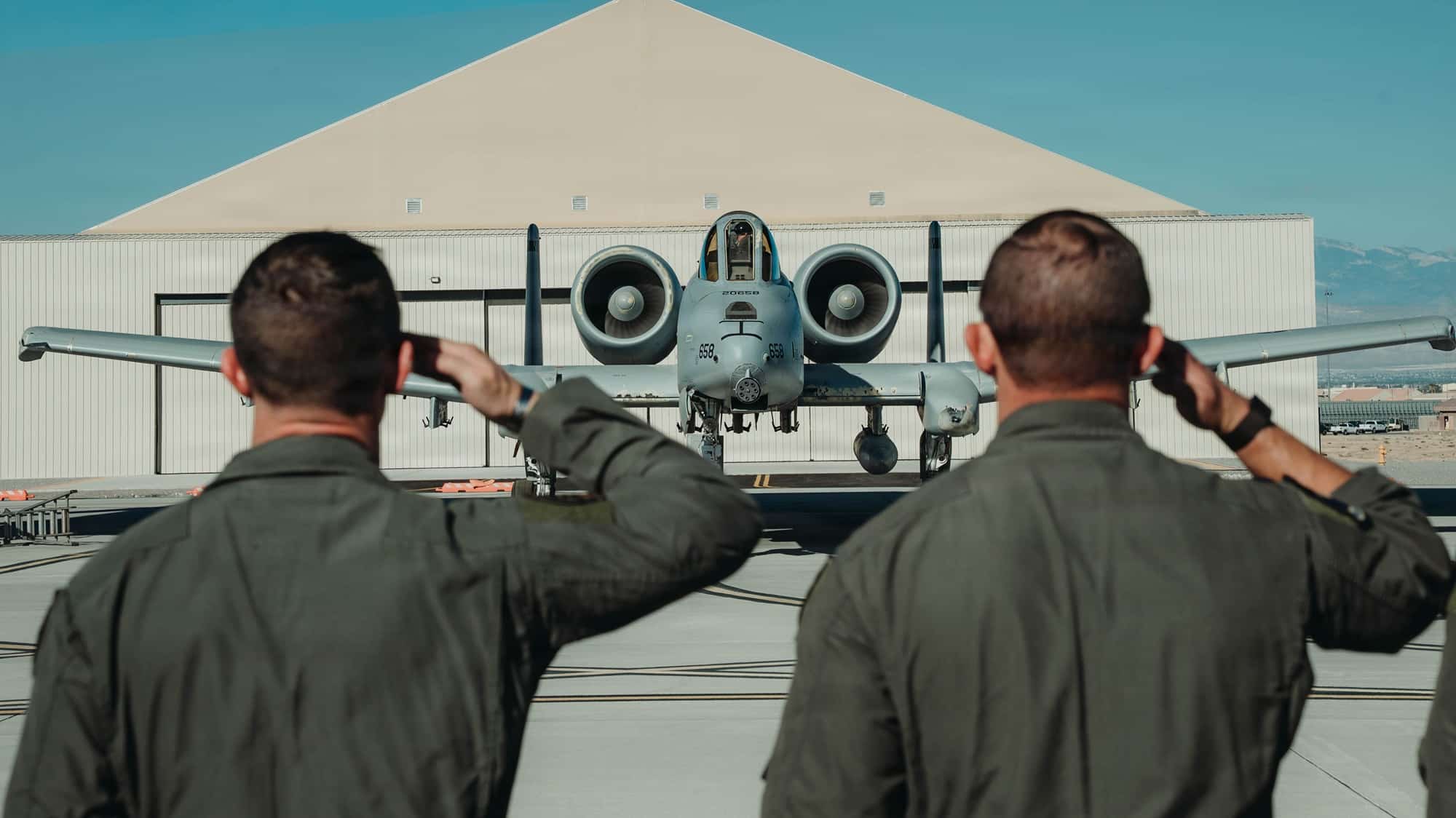
Airmen from the 757th Aircraft Maintenance Squadron’s Thunder Aircraft Maintenance Unit are being reassigned to other squadrons and airframes, such as the F-35 and the F-16. At the same time, fifth-generation platforms like the F-35 are absorbing new close air support and combat search-and-rescue command roles into their operational profiles.
Regarding the 66th WPS, Lt. Col. Flick emphasized the squadron’s mission of forging elite tactical leaders remains unchanged. The unit will continue training the next generation of ground-based specialists, including combat rescue officers, pararescue, special tactics officers and combat controllers.
“Although the A-10’s engines have gone quiet at Nellis, the tactical DNA forged over five decades of service remains hardwired into the flight line,” said the Air Force. “The transition marks less of a retirement and more of an evolution, ensuring that the Warthog’s legendary commitment to protecting troops on the ground is carried forward by the Airmen and advanced platforms shaping the future fight.”
The A-10’s retirement
The A-10 has played an important role in the U.S. Air Force’s close air support mission since entering service in the 1970s. Designed around the requirements of supporting ground forces, the aircraft combines a heavily protected airframe with the GAU-8/A Avenger 30 mm cannon and the ability to employ a wide range of precision-guided and unguided weapons.
U.S. Airmen assigned to Nellis Air Force Base salute an A-10 Thunderbolt II aircraft at Nellis AFB, Nevada, Sept. 22, 2026. | Source: U.S. Air Force photo by Airman Isabella Borrillo
However, the requirements have now changed and many argue the A-10C is not fully relevant in modern combat scenarios. The aircraft is considered vulnerable in highly contested airspaces with Anti-Access/Area Denial (A2/AD) systems, thus resulting in a shift toward more survivable platforms.
The end of the A-10’s flight operations represents yet another step towards the retirement of the aircraft. These steps appear to be continuing even if the service announced that it would retain two squadrons through 2030.
These will be one active-duty squadron at Moody Air Force Base, Georgia, and one Air Force Reserve squadron at Whiteman Air Force Base, Missouri. However, things might still change and the A-10’s time in the Air Force further extended.
In fact, in an attempt to further delay the retirement, Rep. Abe Hamadeh (R-Ariz.) introduced in the U.S. Congress the ‘BRRRRT Act’, or ‘Bolstering Recognition, Resurgence, Retention, and Remembrance of the Thunderbolt’, (H.R. 9780) on July 20, 2026. The bipartisan bill would require the U.S. Air Force to maintain a viable A-10 fleet through Fiscal Year 2033, as well as halting the dismantling of the infrastructure needed to sustain the aircraft.
The bill was referred to the Committee on Armed Services, and goes considerably further than simply preventing the U.S. Air Force from retiring the A-10 Thunderbolt II. The bill would require the Air Force to maintain at least 126 A-10 aircraft and restore depot maintenance, pilot training, sustainment activities and flight testing.
In order to proceed with the retirement, the Secretary of War would have to certify that a replacement aircraft has fully assumed the A-10’s mission before any further divestment could proceed. That certification would also need to be approved in writing by the Secretary of the Army, the Commandant of the Marine Corps, and the Commander of U.S. Special Operations Command.