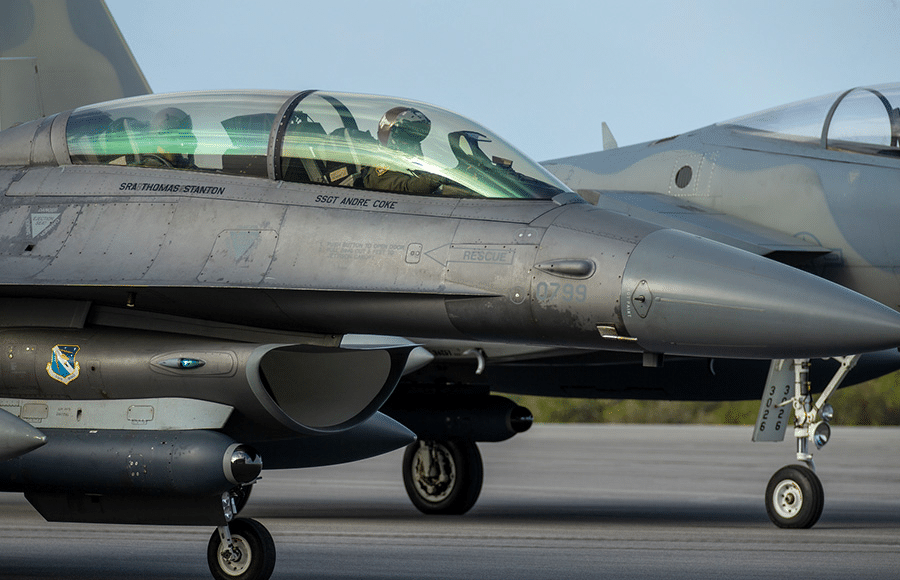
Lockheed Martin Demonstrates Legion IRST Networking with Pod-to-Pod Data Link
The new capability allows two F-16s equipped with Legion sensor pods to share tracking data, improving track accuracy and enabling near-instantaneous passive ranging against multiple airborne targets.
Lockheed Martin has demonstrated a new networking capability with a dedicated datalink for its Legion infrared search-and-track (IRST) sensor pod. During the test, two pods were connected through the HiveLink data link developed by L3Harris, improving tracking accuracy by leveraging the shared data.
The flight tests, conducted in cooperation with the U.S. Air National Guard and the Air Force Reserve Test Center (AATC), involved two F-16 Fighting Falcons equipped with Legion sensor systems enhanced with a pre-production version of HiveLink. The aircraft operated from Morris Air National Guard Base in Tucson, Arizona.
According to Lockheed Martin, the two pods successfully connected through HiveLink during the tests, allowing them to share data and improve the accuracy of their respective tracks. This capability is intended to provide aircrews with faster and more precise situational awareness, particularly in radar-denied and contested environments.
From passive tracking to networked targeting
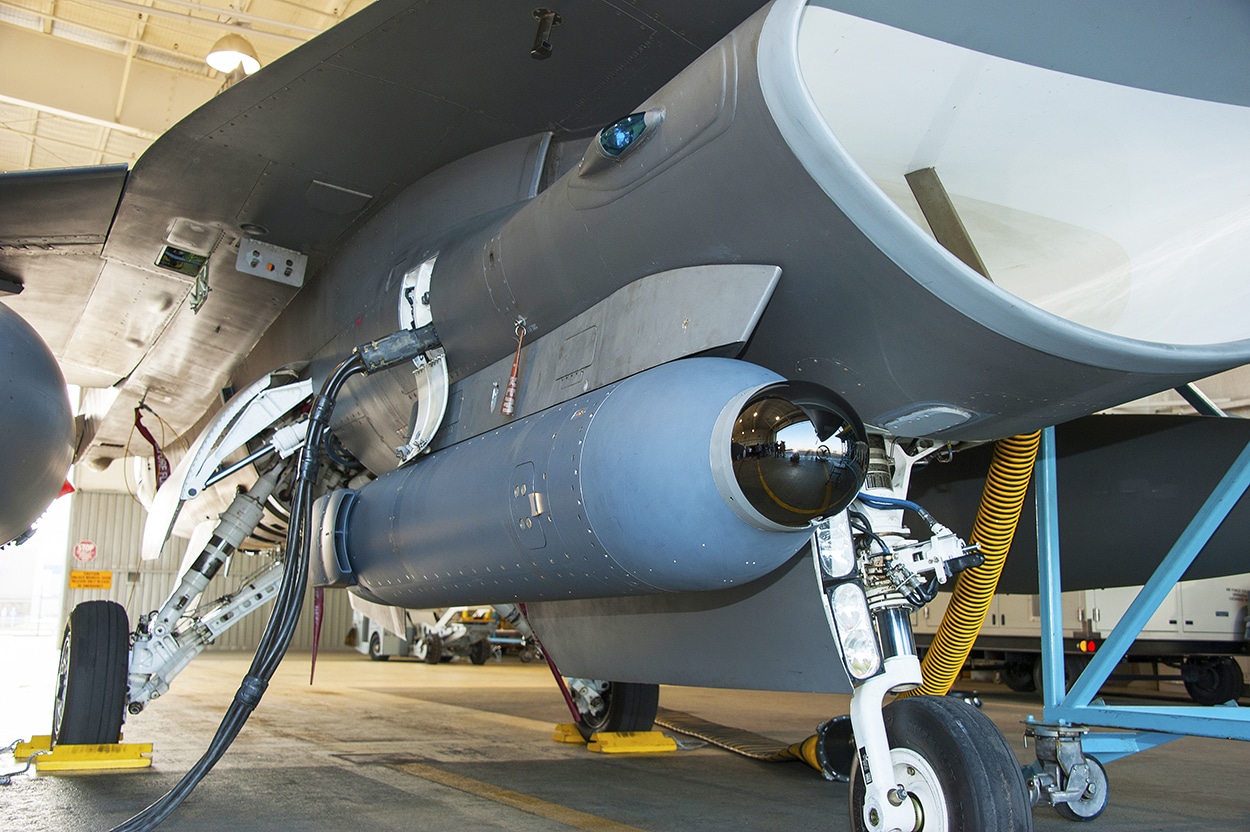
Legion, formerly known as IRST21, is a passive infrared search-and-track system designed to detect and track airborne targets without relying on active radar emissions. The system uses infrared sensing to support the identification and tracking of threats, offering an alternative or complement to conventional radar-based detection.
The Legion pod installed on an F-16 Fighting Falcon. | Source: Lockheed Martin
This capability is particularly relevant in contested environments, where aircraft may need to limit radar emissions to reduce their electromagnetic signature. Passive infrared sensors detect the thermal signatures of airborne objects without actively illuminating them, and thus without being detected by the target’s radar warning receiver (RWR).
Also, it can complement radar systems to detect aircraft with low observability. However, detecting and tracking a target does not automatically provide the same precise range information that a radar can generate.
The integration of a dedicated pod-to-pod data link represents a further development of Legion’s capabilities, addressing the limitation. By sharing information between sensors mounted on separate aircraft, the system can improve track accuracy and establish “near-instantaneous” range information for multiple targets thanks to triangulation.
Lockheed Martin describes the capability as providing aircrews with rapid “depth perception,” helping them prioritize contacts and develop engagement solutions more quickly. The company says the networking capability can reduce pilot workload and accelerate target engagement timelines while preserving aircraft bandwidth for other mission requirements.
HiveLink and future growth
The demonstration used a pre-production version of HiveLink. According to Lockheed Martin, the data link provides resilient line-of-sight and beyond-line-of-sight connectivity for operations in contested and denied environments.
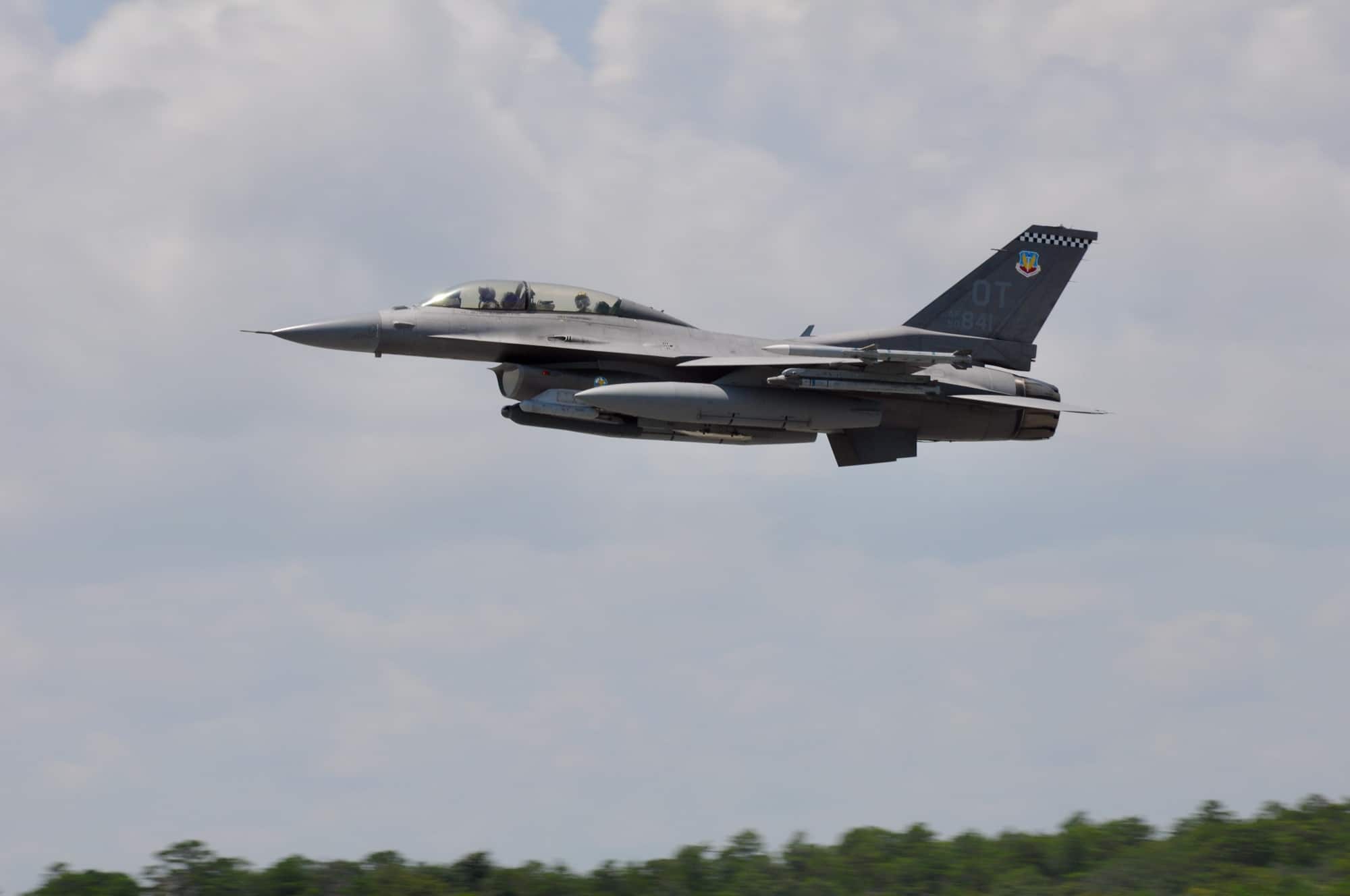
An F-16 Fighting Falcon, piloted by Lt. Col. Jeremy “Clutch” Castor, from the 85th Test and Evaluation Squadron takes flight on its first ever flight with the Legion Pod. | Source: U.S. Air Force photo by 1st Lt Savanah Bray
HiveLink combines mesh networking, CDL interoperability and flexible waveforms intended to support a range of platforms and missions. L3Harris describes it as a “self-forming, self-healing network architecture helps maintain connectivity even when individual nodes are disrupted.”
Lockheed Martin is currently flight-testing Legion on F-16 aircraft under a contract with the Air National Guard. The testing is intended to validate the system’s performance, transportability and interoperability.
Future development efforts are expected to include software-defined radios, multi-waveform gateways and support for manned-unmanned teaming (MUM-T), says the company. It should be noted that the pod has also been tested on the X-62 VISTA and the MQ-20 Avenger, which are being used for development work related to autonomy and MUM-T.
The company’s modular open-systems approach is intended to allow additional capabilities to be integrated into Legion as requirements evolve, potentially expanding its role beyond passive detection and tracking toward a more networked targeting capability. A similar approach is being used for the new Sniper Networked Targeting Pod (NTP), although it uses a different data link solution.
Legion’s deployment on U.S. fighter aircraft
The Legion pod is already fielded and in production for the U.S. Air Force. The system supports operational interoperability across F-15 and F-16 platforms, while its podded design allows it to be adapted for additional fighter, non-fighter and unmanned aircraft without requiring a dedicated internal installation.
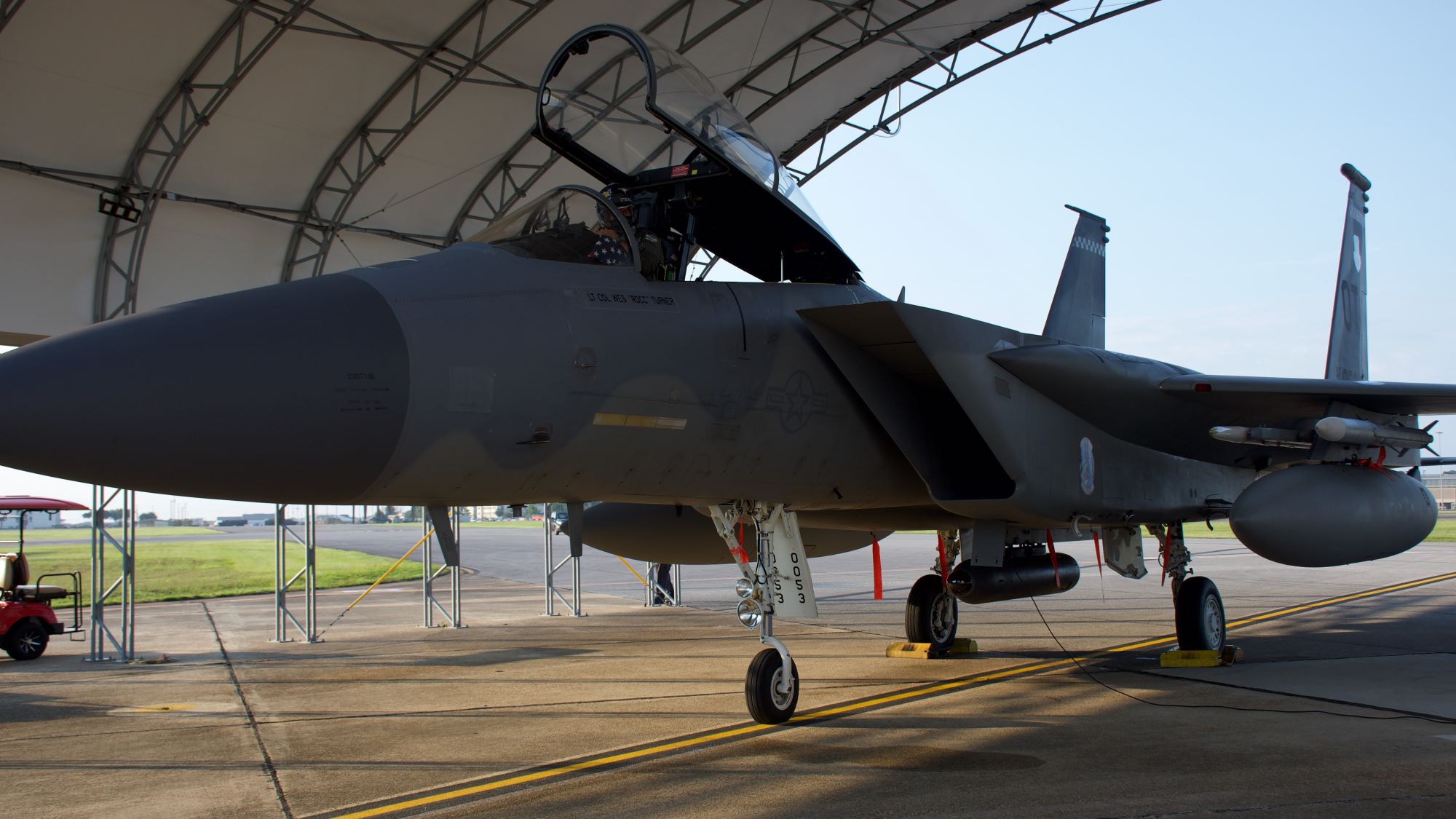
An F-15C Eagle from the 85th Test and Evaluation Squadron, showcasing Lockheed Martin’s Legion Pod IRST Block 1.5 system. | Source: U.S. Air Force photo by 1st Lt Lindsey Heflin
The system builds on Lockheed Martin’s experience with earlier IRST technologies, which the company says have accumulated more than 300,000 flight hours on F-14 and F-15 platforms. Its open architecture is also designed to enable threat data to be fused with other sensors and shared across the battlespace.
“Use of the Legion Pod and its IRST capabilities allows a pilot to have another sensor that integrates with the aircraft and builds a more complete picture of the battlespace,” said the U.S. Air Force following the first test flight of the pod on the F-16 in 2020. Because of its use of infrared, it provides the ability to identify, track and shoot enemy aircraft in a RADAR jamming environment to include stealth aircraft that a traditional radar may not see.
Before the F-16, the pod was integrated on the F-15C, with the first flight in 2016. In 2022, the service declared the Initial Operational Capability of Legion on the F-15.
“In today’s warfighting environment, not only do we have the capability and technology to jam and counter radar, but our enemies do too,” said Maj. Daniel Hermanski, Air Combat Command’s F-15 requirements branch chief. “This pod is the next step for countering jamming technology and allowing our warfighters to fight and track the enemy in contested environments.”
Because of this, the pod is being prominently featured in test campaigns, including the ongoing Gray Flag, which also sees the pod installed on the new F-15EX Eagle II.
A gaggle of F-16’s from Arizona 2 with @SpaceX #STARSHIELD antenna in the rear of the cockpit, arriving into MUGU for #GrayFlag2026 09-21-26 pic.twitter.com/W6XVhZ6LQa
— Matt Hartman (@ShorealoneFilms) September 22, 2026
My EX’s showed up lolol #F15EX #GrayFlag2026 pic.twitter.com/d7LVvgB5ms
— Matt Hartman (@ShorealoneFilms) September 22, 2026
“It’s a game-changer,” said on that occasion Todd Mathes, Air Combat Command’s F-15C program element monitor. “The capabilities this pod provides are critical to the way we provide combat power and keeps us at the leading edge of the fight.”